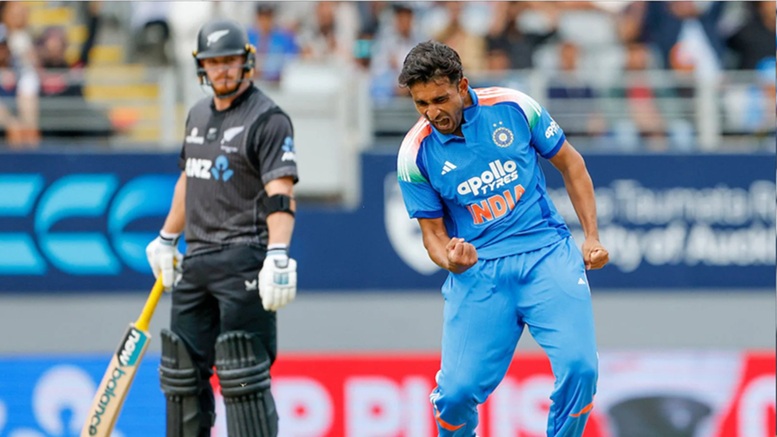

Indian cricket has witnessed numerous emerging fast bowlers rise through domestic competition to leave their mark on the international scene. Nonetheless, performing consistently in foreign conditions against a strong batting lineup presents an entirely different set of challenges. Anshul Kamboj exemplified this capability during India’s inaugural ODI against New Zealand at Eden Park, Auckland, on November 4, 2026.
The young Indian fast bowler delivered a remarkable spell, concluding with a record of 2 wickets for 22 runs over his allocated 10 overs. His performance included two maiden overs and an impressive 46 dot balls, exerting substantial pressure on the New Zealand batting order.
The outcome was particularly uplifting, given that Eden Park is famous for its unique dimensions and can provide favorable conditions for both batsmen and bowlers. While other Indian bowlers played their part in restricting the home team, Kamboj’s economical bowling was instrumental in allowing India to maintain dominance during critical phases of the innings.
His performance earned him the Player of the Match accolade, as India triumphed with a five-wicket victory via the Duckworth-Lewis-Stern (DLS) method.
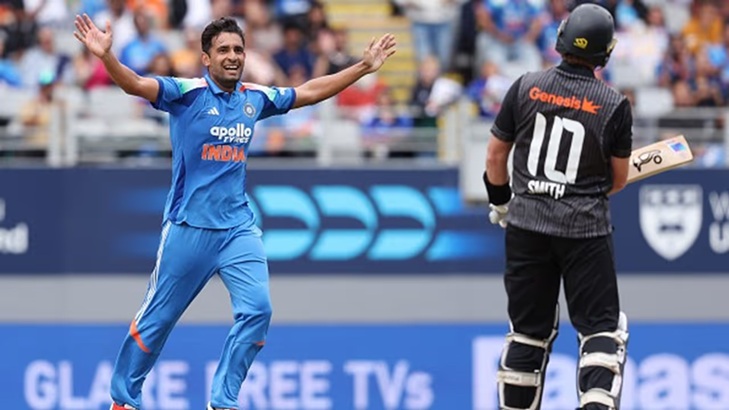
Anshul Kamboj’s Display Against New Zealand in Auckland
The initial ODI between India and New Zealand allowed India’s bowling unit to showcase its skills in tough overseas environments. After winning the toss, India opted to field, giving New Zealand the chance to bat first.
The home team faced challenges in establishing a steady scoring rhythm as India’s pace bowlers consistently applied pressure.
Kamboj was pivotal in this effort. Rather than simply aiming for wickets, he concentrated on maintaining a disciplined line, regulating his length, and making it tough for the opposition to score.
His final statistics were particularly commendable:
- Overs: 10
- Maidens: 2
- Runs given: 22
- Wickets: 2
- Economy rate: 2.20
- Dot balls: 46
These statistics clarify why his performance drew significant attention. In a 50-over match, delivering an entire 10-over spell while only allowing 22 runs reflects high levels of concentration, consistency, and precise control.
The figures also indicated that Kamboj could sustain pressure without relying on constant wicket-taking chances.
How Anshul Kamboj Created Problems for New Zealand’s Batting Order
New Zealand approached the match with seasoned players capable of forming partnerships and accelerating during the middle overs. However, India’s bowling attack thwarted the home side from constructing the type of innings they desired.
Kamboj’s role became especially critical during the innings’ middle and lower sections.
Mitchell Santner’s Wicket
A key moment in his bowling spell occurred when he claimed the wicket of Mitchell Santner.
Santner is a seasoned all-rounder known for providing crucial runs in demanding situations. His ability to rotate the strike and ramp up scoring makes him a vital member of New Zealand’s batting lineup.
His dismissal was crucial, as New Zealand required support from its middle and lower order to set a competitive score.
Kamboj successfully broke through, strengthening India’s position.
Nathan Smith’s Dismissal
Kamboj also sent Nathan Smith back to the pavilion, adding a significant wicket to his tally.
New Zealand already found themselves in a tough spot, and the loss of another batsman made matters even more challenging for the home team.
His knack for claiming wickets while keeping an economical bowling rate enhanced the value of his spell.
These two dismissals highlighted that he was not merely limiting the opposition. He also had the ability to secure breakthroughs when chances presented themselves.
Why His 2/22 Bowling Stats Were Remarkable
At first glance, bowling figures of 2/22 might seem simple, yet the context surrounding the performance adds layers of intrigue.
Kamboj completed his full quota of 10 overs, allowing only 22 runs. His economy at 2.20 represented an exceptional achievement within an ODI match.
More significantly, he delivered 46 dot balls.
In limited-overs cricket, dot balls play a crucial role, as they hinder the batting side’s chances of maintaining momentum. When a bowler consistently produces deliveries that yield no runs, batsmen are often driven to take greater risks against other bowlers.
Kamboj’s spell produced this very pressure.
Two Maiden Overs Enhanced Pressure
Another noteworthy aspect of his performance was his ability to bowl two maiden overs.
A maiden over signifies that the batting team did not score any runs during that over, barring a few penalty situations.
Delivering two maidens in a 10-over spell is a strong testament to control, especially when facing an international batting unit.
His display showcased three significant qualities:
- Steady line and length.
- An ability to build pressure through dot deliveries.
- Patience to maintain precision throughout an entire bowling spell.
These attributes are particularly advantageous in overseas ODI settings, where bowlers need to adjust to various pitches, weather, and batting techniques.
New Zealand vs India 1st ODI 2026: Match Summary
The first ODI in India’s tour of New Zealand was held at Eden Park in Auckland on November 4, 2026.
India won the toss and opted to bowl first. This decision proved fruitful as New Zealand found it difficult to amass a sizable total against India’s bowling lineup.
New Zealand ultimately was bowled out for 185 runs in 40.2 overs.
India’s bowling performance featured several contributors, with significant spells from Arshdeep Singh and Gurnoor Brar as well.
New Zealand Innings
New Zealand’s batting order faced consistent challenges and struggled to form the partnerships needed to achieve a higher score.
Tim Seifert made a valuable contribution with 38 runs from 43 balls. Daryl Mitchell added 28 runs, while Glenn Phillips scored 30.
Blair Tickner chipped in with 34 runs near the end of the innings, helping New Zealand reach a total of 185.
Nonetheless, the Indian bowlers kept taking wickets and eventually dismissed the entire batting lineup.
The key batting contributions included:
- Tim Seifert: 38 runs
- Glenn Phillips: 30 runs
- Daryl Mitchell: 28 runs
- Blair Tickner: 34 runs
- Jacob Duffy: 15 not out
Kamboj’s two wickets was instrumental in India maintaining control during the innings.
India’s Bowling Performance
India’s bowling unit functioned as a cohesive group to limit New Zealand’s scoring.
Arshdeep Singh spearheaded the wicket-taking efforts with four wickets, while Gurnoor Brar secured three wickets.
Kamboj concluded with a total of two wickets, and his tight bowling was crucial to India’s overall showing.
The bowling statistics for India included:
| Bowler | Overs | Runs | Wickets |
|---|---|---|---|
| Arshdeep Singh | 10 | 70 | 4 |
| Auqib Nabi | 6 | 33 | 0 |
| Anshul Kamboj | 10 | 22 | 2 |
| Gurnoor Brar | 9.2 | 44 | 3 |
| Axar Patel | 5 | 12 | 0 |
The contrast in Kamboj’s economy rate compared to the other bowlers underscores how well he limited the runs scored.

India’s Run Chase: Virat Kohli Leads the Way
After limiting New Zealand to a score of 185, India had a chance to dominate the first ODI.
However, the match was impacted by rain, altering the conditions for the chase. Through the DLS method, India was assigned a new target of 143 runs to achieve in 32 overs.
Accomplishing this target required India to keep a steady scoring rate while minimizing their loss of wickets.
Virat Kohli was pivotal in the run chase, delivering an outstanding performance with 74 runs off 51 balls.
His innings featured 13 fours and one six, supplying India with the necessary momentum to progress towards the adjusted target.
Shubman Gill added support with 37 runs from 56 balls, establishing a solid base for the visitors.
Despite India losing several wickets during the pursuit, they ultimately attained a score of 143/5 in 22.4 overs.
India clinched a win by five wickets, marking a favorable commencement to the ODI series.
Why Anshul Kamboj Won Player of the Match
Receiving the Player of the Match title in an ODI with numerous remarkable contributions is a notable accomplishment.
Kamboj earned this accolade due to his impactful bowling that played a vital role in India’s overall success.
While Arshdeep Singh took four wickets and Gurnoor Brar secured three, Kamboj’s unique asset lay in his remarkable command over the scoring pace.
His bowling figures of 2/22 revealed his ability to apply sustained pressure across an extended bowling session.
The significance of his performance is highlighted by several key factors.
- Firstly, he fulfilled his entire allotment. By bowling 10 overs while maintaining accuracy, he showed both consistency and endurance.
- Secondly, he exerted scoring pressure. His 46 dot balls limited New Zealand’s capacity to generate momentum.
- Thirdly, he dismissed key players. Taking the wickets of Mitchell Santner and Nathan Smith further destabilized the lower-middle order.
- Lastly, he upheld an outstanding economy rate. Allowing only 22 runs in 10 overs provided India a crucial edge.
Thus, his contribution extended well beyond the two wickets reflected on the scorecard.
A Significant Moment in Anshul Kamboj’s ODI Career
Performances of this kind can serve as vital milestones in a young cricketer’s international career.
Kamboj has honed his skills through domestic competitions, where a steady performance and the ability to adapt to various conditions are crucial for advancing to higher levels.
His bowling display in Auckland served as yet another example of how experiences in domestic cricket can lead to achievements on the international stage.
To excel as a fast bowler in ODIs, one must possess more than just sheer speed. It’s essential to discern when to attack, when to defend, and how to modify strategies based on the batter’s strengths.
Kamboj’s disciplined tactics against New Zealand revealed promising signs in these crucial areas.
What Makes His Bowling Style Effective?
A compelling feature of Kamboj’s performance was his emphasis on consistency.
Rather than striving to deliver a spectacular ball every over, he prioritized maintaining a dependable line and length.
This strategy can be especially effective against batters who are inclined towards aggressive shot-making.
A disciplined fast bowler has the ability to create chances by compelling batsmen to make their own scoring plays. This often leads to poorly timed strokes, unforced errors, and wickets.
His display underscored the need for patience in the 50-over format.
Conditions at Eden Park and India’s Bowling Tactics
Eden Park represents one of the most iconic cricket locations in New Zealand. The conditions for gameplay here can present various hurdles for visiting teams, especially those who are not well-acquainted with the local climate and pitch dynamics.
The Auckland venue is also recognised for its atypical boundary sizes, rendering it a captivating location for ODI matches.
For fast bowlers, it is critical to maintain their control since batters might exploit the shorter boundaries to focus on specific sections of the field.
In this match, India’s bowling strategy revolved around obtaining regular wickets while limiting scoring chances.
Kamboj’s performance aligned seamlessly with that approach.
His economical spell meant that New Zealand could not easily dominate every bowler. The pressure exerted during his overs also assisted India’s other bowlers in keeping their composure.
Weather conditions played a significant role in the match, as rain ultimately influenced the second innings, introducing the DLS method into the outcome.
Implications of This Performance for India’s ODI Bowling Unit
India’s ODI bowling lineup features seasoned international athletes as well as rising stars eager to make their mark.
A performance like Kamboj’s gives the team management an additional promising alternative.
Having bowlers capable of delivering efficient spells is crucial in contemporary ODI cricket. Teams typically seek players who can assume various roles according to the dynamics of the match.
Kamboj’s showing indicates that he can add value through disciplined bowling and the capacity to claim wickets.
Nevertheless, a standout match is merely the start of a much more extended process.
His consistency across various venues, against different opponents, and under diverse playing conditions will ultimately shape his growth as an international player.
The forthcoming matches on the New Zealand tour will offer him more chances to showcase his skills.
Conclusion
The initial ODI in Auckland between India and New Zealand provided a positive showcase from India’s bowling team, with Anshul Kamboj standing out prominently.
His statistics of 2/22 from 10 overs, which included two maidens and 46 dot balls, reflected remarkable control and discipline.
The dismissals of Mitchell Santner and Nathan Smith further fortified India’s standing during New Zealand’s innings.
Although Virat Kohli’s innings of 74 runs were instrumental in completing the chase, Kamboj’s bowling performance was crucial in keeping the host team to 185 runs.
For supporters of Indian cricket, this performance was a promising display from a young fast bowler striving to make a name at the international level.
The real test ahead will be sustaining the same level of discipline in forthcoming matches. If he continues to deliver precise spells and secure vital wickets, he could become an important component of India’s ODI bowling strategy.
His show in Auckland has undoubtedly provided cricket enthusiasts with more reasons to track his progress during the 2026 New Zealand tour.