
The India-Pakistan cricket rivalry delivered another unforgettable chapter during the 2026 Under-19 Asia Cup final in Oman. A dramatic last-ball finish, an extraordinary run chase and celebrations filled with emotion made the contest one of the tournament’s biggest talking points. However, the discussion did not end when the winning boundary was struck. The celebrations that followed became a separate talking point, attracting reactions from former cricketers and supporters on both sides of the border.
Former Pakistan captain Mohammad Yousuf entered the conversation with a message directed towards young cricketers. Rather than focusing only on the result, he highlighted the importance of upbringing, values, discipline and respect for opponents. He also referred to two legendary names from international cricket: Sachin Tendulkar and Saeed Anwar.
His comments attracted attention because these two former opening batters represented India and Pakistan during an era when the rivalry was intense, but mutual respect between players remained an important part of cricket’s culture.
The Mohammad Yousuf Message on India became a major discussion point among cricket followers, particularly because it connected a modern Under-19 controversy with the behaviour of some of the game’s most respected former players.
India vs Pakistan U19 Asia Cup Final 2026: A Match to Remember
Before discussing the reaction, it is important to understand what happened during the final. India and Pakistan entered the championship match with plenty of expectations, knowing that an Under-19 Asia Cup trophy against their biggest cricket rivals would be a special achievement.
The final took place in Oman on Saturday, November 14, 2026. Pakistan batted first and produced a competitive total of 337 runs for nine wickets in 50 overs. Usman Khan played an important role with a century, helping Pakistan establish a challenging target.
India needed 338 runs to win the championship. It was never going to be an easy chase, particularly against a Pakistan bowling attack that had already demonstrated its ability to create pressure during the tournament.
India’s Incredible Last-Ball Victory
India’s chase experienced several difficult moments. The batting side lost wickets at important stages and eventually found itself at 252 for eight. With the required runs still substantial and only two wickets remaining, Pakistan appeared to have control of the final.
However, the Indian lower order refused to surrender.
Manal Chauhan and Mohit Ulva produced a remarkable partnership that brought India back into the contest. Manal scored 47 from 32 deliveries, while Mohit Ulva remained unbeaten on 49 from just 26 balls.
Their partnership changed the atmosphere of the match. India moved from a difficult position to a situation where the championship was suddenly within reach.
Manal’s dismissal created another moment of pressure, but Mohit continued fighting. Chigurupati Venkata also contributed valuable runs at the other end.
India entered the final over needing eight runs. The contest went down to the final delivery, with three runs required from the last ball. Mohit Ulva found the boundary, completing an extraordinary chase.
India finished at 339 for nine and secured a one-wicket victory.
The result gave India its ninth Under-19 Asia Cup title, extending its record in the competition.
Why the Victory Created So Much Emotion
A final-ball victory against Pakistan is naturally an emotional occasion for any young Indian cricketer. The players had experienced pressure, uncertainty and the possibility of losing the championship before producing a remarkable comeback.
Celebrations were therefore expected.
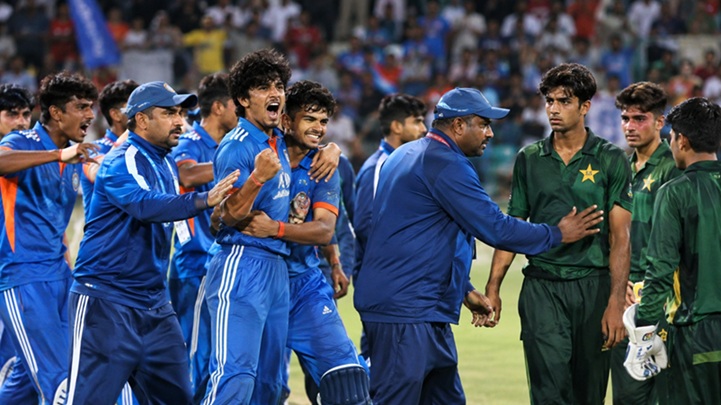
However, some footage circulating after the match appeared to show players making provocative gestures and directing animated reactions towards members of the Pakistan team.
The scenes attracted criticism because several viewers felt that certain celebrations crossed the boundary between expressing happiness and showing disrespect towards opponents.
It is important to distinguish between celebrating a major sporting achievement and directing inappropriate behaviour towards another team. Both are different matters, and the controversy largely developed around that distinction.
What Did Mohammad Yousuf Say About India’s Celebrations?
Former Pakistan batter Mohammad Yousuf shared his thoughts through a post on X on November 15, 2026.
He congratulated India on its performance under pressure and described the tournament as a valuable learning experience for both teams. He also acknowledged that several youngsters participating in the competition had the potential to become future stars.
However, the central part of his message focused on sportsmanship.
Yousuf explained that representing a country in sport involves more than wearing the national jersey. Players also represent their upbringing, family values and the ethics they learned while growing up.
His message encouraged young cricketers to remain respectful and composed in both victory and defeat.
He concluded by referring to Sachin Tendulkar and Saeed Anwar as role-model legends.
The Mohammad Yousuf Message on India was therefore not simply about the result of one Under-19 final. It raised a wider question about how emerging international cricketers should behave when emotions become intense.
Yousuf’s Message About Upbringing and Values
One of the most discussed aspects of his statement was his reference to parents and upbringing.
Professional cricket involves enormous pressure. Players represent millions of supporters, carry national expectations and compete in environments where even a small mistake can change the result.
Under such circumstances, emotions are natural. Young players may celebrate loudly, express frustration or become involved in heated exchanges.
Nevertheless, Yousuf’s argument was that a player’s conduct should not depend entirely on the match situation.
A cricketer can be aggressive while batting, competitive while bowling and determined while defending a total. None of those qualities requires disrespect towards the opposition.
His message also carried an important lesson for players who are beginning their international careers: reputation is built through performance as well as behaviour.
Why Did Mohammad Yousuf Mention Sachin Tendulkar and Saeed Anwar?
The reference to Sachin Tendulkar and Saeed Anwar was one of the most interesting parts of the discussion.
Both players were outstanding opening batters and important figures in their respective national teams. They competed against each other during some memorable India-Pakistan encounters and experienced the pressure that comes with representing two cricket-loving countries.
Sachin Tendulkar: India’s Legendary Batting Icon
Sachin Tendulkar is widely regarded as one of the greatest batters in cricket history.
He represented India for more than two decades and became an important figure in the development of modern international cricket. His consistency across Tests and One Day Internationals made him one of the most recognisable sporting personalities in the world.
Tendulkar’s career included numerous encounters against Pakistan. These matches were followed passionately by supporters, and his performances often attracted enormous attention.
What made his example relevant to Yousuf’s message was the combination of competitive excellence and professionalism.
Tendulkar faced some of the most challenging bowling attacks in international cricket. He competed fiercely, handled pressure and continued to earn admiration from players and supporters across different countries.
His career demonstrates that a cricketer does not need to disrespect opponents to establish greatness.
For young Indian players, following his example means concentrating on preparation, consistency, discipline and respect for the game.
Saeed Anwar: Pakistan’s Elegant Opening Batter
Saeed Anwar was one of Pakistan’s most admired opening batters.
Known for his timing, elegant stroke play and ability to score quickly, Anwar enjoyed an impressive international career. His batting performances against several leading teams made him a memorable figure in Pakistan cricket.
He was also part of the generation that regularly competed against India’s leading players.
Anwar’s name alongside Tendulkar is significant because both players belonged to different national teams but shared the same competitive environment.
They understood the intensity of international cricket and the importance of performing under pressure.
By mentioning Anwar, Yousuf highlighted that role models should not necessarily come from a player’s own country.
An Indian youngster can learn from a Pakistani legend, just as a Pakistani youngster can admire an Indian great.
India U19 Celebrations Dispute: What Occurred Following the Final?
The dispute arose due to the way certain Indian players celebrated their thrilling win.
When Mohit Ulva hit the decisive boundary, the Indian squad surged onto the field. The initial festivities showcased the exuberance of clinching a substantial tournament following a challenging chase.
Yet, various videos circulated on social media seemed to depict players making gestures and shouting towards Pakistan’s wicketkeeper-batter Hamza Zahoor and others from the opposing team.
Reports further indicated that members of the Indian coaching staff stepped in to diffuse the situation.
These events became a focal point of conversation among cricket enthusiasts, ex-players, and analysts.
Why the Celebrations Sparked Debate
The rivalry between India and Pakistan possesses a lengthy history marked by fierce competition. Matchups between these two nations typically draw more attention compared to regular international games.
The Under-19 athletes were also cognizant of the greater implications of the final match.
Earlier in the tournament, Pakistan had claimed victory over India in their group-stage clash. The celebrations that followed that game also gained considerable notice.
Thus, the win in the final held an even greater emotional significance for the young Indian players.
Nevertheless, the broader discussion was centered around whether the feelings generated during a tight contest should dictate how players engage with their rivals.
It is common for players to celebrate exuberantly after a hard-fought win. Cricket has long included spirited celebrations, vigorous appeals, and heartfelt reactions.
The concern arises when those celebrations turn personal or seem intended to provoke rival players.
The Need for Appreciating Both Perspectives
The debate should not be simplified into a mere India-versus-Pakistan issue.
- Pakistan had valid reasons to celebrate its victory in the group stage, while India had ample cause to revel in its impressive final win.
- Both sides faced considerable pressure while competing.
- Simultaneously, criticism of specific behaviors should rely on the footage and context at hand rather than on assumptions about every player involved in the situation.
Young cricketers are in the process of developing their identities and learning to navigate significant sporting events. Constructive feedback can aid them in grasping the responsibilities associated with representing their nation.
Mohammad Yousuf’s Guidance for Up-and-Coming Cricketers
Yousuf’s insights offer lessons that resonate beyond the players engaged in this specific final.
The realm of international cricket is becoming more and more competitive. Young athletes are often introduced to professional settings early on, where media exposure, social platforms, and public expectations can increase pressure.
In this context, mere technical skills are inadequate.
Honor Opponents Regardless of the Outcome
- A victorious team has the right to celebrate.
- A losing team merits respect.
This tenet holds true no matter the tournament, nation, or significance of the match.
Young cricketers must recognize that today’s opponent may become tomorrow’s teammate, colleague, or friend.
Showing respect also enhances the reputation of the sport.
Maintain Aggression Within the Realm of the Game
Aggression plays a crucial role in cricket.
- Fast bowlers employ intensity to challenge batters.
- Batters demonstrate resolve when facing tough deliveries.
- Fielders motivate each other and celebrate significant wickets.
These actions enhance the excitement of cricket.
Nonetheless, competitive intensity should always relate to the game itself.
Athletes can engage in fierce rivalry without resorting to personal insults or trying to degrade their adversaries.
Gain Insights from Icons Across Nations
A notable strength in Yousuf’s remarks was his choice to highlight players from both nations.
Tendulkar and Anwar played for opposing countries, yet both made significant impacts on cricket.
Emerging players should observe athletes from other teams and grasp the elements that contributed to their achievements.
There are essential teachings in the journeys of batters, bowlers, captains, and wicketkeepers globally.
Acknowledge the Duty of Representing a Nation
When a young athlete dons the national uniform, their behavior is scrutinized beyond their team environment.
Fans, coaches, guardians, and future generations closely watch how players act.
Thus, a professional cricketer must uphold discipline, especially in high-pressure situations.
Approach Wins and Losses With Poise
Celebrating a championship can bring immense joy. Conversely, losing can lead to disheartenment.
Both scenarios evaluate a player’s integrity.
Mastering the art of staying calm after a loss and gracious after a win is crucial to becoming a well-rounded professional.
How Did Players and Cricket Figures from India React?
The celebrations spurred various responses from former cricketers and the Indian cricket community.
Some viewed the celebrations as warranted given the match context. Others believed certain actions deserved critique.
The varied perspectives illustrated how passionate India-Pakistan matches can get, particularly regarding a tournament trophy.
Mohit Ulva Shared His Thoughts on India’s Celebrations
India’s game-winning hero Mohit Ulva later shared his thoughts on the celebrations.
Reflecting on the event, he mentioned that the emotions were authentic due to the India-Pakistan final.
He expressed that the squad was celebrating their success rather than intentionally trying to boast or disrespect the defeated team.
His insights added depth to the debate.
It emphasized the contrast between how players perceive an on-field moment and how viewers interpret it after watching brief video snippets.
Shoaib Akhtar Also Offered His Perspective
Former Pakistani fast bowler Shoaib Akhtar also weighed in on the discussion.
He highlighted the significance of values in cricket and mentioned his amicable relationships with Indian athletes, including Sachin Tendulkar, Virender Sehwag, and Sourav Ganguly.
Akhtar recognized the enthusiasm and intensity exhibited by younger players but stressed the necessity of instilling appropriate values in them.
His remarks supported the larger dialogue about finding a balance between competitive spirit and mutual respect.
Sachin Tendulkar and Saeed Anwar: Insights from a Prior Era
The mention of two iconic players encourages cricket fans to consider the evolution of the game.
Throughout the 1990s and early 2000s, India and Pakistan frequently delivered unforgettable cricket matches. Athletes from both nations faced tremendous public expectations.
The rivalry was fierce, yet their cricketing connection was also marked by admiration and camaraderie.
Cricketing Rivalry Does Not Require Personal Animosity
- The most intense rivalries are founded on competition.
- A bowler aims to get rid of the top batter.
- A batter strives to take charge of the opposing bowling.
- Captains seek strategies to outsmart one another.
Such challenges contribute to the thrill of international cricket.
Nonetheless, the competition need not carry over into personal animosity after the game.
The instances of Tendulkar and Anwar serve as a reminder to aspiring players that admiration can coexist with fierce rivalry.
Role Models Should Be Evaluated on Their Entire Careers
Aspiring cricketers often look up to renowned athletes due to their statistics, milestones, wickets taken, and game-winning contributions.
While these accomplishments are important, other attributes merit attention as well.
Skills such as preparation, regularity, patience, professionalism, and the capacity to manage tough circumstances hold equal significance.
A player who only masters scoring runs might improve as a batter. Conversely, a player who also learns professional behavior can evolve into a respected figure in sports.
That represents the broader importance of Yousuf’s mention of these icons.
India vs Pakistan Cricket Rivalry: The Importance of Sportsmanship Today
The rivalry between India and Pakistan is among the most highly watched matchups in international cricket.
Each significant game draws large television audiences, generates online chatter, and incites considerable enthusiasm from fans.
Under-19 contests are crucial, as they prepare future stars for this competitive arena.
Players excelling at this tier may go on to represent their senior national squads, compete in significant ICC events, and become recognizable to millions of fans.
This highlights the importance of lessons learned during youth competitions.
Social Media Has Altered Player Perception
In previous eras, a contentious incident might only have been reported through TV highlights and print articles.
Currently, brief videos can disseminate to millions almost instantly.
A celebration lasting merely seconds can turn into the focal point of an entire tournament.
This presents an added responsibility for younger athletes.
They must recognize that their public persona is influenced not only by their gameplay but also by their conduct off the field.
Simultaneously, audiences should keep in mind that short clips may not always convey the full picture of an event.
Coaches and Experienced Players Play a Crucial Role
Younger athletes require leadership when they step into high-pressure environments.
Coaches, mentors, and seasoned cricketers can assist them in navigating challenging situations.
Youth development initiatives should emphasize not just technical skills but also encourage:
- Respect for rivals and match referees.
- Managing emotions during crucial instances.
- Professional behavior in front of the media.
- Accountability to teammates and fans.
- Acceptance of both triumphs and setbacks.
These principles can aid players in forging careers that are celebrated for more than just personal achievements.
What This Controversy Signifies for Future India-Pakistan Matches
The final of the Under-19 Asia Cup has sparked numerous discussions among cricket fans.
India’s remarkable attempt to chase down the target will be an essential chapter in the tournament’s story. The final-ball boundary by Mohit Ulva, the efforts of Manal Chauhan, and the team’s comeback from a challenging position should be acknowledged.
Pakistan also showcased a strong effort by posting 337 runs and pushing the match deep into the final over.
Nevertheless, the controversy related to the celebrations has initiated a significant dialogue.
Future matches between the two sides will undoubtedly be laden with similar intensity. Players will strive for victory, fans will anticipate high-quality performances, and emotions might occasionally become hard to manage.
The key challenge is to sustain a competitive rivalry without allowing personal animosity to overshadow the spirit of the game.
The message from Mohammad Yousuf regarding India offers one viewpoint on how young athletes can handle that responsibility.
Can Young Players Harmonize Passion and Rules?
Certainly. Passion and rules coexist.
One is able to celebrate a century with enthusiasm, dash towards teammates after claiming a wicket, or show joy upon winning a championship.
The crucial factor is whether the celebration honors all individuals involved in the event.
Being professional does not entail devoiding cricket of emotions. Rather, it means discovering ways to channel that emotion while adhering to essential limits.
For developing players, grasping this distinction can be just as important as refining their individual batting or bowling skills.
Final Thoughts
India’s narrow victory over Pakistan by one wicket in the Under-19 Asia Cup final of 2026 will be remembered for its spectacular conclusion. Recovering from a position of 252 for eight while chasing 338 runs and securing the winning boundary on the last ball marked a notable sports accomplishment.
However, the dialogue following the match emphasized that cricket encompasses more than merely obtaining trophies.
Mohammad Yousuf’s message underscored the significance of upbringing, respect, and sportsmanship. By referencing Sachin Tendulkar and Saeed Anwar, he pointed out how players can derive inspiration from legends of various cricketing backgrounds.
His main message was clear: to represent one’s country is also to embody the values tied to that duty.
Consequently, the message from Mohammad Yousuf about India has become part of a broader conversation regarding the future of young cricket and the expectations from rising international stars.
The youth of India now celebrate a remarkable championship win, while Pakistan’s squad can gain meaningful insights from a closely fought finale. Both teams boast skilled players who have the potential to become significant figures in the global cricket arena.
In the end, the most favorable result for the game would be a rivalry that consistently yields:
- Extraordinary performances
- Thrilling conclusions
- Passionate contests
- Respect between adversaries
This is a lesson worth absorbing from Sachin Tendulkar, Saeed Anwar, and every esteemed cricketer who has contributed to the sport’s greatness.