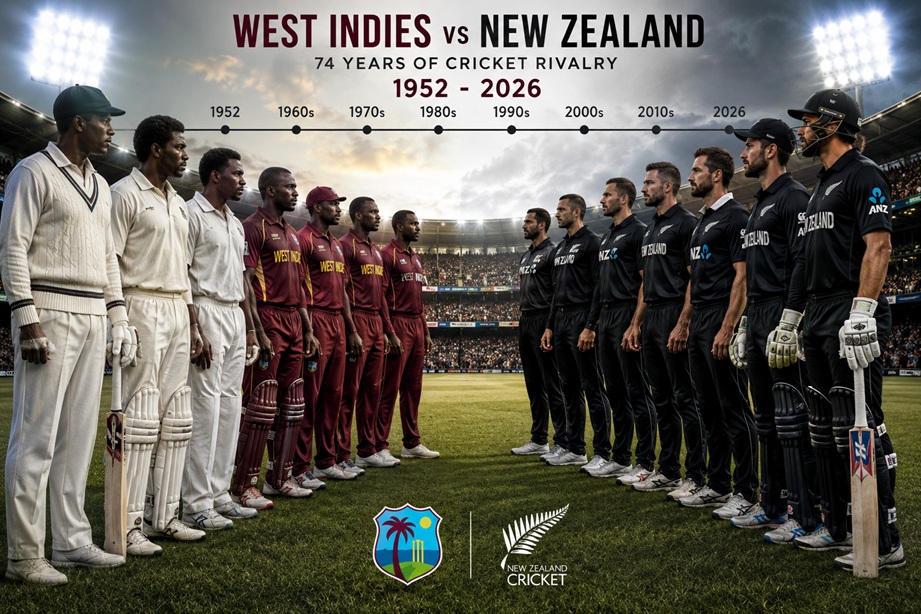

Throughout the history of cricket, numerous rivalries have emerged, but few have developed as intriguingly as the battles between the West Indies and New Zealand. Over a span that exceeds seventy years, these two teams have created lasting memories, shattered records, experienced thrilling finishes, and witnessed the emergence of iconic cricketers.
This saga commenced in 1952 when the West Indies made their inaugural tour to New Zealand. From that point, successive generations of cricketers have continued to advance the rivalry, evolving it from an initially lopsided matchup into a fiercely contested clash in Test matches, One-Day Internationals, and T20 Internationals.
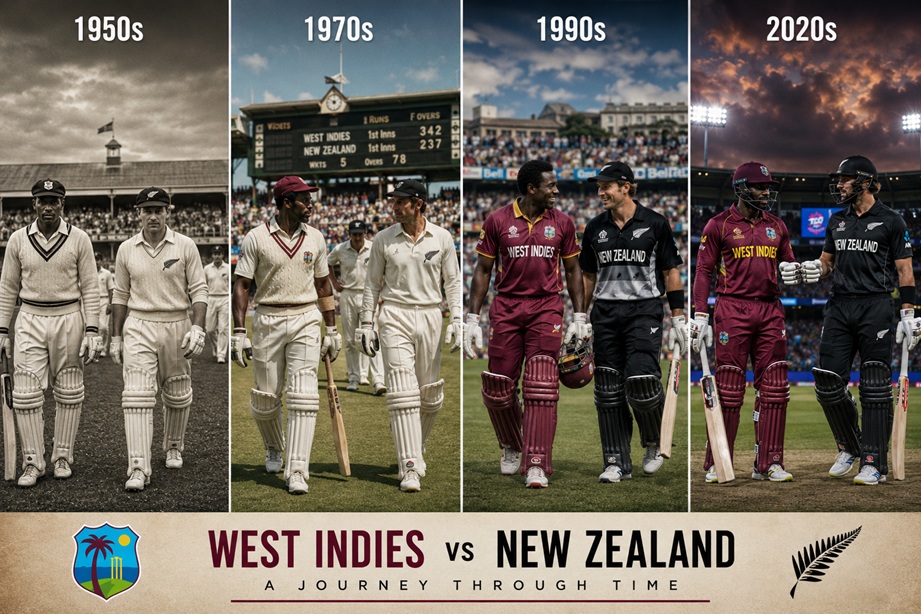
This comprehensive historical account chronicles every significant period, milestone, and critical moment that shaped the connection between these two cricketing countries. The West Indies NZ Timeline illustrates the evolution of both teams and their contributions to the global advancement of the sport.
The Beginning of a Long Cricket Relationship (1952–1959)
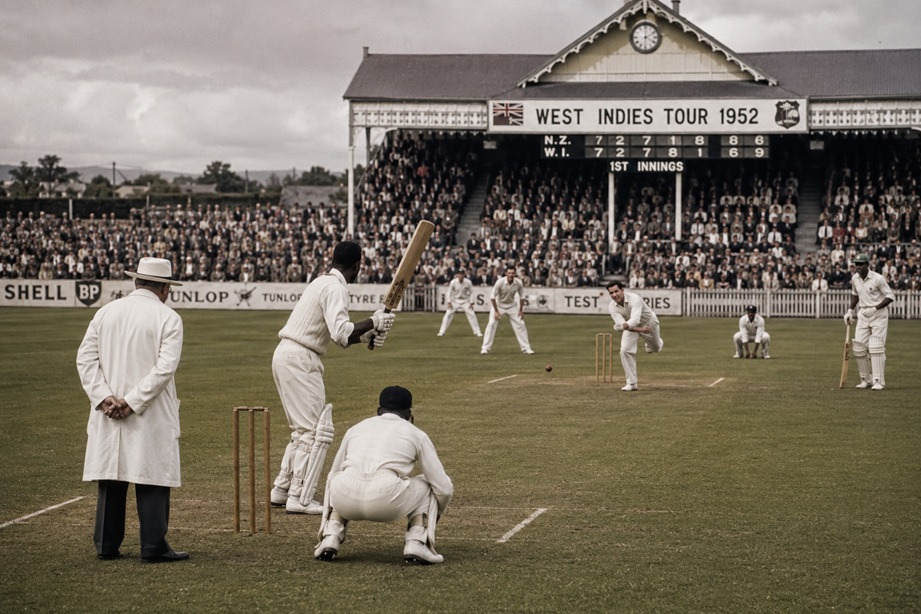
The rivalry commenced properly during the West Indies’ tour of New Zealand in 1951–52. The visitors arrived with a formidable team and showcased why they were emerging as a significant force in world cricket.
The two-match Test series concluded with the West Indies triumphing 1–0, marking the initial chapter in their collective narrative. Notable figures such as Frank Worrell and Sonny Ramadhin had crucial impacts during the tour. Worrell stood out as the top run-scorer, while Ramadhin’s spin bowling consistently challenged New Zealand’s batsmen throughout the encounters.
Years later, the West Indies returned for another important tour in 1955–56. This occasion saw them dominate a four-match Test series, concluding with a 3–1 victory. This tour included several future cricket legends, such as Garry Sobers, Everton Weekes, and Sonny Ramadhin.
Key Highlights of the 1950s
- The initial Test rivalry emerged in 1952
- The West Indies claimed the first series 1–0
- Frank Worrell excelled with the bat
- Sonny Ramadhin shone with his spin bowling
- The West Indies achieved a strong 3–1 series victory in 1956
The initial years predominantly belonged to the Caribbean side, laying the groundwork for future matchups.
Growing Competition During the 1960s
The 1960s saw the expansion of cricket and a rise in international competition. Both countries aimed for greater consistency in Test match performances while establishing more robust domestic frameworks.
For the West Indies, this decade was characterized by Frank Worrell’s leadership and the rise of Garry Sobers, regarded as one of the finest all-rounders in the game’s history. Conversely, New Zealand dedicated efforts to enhance their competitiveness against well-established cricketing nations.
The West Indies NZ Timeline for this decade displayed New Zealand progressively closing the gap. While the Caribbean team maintained a stronger overall position, the Black Caps emerged as more formidable rivals both at home and internationally.
Series during this era frequently included lengthy, tactical Test matches where patience and discipline were vital components.
The 1970s: New Zealand’s Rise
As the 1970s unfolded, New Zealand cricket became more systematic and competitive. Players like Glenn Turner and Richard Hadlee began to forge a new chapter for the Black Caps.
The West Indies maintained an abundance of skill, yet the competitiveness of matches started to escalate. Victories for the Caribbean team were not viewed as guaranteed anymore.
Numerous tight Test matches showcased the increasing self-assurance of New Zealand. The rise of Richard Hadlee as a premier fast bowler fundamentally altered how other teams prepared for New Zealand.
Significance of the 1970s
This decade represented a shift from sheer supremacy to rivalry. New Zealand demonstrated its capacity to compete with more formidable teams consistently, whereas the West Indies were gearing up for what would evolve into their period of greatness.
The Golden Period of West Indies Cricket (1980s)
The 1980s arguably marked the peak of dominance in cricket’s history. The West Indies formed a formidable squad that included some of the finest fast bowlers ever witnessed.
Players such as Malcolm Marshall, Michael Holding, Joel Garner, Andy Roberts, Gordon Greenidge, Desmond Haynes, and Viv Richards turned the team into an almost invincible powerhouse.
Whenever New Zealand confronted the Caribbean titans during this timeframe, they faced remarkable obstacles. The West Indies’ fast bowlers continually put batting lineups globally to the test.
Nevertheless, New Zealand also featured a star player: Richard Hadlee. His outstanding bowling ensured that matches remained challenging despite the Caribbean’s stronghold.
The timeline of West Indies and New Zealand throughout the 1980s showcased the disparity between one of cricket’s most remarkable legacies and a resolute New Zealand team aiming for breakthroughs.
The ODI Revolution and Growing Rivalry
Limited-overs cricket gained prominence throughout the 1980s and 1990s. One-Day Internationals provided a fresh avenue for both teams to display their skills.
The West Indies initially thrived in this format, having already secured victory in the inaugural two Cricket World Cups in 1975 and 1979.
Conversely, New Zealand began creating imaginative strategies that frequently challenged conventional cricket perspectives. Their tactical methods rendered them a formidable rival in ODI competitions.
As limited-overs cricket surged in popularity, the rivalry extended beyond classic Test matches. Fans relished more regular matchups and exciting conclusions.
The 1990s: A Shift in Authority
The 1990s ushered in noteworthy transformations. The West Indies were no longer the invincible entity they had been during the previous decade.
Though they still had remarkable talent, maintaining consistency proved to be a challenge. At the same time, New Zealand continued to enhance its performance in all formats.
Athletes like Stephen Fleming, Chris Cairns, Nathan Astle, and Adam Parore contributed significantly to the Black Caps’ roster.
This era observed a more level competition. Series outcomes became less certain, and individual players’ performances frequently influenced the results.
Noteworthy Developments in the 1990s
- More intense Test series
- Increased parity between the teams
- Emergence of New Zealand’s modern cricket framework
- Ongoing generation of high-caliber talent from both countries
The rivalry transitioned into a new stage where either side could realistically anticipate victory.
Embracing the New Millennium (2000–2010)
The 2000s presented a new crop of talents.
For the West Indies, Brian Lara was the standout figure. His exceptional batting consistently mesmerized cricket enthusiasts across the globe.
New Zealand responded with the leadership of Stephen Fleming, along with the versatile skills of players such as Daniel Vettori and Jacob Oram.
Matches between the two squads frequently resulted in enjoyable showdowns. Each team underwent phases of restructuring while trying to find lasting stability.
The timeline concerning West Indies and New Zealand transitioned into a contemporary era where T20 cricket started to shape player growth and game tactics.
The Impact of Brian Lara
Few athletes have left such a significant mark on a rivalry like Brian Lara did. His graceful shot-making and capability to overpower bowlers often positioned him as a key figure in performances for the West Indies.
Bowlers from New Zealand often encountered the tough task of limiting one of cricket’s finest batsmen.
The T20 Era Transforms Everything (2010–2020)
The swift emergence of T20 cricket revolutionized the landscape of international cricket.
The West Indies emerged as one of the most successful teams in this format, claiming several T20 World Cup titles and developing explosive talents like Chris Gayle, Kieron Pollard, Dwayne Bravo, and Andre Russell.
New Zealand cultivated its own vibrant T20 style with players such as Brendon McCullum, Kane Williamson, Trent Boult, Tim Southee, and Martin Guptill.
The rivalry became even more thrilling as games were held across three different formats.
Notable Features of This Period
- High-scoring T20 matches
- Aggressive batting techniques
- Increased global fan engagement
- More frequent bilateral series
- Rise of franchise-cricket superstars
The difference between the West Indies’ powerful hitting and New Zealand’s strategic discipline often resulted in captivating clashes.
Kane Williamson and the Contemporary Black Caps
Kane Williamson has been one of the key personalities in modern New Zealand cricket.
His composed leadership, graceful batting, and strategic insight contributed to New Zealand’s ascent as one of the most esteemed cricket teams globally. Williamson continued to play a significant role in the New Zealand teams competing against the West Indies through the mid-2020s.
Under his guidance, New Zealand regularly vied for important ICC trophies and established their reputation as a formidable force in all formats.
His contests with Caribbean bowlers became a regular highlight in the recent series.
West Indies in the Modern Era
Despite experiencing fluctuations in performance, the West Indies consistently produced thrilling players.
Individuals like Jason Holder, Shai Hope, Nicholas Pooran, Alzarri Joseph, and others contributed to sustaining the team’s competitive edge.
The Caribbean team frequently depended on aggressive batting and skilled fielding to compete against stronger adversaries.
The West Indies NZ Timeline shows a side that is constantly evolving while retaining its rich cricketing legacy.
Historic Records and Remarkable Performances
Every long-lasting rivalry builds a collection of unforgettable experiences.
One of the most notable recent instances took place when the West Indies showcased a historic defiance in New Zealand. Their outstanding performance in the fourth innings led to numerous records, including the highest total ever in fourth innings of a five-day Test match and one of the longest successful defensive innings seen in modern cricket.
These accomplishments highlighted the determination and fighting spirit that have been hallmarks of West Indies cricket for generations.
Such displays ensure that the rivalry remains captivating, irrespective of rankings or forecasts.
The Rivalry in 2025 and 2026
Recent years have consistently added new narratives to the saga.
New Zealand approached the 2025–26 period with seasoned players and rising stars, while the West Indies concentrated on revitalizing their Test team and enhancing their capabilities across all formats. Williamson’s comeback for a significant Test series underscored New Zealand’s dedication to sustaining a robust red-ball team.
Simultaneously, the West Indies kept blending seasoned players with promising young talents into their squads as they readied themselves for impending challenges.
The rivalry continues to hold significance as both sides embrace the values of competitive cricket, sportsmanship, and athlete development.
Legacy of the Rivalry
The primary strength of this contest is its endurance.
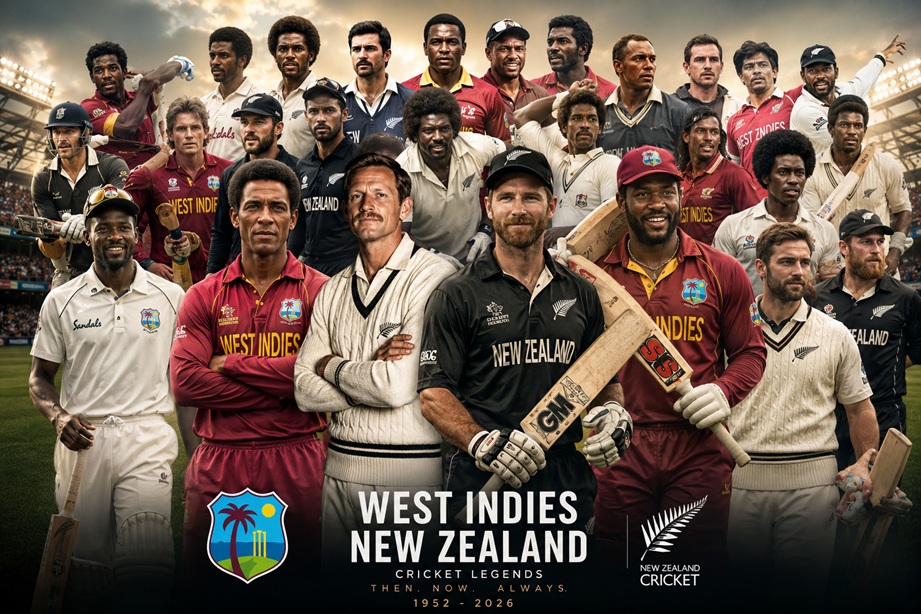
From Frank Worrell and Sonny Ramadhin to Kane Williamson and Shai Hope, numerous generations have enriched the narrative.
The rivalry has withstood significant transformations in the cricket landscape:
Major Changes Witnessed
- Expansion of international calendars
- Onset of ODI cricket
- Introduction of T20 cricket
- Rise of franchise leagues
- Technological advancements in the sport
Even with these shifts, the competitive essence between the two teams remains intact.
Conclusion
The West Indies NZ Timeline chronicles 74 years of cricket progression. It starts with the first Test series in 1952 and continues through the contemporary era of multi-format competitions, producing unforgettable matches, legendary athletes, and significant milestones.
From the supremacy of the early West Indies sides to New Zealand’s rise as a formidable force globally, each decade has contributed a distinct segment. This journey involves iconic individuals such as Frank Worrell, Garry Sobers, Viv Richards, Richard Hadlee, Brian Lara, Kane Williamson, and many others who have shaped cricket’s history.
As both nations continue to nurture new generations of talent, the rivalry remains a crucial element of international cricket. The West Indies NZ Timeline is not merely a compilation of games and statistics; it represents a narrative of resilience, excellence, and the lasting fascination with the sport over more than seventy years.