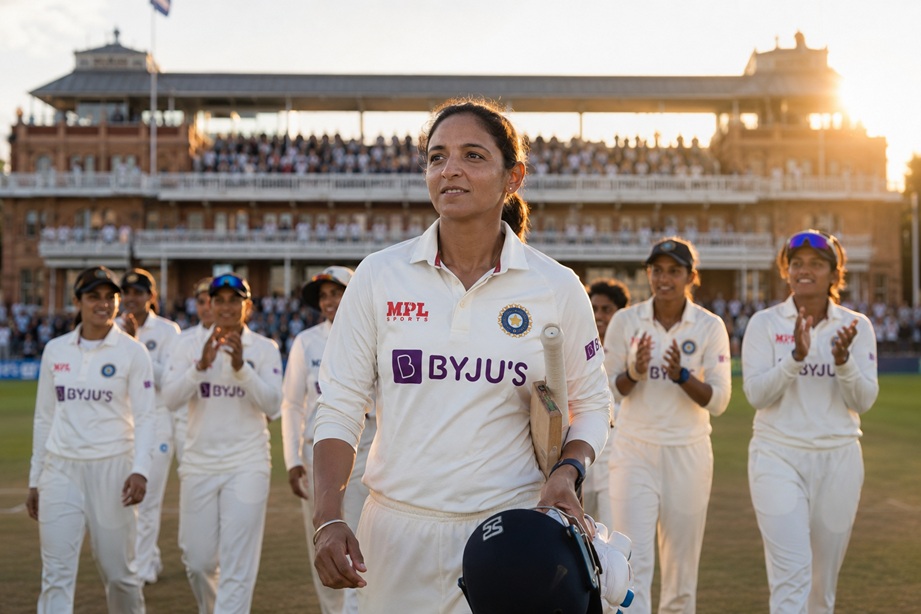

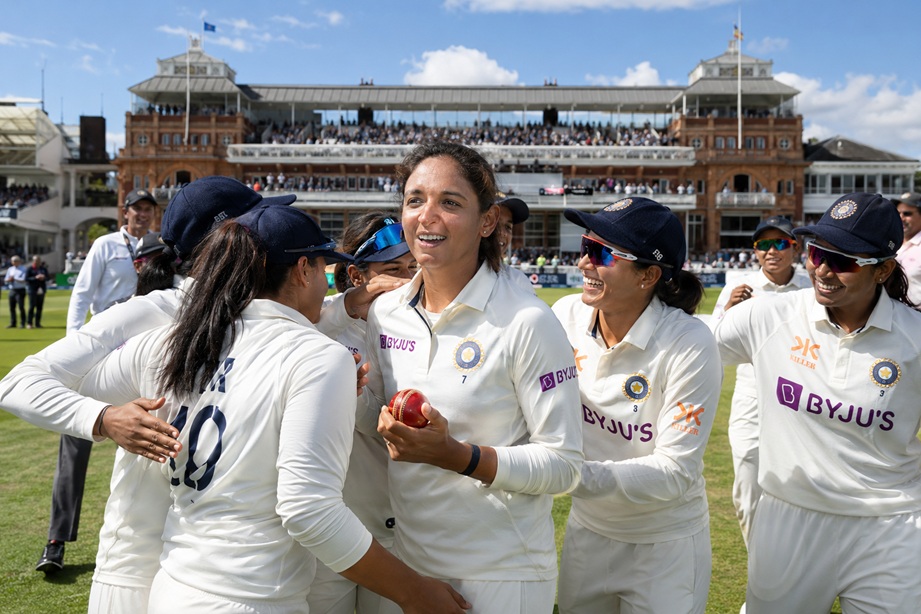
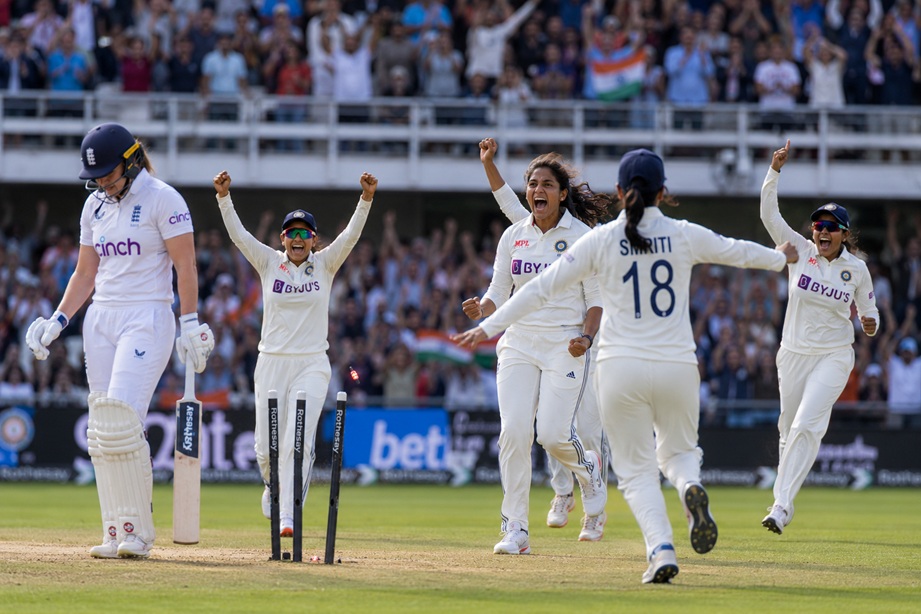
The Indian women’s cricket squad achieved one of its most remarkable international feats by overcoming England in the inaugural women’s Test held at the prestigious Lord’s Cricket Ground. The substantial 270-run win was not merely another addition to the international schedule; it marked a pivotal moment in the growth of women’s cricket.
Under the leadership of captain Harmanpreet Kaur, India dominated the match from the first session to the final dismissal. Exceptional batting, steady bowling, and composed leadership fused to create a memorable victory that will be cherished for future generations. The match also saw several individual achievements that heightened the importance of this momentous event. India made history by becoming the first female international team to celebrate a Test victory at Lord’s, excelling in every aspect of the game.
A Momentous Event at the Cricketing Icon
Excitement was palpable even before the first ball was bowled, with significant anticipation surrounding the match. Lord’s, having hosted numerous iconic men’s Tests, welcomed its first-ever women’s Test, making each part of the match a significant chapter in cricketing history.
A large crowd gathered to witness this historic milestone in the sport. Players from both sides recognized the event’s significance, but India adapted much better to the conditions than their opponents. The victory displayed the remarkable progress made by the Indian women’s team in recent years, highlighting their capability to excel under pressure in high-stakes situations.
India Women’s Lord’s Test Performance Established an Early Advantage
Achieving success overseas involves patience, composure, and consistency, and India exhibited all three traits from the very first day.
Despite early wickets that added pressure, the middle order stepped up confidently. Smriti Mandhana steadied the innings with a brilliant 83, while captain Harmanpreet Kaur contributed a crucial 58. Deepti Sharma also played a significant role by adding a half-century that bolstered India’s total in their first innings to 285.
England’s bowlers fought valiantly, with Sophie Ecclestone picking up key wickets, but India consistently prevented the hosts from taking full control of the match. The visitors ensured they compiled a sufficient score to maintain scoreboard pressure throughout the game.
Middle Order Thrived Under Stress
One of India’s key advantages during the Test was the determination and experience of its players.
Instead of pursuing rapid runs, the batters withstood pressure and took advantage of each scoring opportunity that arose. Partnerships in the middle overs thwarted England’s bowling attack and averted the collapses that can often occur in overseas Test matches.
This disciplined approach demonstrated thorough preparation and revealed India’s increasing maturity in the longer format of the game.
Kranti Gaud Delivered a Pivotal Bowling Spell
The crucial moment of the match came when India’s pace bowlers dismantled England’s first batting innings.
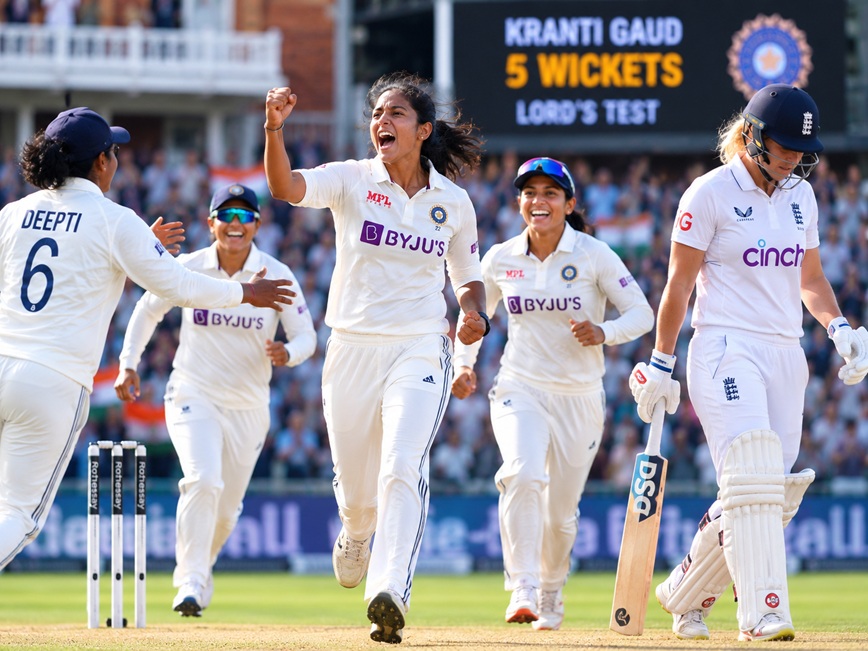
Emerging pacer Kranti Gaud presented one of the best bowling outings by an Indian woman in Test cricket, achieving a stunning five-wicket haul. Her precise line, movement off the pitch, and unwavering consistency posed significant challenges to England throughout their innings.
Ultimately, England could only amass 170 runs, granting India a significant first-innings lead and completely shifting the momentum in favor of the visitors.
Gaud’s impressive performance also secured her a spot on the esteemed Lord’s Honours Board, as she became the first female player to achieve a five-wicket haul in a Test match at this renowned venue.
Yastika Bhatia Made Another Lord’s Milestone
If Kranti Gaud was a standout with her bowling, wicketkeeper-batter Yastika Bhatia made sure India asserted its dominance with the bat.
Her outstanding century during the second innings marked another significant event in the annals of women’s cricket. She became the inaugural woman to achieve a Test century at Lord’s, showcasing a blend of graceful shot execution and exceptional composure.
Supporting her were vital contributions from Smriti Mandhana and Richa Ghosh, leading Yastika to assist India in declaring at 341 for seven.
This declaration presented England with a formidable target of 457, a figure that seemed consistently unattainable on a deteriorating pitch.
Serenity Characterized Her Performance
In contrast to her aggressive innings in white-ball formats, Yastika’s century was established through meticulous shot selection.
She effectively rotated the strike, capitalized on loose deliveries, and maintained her poise despite England’s efforts to impede the scoring pace. Her performance showcased the level of patience needed to thrive in Test cricket and illustrated her development as an international batter.
Bowlers Concluded a Commanding Performance
England required something extraordinary to achieve 457 runs, but India’s bowlers consistently denied the hosts any footing.
Sneh Rana leveraged her experience to exert pressure from one end while the seam bowlers persistently targeted the stumps. Kranti Gaud continued to unsettle the batters with her precise pace bowling, while Deepti Sharma delivered crucial breakthroughs whenever partnerships threatened to form.
Despite Sophie Ecclestone putting up a commendable fight with an impressive half-century, wickets rapidly fell around her. England ultimately collapsed for 186 runs, resulting in a definitive 270-run victory for India.
Captain Harmanpreet Kaur Set the Standard
Leadership often plays a critical role in determining the winner of tightly contested matches, and Harmanpreet Kaur skillfully managed the game.
Her half-century in the first innings steadied India’s batting after a shaky start, while her strategic field placements and bowling changes kept constant pressure on the England team throughout the Test.
The captain remained composed, even when England sought to rebuild, placing her trust in her bowlers and ensuring that the intensity of play never waned.
Following the victory, Harmanpreet commended the team’s resilience, preparedness, and collective effort, underscoring that every player was instrumental in this historic success.
Prudent Tactical Choices
Several decisions made during captaincy were crucial:
- Declaring at an opportune moment to maximize the bowling opportunity.
- Adjusting bowlers to suit the shifting conditions.
- Maintaining an aggressive field setup despite England’s defensive strategy.
- Entrusting young players during pivotal moments.
These tactical decisions reflected an increase in confidence within the Indian squad.
England Failed to Rebound
Although England came into the match with the benefit of playing at home and high expectations, various batting shortcomings proved detrimental.
After facing a first-innings deficit, they faltered again while pursuing a daunting target. Early wickets incited panic, and despite Sophie Ecclestone’s solitary resistance, partnerships failed to last long enough to pose a real threat to India.
This defeat also served as an emotional farewell for seasoned England players Heather Knight and Tammy Beaumont, adding to the significance of the result for the home side.
Significance of This Victory Goes Beyond The Metrics
The value of this victory surpasses mere statistics.
Women’s Test cricket is still quite uncommon when compared to the men’s schedule. Each high-caliber Test match reinforces the case for broadening the format and granting players additional chances to engage in four-day competitions.
India’s display showcased that women’s cricket embodies the craftsmanship, stamina, and strategic depth essential for delivering captivating Test matches.
Several significant achievements made this match a memorable one:
- The inaugural women’s Test held at Lord’s.
- India’s impressive win by 270 runs.
- Kranti Gaud’s remarkable five-wicket performance.
- Yastika Bhatia’s milestone of the first women’s Test century at Lord’s.
- Multiple athletes securing spots on the Honours Board at Lord’s.
These milestones guarantee that this match will be permanently etched in the annals of cricket history.
A New Era for Indian Women’s Cricket
Over the last ten years, Indian women’s cricket has progressively advanced thanks to enhanced domestic tournaments, the introduction of professional contracts, and increased exposure at an international level.
Victories in foreign lands have become more frequent, yet achieving triumph in a historic Test at Lord’s holds a distinct importance. It showcases that India has both the skills and mindset necessary to thrive in the longest format of the game.
Young players across the globe witnessing this display will see it as evidence that women’s Test cricket is capable of producing remarkable sporting experiences.
This achievement may also motivate organizers to plan more bilateral Test series, providing players with enhanced chances to sharpen their red-ball abilities and inspiring future generations.
Final Thoughts
This extraordinary victory will stand out as a landmark accomplishment in Indian women’s cricket. India excelled in batting and bowling, confidently faced every obstacle, and presented a performance fitting for cricket’s most iconic venue.
From Smriti Mandhana’s steady batting to Harmanpreet Kaur’s leadership, Yastika Bhatia’s record-setting century, and Kranti Gaud’s unforgettable bowling display, each significant input contributed to a win that went beyond the final score.
As the jubilation filled the air at Lord’s, it became evident that this was more than just a Test victory. It served as a powerful declaration regarding the escalating prowess of Indian women’s cricket and represented yet another significant achievement in the ongoing advancement of the women’s game globally.