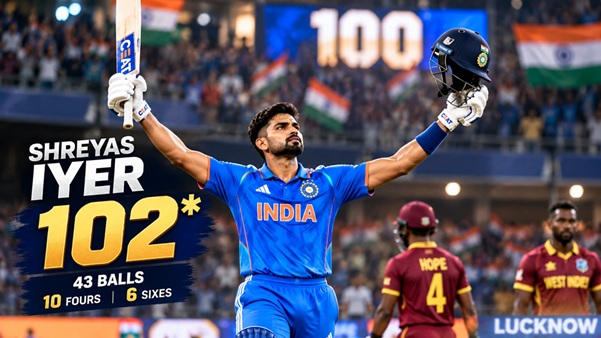

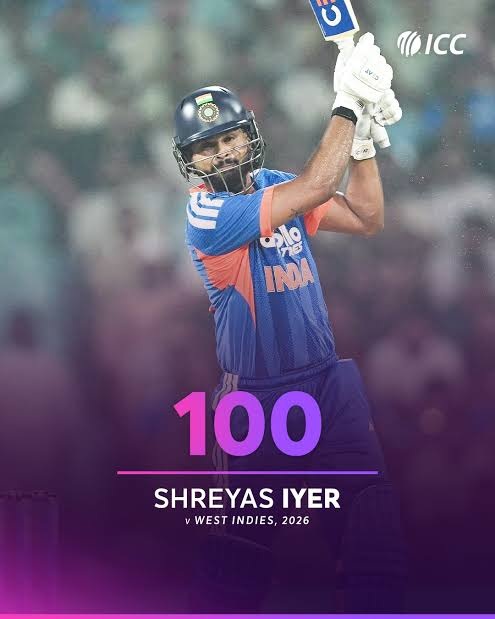
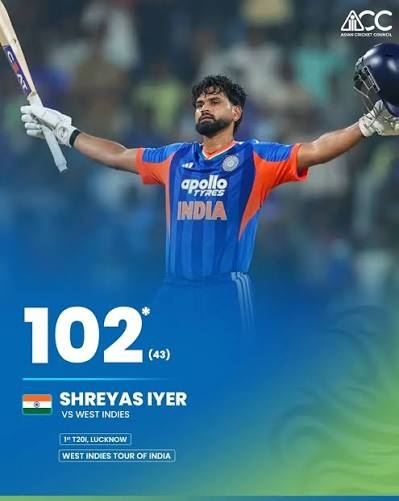
Shreyas Iyer vs West Indies: Certain innings can secure victories, while others can completely transform the perception of a player. On October 6, 2026, Shreyas Iyer delivered the latter in Lucknow, converting a potentially challenging chase into a dominant performance with an unbeaten score of 102 off 43 balls.
India needed to chase down 172 after the West Indies managed to score only 171 runs before being all out in 19.1 overs. The beginning of the innings was not ideal for the home side. Abhishek Sharma contributed 21 runs off 10 balls, and Sanju Samson scored just 11, leaving India at 35 runs for 2 wickets early on. At this juncture, the match had the potential to become quite close.
However, Iyer took charge of the situation.
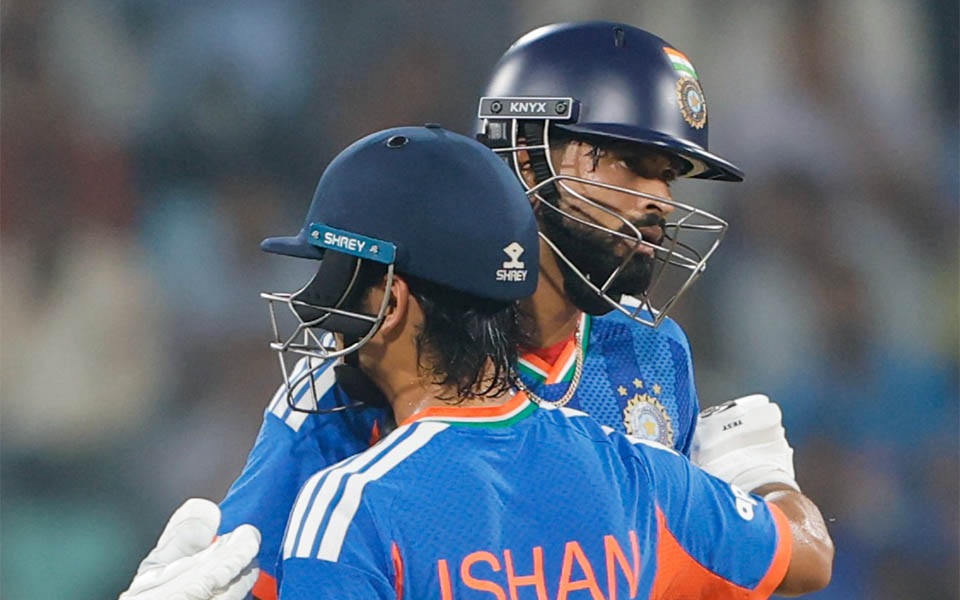
He concluded with 102 runs off 43 balls, featuring 10 fours and six sixes, while Ishan Kishan remained not out with 37 runs from 27 deliveries. Their partnership of 137 runs effectively alleviated the tension of the chase, enabling India to achieve 172 runs for the loss of just 2 wickets in only 14.4 overs.
IND 172/2
India chased 172 at the Bharat Ratna Shri Atal Bihari Vajpayee Ekana Cricket Stadium, Lucknow, reaching the target in 14.4 overs after Shreyas Iyer smashed an unbeaten 102.
This outcome resulted in an eight-wicket triumph for India with 32 balls to spare, granting them a 1-0 advantage in the five-match T20I series. More significantly, it showcased their captain’s performance that could mark the start of a new era.
Shreyas Iyer vs West Indies: Match Summary
The opening T20I took place at the Bharat Ratna Shri Atal Bihari Vajpayee Ekana Cricket Stadium located in Lucknow.
India won the toss and opted to field first. The West Indies began on a positive note but consistently lost wickets. Shai Hope and Sherfane Rutherford were the leading run-scorers with 52 and 56 runs respectively, though the remaining batsmen struggled to remain at the crease for extended periods.
Eventually, the West Indies ended their innings at 171 all out after 19.1 overs.
India’s bowlers displayed a balanced effort rather than relying on a single player. Naman Dhir made his T20I debut, taking three wickets, while Axar Patel and Kuldeep Yadav each claimed two wickets. Meanwhile, Arshdeep Singh and Mayank Yadav each added one wicket to their tally.
A chase of 172 appeared competitive, especially since the Lucknow pitch had already provided some assist to the West Indies batsmen.
Yet, India had Iyer on their side.
Initially, the chase seemed more challenging than the final results indicated. Abhishek Sharma’s quick contribution of 21 was cut short by Roston Chase’s bowl, and Sanju Samson soon fell victim to Akeal Hosein, leaving India with two wickets lost at 35 runs.
Iyer stepped onto the field and altered the tempo of the innings entirely.
A Challenging Beginning Evolved into a Dominant Chase
The brilliance of Iyer’s innings lay not only in the number of runs he amassed. It was also in the timing of his onslaught.
He entered the game without recklessly attacking every delivery. There was a phase where he analyzed the bowling, identified the gaps, and forged a partnership with Kishan. Once he grasped the situation, the runs began to flow effortlessly.
The innings played by the Indian captain showcased a mix of powerful hitting and strategic boldness. He scored 102 runs at an impressive strike rate of 237.2, achieving this remarkable total in just 43 balls. He hit the boundary 16 times, which included 10 fours and six sixes.
This indicated that 76 out of his 102 runs came solely from boundaries.
The remaining runs were accumulated through singles and twos along with running between the wickets, illustrating that the innings was not purely reliant on big hits.
Iyer’s composure was crucial, particularly as India had lost two wickets in quick succession. Instead of allowing the West Indies to control the middle overs, he seized the momentum away from their bowlers.
The Indian Express highlighted that he came to the crease with a score of 35/2 and initially faced the challenging bowling of Roston Chase and Akeal Hosein. Once the intensity lessened, Iyer shifted his focus to attacking the pace bowlers and significantly increased the scoring rate.
That shift can be regarded as one of the most remarkable aspects of his innings.
The Collaboration With Ishan Kishan
Iyer did not achieve victory by himself.
Ishan Kishan contributed significantly by remaining not out on 37 from 27 balls. Together, the duo combined for 137 runs in just 67 balls for the third wicket.
Their partnership succeeded because both batters adopted different approaches to dominance.
Kishan provided grounding while Iyer took a more aggressive stance. This combination enabled India to sustain a high scoring rate while minimizing unnecessary risks.
The partnership is also a testament to the importance of having a middle-order player who can stabilize a chase after early dismissals.
At 35/2, the West Indies had a real chance to pressure India. By the time their combined score exceeded one hundred, that opportunity had vanished.
The required run rate for India was no longer an issue. The only question left was the speed of the chase’s conclusion.
How Iyer Achieved His First T20I Century
The century itself was yet another highlight of the evening.
Iyer reached the landmark of three figures off 42 balls, marking his first T20I century. He concluded his innings with a score of 102 from 43 balls.
The century was sealed with a six off Roston Chase, adding a thrilling element to the occasion.
He was at 95 when India needed just eight runs from 36 balls. Kishan returned the strike to Iyer, who then secured the milestone with a six before scoring the final run necessary to complete the chase.
This conclusion was apt as Iyer’s innings had been characterized by thoughtful aggression.
There was no need for a tense final over, as he had already alleviated the pressure that came from the early wickets.
His celebration was deeply felt. Upon reaching the milestone, he removed his helmet and recognized the Indian dugout while the audience celebrated his first T20I century.
For a player who had been anticipating this moment in the format, it was a momentous release.
Why This Century Holds Such Significance
Scoring a hundred in T20 cricket is always a remarkable feat, but the context rendered this particular one even more significant.
Iyer entered the match under intense scrutiny.
His latest T20I results had fallen short of the high expectations set for him, and he experienced a tough phase following his unbeaten score of 80 against England in Bristol. According to Indian Express, he failed to exceed a score of 30 in his following 10 innings prior to the match in Lucknow.
This backdrop heightens the significance of his innings.
Rather than merely achieving a century in an easy outing, he accomplished it after India faced the loss of two quick wickets.
Consequently, this performance felt more like a declaration than a standard accomplishment.
The innings addressed multiple inquiries simultaneously:
- Was Iyer capable of performing under the pressure of captaincy?
- Could he increase the run rate in a short format without sacrificing control?
- Could he lead a chase while achieving an impressive strike rate?
- Was he able to transform a promising beginning into a match-winning century?
Against the West Indies, he affirmed all four.
A New Record Against West Indies
The century also marked an important statistical achievement.
Iyer became the first Indian batsman to hit a T20I century while pursuing a target against West Indies. His not-out score of 102 also surpassed Virat Kohli‘s prior record of 94 during a T20I chase as captain against the same team.
This comparison is particularly noteworthy, as Kohli’s 94 had long been seen as one of India’s significant T20I chase performances versus the West Indies.
Iyer’s innings exceeded that record in an impressive manner.
Furthermore, he became only the third Indian captain in men’s T20I history, after Rohit Sharma and Suryakumar Yadav, to reach a century in this format, as reported.
Thus, the accomplishment falls into two distinct categories: individual batting prowess and captaincy achievements.
The Statistics Behind the Innings
Data frequently reveals the reasons that a T20 innings feels remarkable.
In this instance, the figures are notably impressive.
Iyer achieved:
- 102 runs
- 43 deliveries
- 10 boundaries
- 6 home runs
- 237.2 strike rate
- 100 runs reached off 42 deliveries
This innings marked the highest T20I score of Iyer’s international career. His former T20I record was eclipsed by a century earned under the challenge of leading the team and an early batting collapse.
The sixes he hit were crucial during the phase of acceleration. As the field spread, he continued to discover scoring chances instead of letting West Indies manage the run rate.
What stands out is that he was able to score at a pace exceeding more than double what is usually needed for a standard chase.
West Indies Had Their Chances
It would be inaccurate to claim that West Indies merely surrendered the match to India.
Their initial innings showcased two remarkable individual contributions.
Shai Hope scored 52 runs off 37 balls, including six boundaries and two sixes. Sherfane Rutherford followed with an aggressive 56 runs from 34 balls, featuring six fours and three sixes.
This duo aided West Indies in bouncing back after quick wickets fell.
At one point, West Indies dropped to 45/3, but Hope and Rutherford revitalized the innings and elevated the total past 100 runs.
Nevertheless, India‘s bowlers consistently took wickets anytime the visitors seemed poised to gain momentum.
Naman Dhir‘s collection of three wickets on debut proved especially significant. He dismissed Hope and played a crucial role in dismantling the West Indies middle order. Axar Patel and Kuldeep Yadav each claimed two wickets, ensuring that West Indies could not turn their recovery into a total nearing 190 or 200.
This disparity ultimately became significant.
India’s Bowling Laid the Foundation for the Chase
While the batting display garnered the most attention, India’s bowlers also deserve recognition for establishing the groundwork for such a prosperous chase.
West Indies were limited to 171 runs in 19.1 overs.
Arshdeep Singh concluded with 1/34, Mayank Yadav had 1/40, Axar Patel finished at 2/26, Kuldeep Yadav achieved 2/33 and Naman Dhir recorded 3/31.
The bowling unit did not completely contain West Indies. In reality, the visitors maintained a scoring rate of 8.92 runs per over.
However, India continued to target the stumps and forced West Indies to regroup after losing wickets.
This setup made the target of 172 more manageable rather than daunting.
The bowling performance also allowed Iyer to approach the chase with the knowledge that India did not have to take outlandish risks right from the start.
Shreyas Iyer vs West Indies: The Importance of Captaincy
The significance of the performance is heightened by the fact that Iyer is captaining the Indian T20I team.
A captain’s innings is often evaluated differently compared to a regular player’s performance. The captain must comprehend the match dynamics, control risk, and keep an eye on the overall strategy.
Iyer excelled in this aspect.
At 35/2, there was no cause for alarm. He nurtured a partnership with Kishan and allowed the chase to unfold.
Then, as soon as the chance presented itself, he accelerated his approach.
That development is what rendered the innings so effective.
It was not merely aggression for aggression’s own sake. It was a measured acceleration.
The outcome also provided Iyer with a significant boost in confidence as a captain. India entered the series following a successful stretch in T20Is, and this victory extended their consecutive wins in this format to ten matches, based on ICC statistics.
Shreyas Iyer’s 102 Against West Indies Altered the Narrative
Prior to this game, the majority of the discussions surrounding Iyer revolved around his performance and his role as a leader.
Following the game, the dialogue changed significantly.
His performance demonstrated that he can still deliver an innings that can thoroughly dominate a T20I bowling attack.
It also highlighted something vital regarding his batting position.
Iyer does not need to step in during the initial over to make an impact in a T20 match. Coming in at the No. 4 position actually allows him to assess the match before initiating an assault.
In the contest against West Indies, that role was executed flawlessly.
He entered after two wickets were gone, absorbed the initial pressure, and then transformed the run chase into a smooth process.
This is precisely the sort of innings that India desires from their middle-order batsmen.
Why Iyer’s 102 Was Distinct from a Standard T20 Century
Not all T20 centuries carry the same significance.
Some are scored in matches where a batsman opens, faces fifty or more deliveries, and constructs an innings from the outset.
Iyer’s century was unique.
He came to bat after India lost two wickets, with the opposition still convinced it could defend the target.
He subsequently made 102 not out from 43 balls.
This indicated that he was not merely accumulating runs; he was altering the required run rate nearly every over.
The 137-run partnership with Kishan ensured that India never entered a phase where the chase seemed uncertain again.
By the time Iyer approached his century, the match result was practically settled.
This is why this innings might be remembered as one of the standout performances of his early captaincy.
The Influence on India’s T20I Squad
For India, this victory means more than just a single win in this five-match series.
The team now boasts multiple batting options that can swiftly change the dynamics of a game.
Abhishek Sharma brings aggression to the top order. Sanju Samson introduces experience and power. Kishan plays aggressively while also being a supportive partner. Iyer offers stability and acceleration in the middle order.
The rise of players like Naman Dhir also adds further strength to the team.
Dhir’s three wickets on his debut indicated that India can gain contributions from unexpected sources.
This depth could prove crucial as the series progresses.
West Indies will undoubtedly need to address several issues before the upcoming match, especially their capability to contain Iyer once he settles in.
What West Indies Can Take Away from the Game
The visiting team actually exhibited several encouraging signs.
Hope and Rutherford demonstrated that the batting order could bounce back from early challenges. The team also succeeded in claiming two Indian wickets within the first four overs.
The difficulty lay in maintaining pressure.
After Iyer and Kishan established themselves, the West Indies found it challenging to secure another wicket.
Initially, their bowlers created difficulties, but India adjusted their strategy.
In the upcoming match, West Indies will probably need to find a strategy to keep the Indian middle order from settling in.
The initial overs following a dismissal could prove especially crucial.
Should India lose early wickets again, the West Indies will aim to maintain an aggressive field to compel Iyer into taking chances before he finds his rhythm.
A Major Boost in Confidence for Iyer
The most significant triumph of the evening was undoubtedly Iyer himself.
A captain must possess confidence, particularly when guiding a team with significant aspirations.
The not out century arrived at precisely the ideal moment.
It demonstrated his capability to manage pressure, develop an innings, and then unleash his attack when the situation permits.
The timing held weight as the T20I series is just getting underway.
India’s next match is set for October 9 in Ranchi, providing Iyer with another chance to build on the momentum established in Lucknow.
One innings doesn’t determine a series, but it can radically shift the vibe surrounding a player.
That’s precisely what transpired in this case.
What Contributed to the Effectiveness of the Innings?
Multiple small choices came together to form the impressive final score.
- To begin with, Iyer refrained from immediately forcing boundaries upon entering the crease.
- Next, he forged a solid partnership with Kishan.
- Additionally, he launched an attack once the West Indies bowling became easier to tackle.
- Moreover, he kept hitting boundaries even after reaching his fifty instead of easing off.
- Lastly, he finished the innings not out.
This combination resulted in an unusual T20 performance where a batsman fulfilled the roles of both the stabilizer and the primary aggressor.
Typically, these responsibilities are shared between two players.
In this instance, Iyer took on both roles.
Shreyas Iyer 102 Against West Indies: The Broader Context
In the realm of cricket, there is often a tendency to evaluate athletes based on their most recent performances.
This mentality can be risky.
A player may struggle for several games yet then deliver an innings that reminds everyone of their initial selection.
Iyer’s display in Lucknow should be considered within that framework.
His recent form in T20Is had drawn scrutiny, but he answered it with a performance that was impossible to overlook.
The century also came during a period when he was bearing the weight of captaincy.
This fact lends greater significance to his achievement than the mere 102 runs might imply.
The Indian squad requires more than just runs from Iyer. It needs him to emerge as a reliable decision-maker in the middle order.
Against the West Indies, he appeared to be precisely that player.
A Night to Remember at Ekana Stadium
The venue itself enhanced the overall experience.
Ekana Stadium has risen to prominence as a key cricketing location in India, and the audience in Lucknow witnessed a display that will remain etched in memory.
India successfully pursued a target of 172, finishing the match with eight wickets in hand and 32 balls to spare.
That difference illustrates the scenario.
The West Indies set a commendable score. They managed to take two early wickets. Their spin bowlers applied pressure right from the beginning.
Still, India completed the chase with significant ease.
The explanation is straightforward: a remarkable individual performance combined with an essential partnership.
Iyer’s century transformed what could have been a closely contested chase into a commanding victory for India.
What Comes Next for Shreyas Iyer?
The upcoming task is to ensure consistency.
An impressive century grabs attention, but a player’s effectiveness is evaluated over the length of an entire series and ultimately over an extended timeframe.
Iyer has a chance to build on this achievement.
The focus must be on maintaining the same clarity in his approach.
He is not required to score a century every time he bats.
India would be quite satisfied with contributions such as 40 off 25, 65 off 35, or a measured finishing innings, depending on the requirements of the match.
This performance demonstrates that his potential is extraordinarily high.
When necessary, Iyer possesses the ability to lead a T20I chase almost single-handedly.
That is an invaluable asset for any national team.
Conclusion
Shreyas Iyer’s undefeated 102 represented more than just a personal achievement.
It marked his first T20I century, a match-defining innings from a captain, a record-setting chase performance, and a strong reply to concerns about his recent performance level.
India‘s win was decisive: West Indies totaled 171, while India reached 172 for the loss of 2 wickets in just 14.4 overs, securing victory by eight wickets with 32 balls to spare.
The statistics reveal just part of the narrative.
The crucial aspect was the context in which his innings occurred.
India had slipped to 35 for 2.
The opposing team had the upper hand.
The pursuit required calmness.
Iyer offered that calmness initially and then unleashed remarkable aggression.
His 10 fours and six sixes fueled an innings that reached the century milestone in a mere 42 balls, concluding with 102 runs not out from 43 deliveries.
This outcome also granted India a 1-0 lead in the five-match series.
For Iyer, though, the importance extends beyond just the scoreline of the series.
He now has a historic T20I hundred, a noteworthy captaincy performance, and a strong reminder of his capacity to excel on the international stage.
The forthcoming matches will reveal if this serves as the start of a sustained period of success.
Yet, for one unforgettable night in Lucknow, there was no doubt who stood out.
Shreyas Iyer’s 102 against the West Indies was the innings that transformed pressure into strength, a challenging chase into an easy win, and turned inquiries about his form into a central topic of discussion regarding the India-West Indies T20I series.