
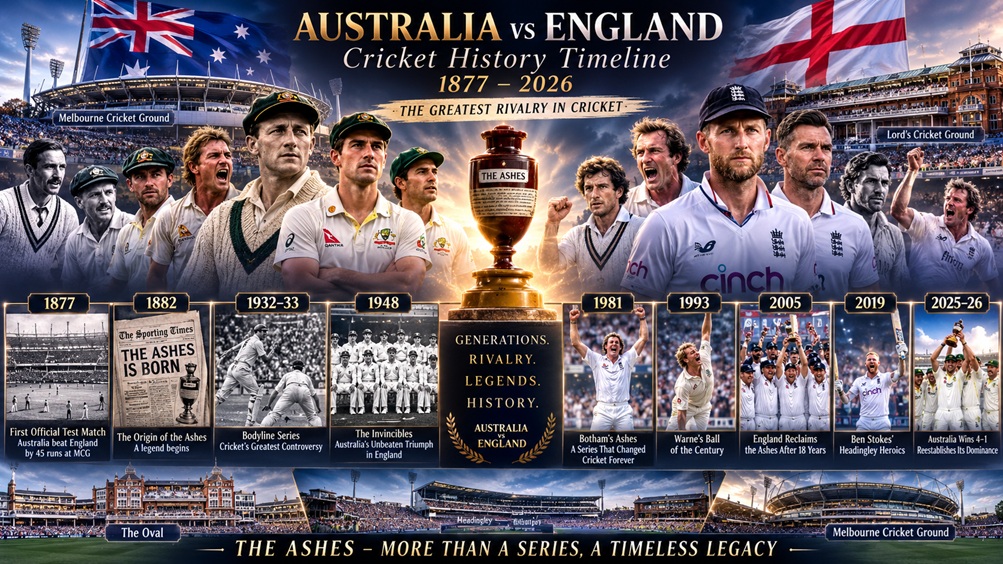

The timeline of Australia and England is much more than merely an enumeration of cricket games—it narrates the essence of the sport itself. Every period has produced unforgettable legends, intense rivalries, thrilling comebacks, and instances that forever altered Test cricket. Although numerous international contests have developed over the years, none holds the same emotional significance or historical value as the Ashes.
Starting with the inaugural official Test match in 1877, Australia and England have established a rivalry that spans almost a century and fifty years. This competition has persevered through global conflicts, shifts in cricket formats, advancements in technology, and numerous generations of iconic players. Even in 2026, this rivalry is looked forward to as one of the most significant fixtures in international cricket, with Australia having won the 2025–26 Ashes series 4–1 at home.
Whether it’s Don Bradman’s remarkable batting, the debated Bodyline strategy, Ian Botham’s heroic performances, Shane Warne’s enchanting deliveries, or Ben Stokes’ courageous leadership, each generation has contributed yet another impressive episode to this storied rivalry.
The Birth of Cricket’s Greatest Rivalry
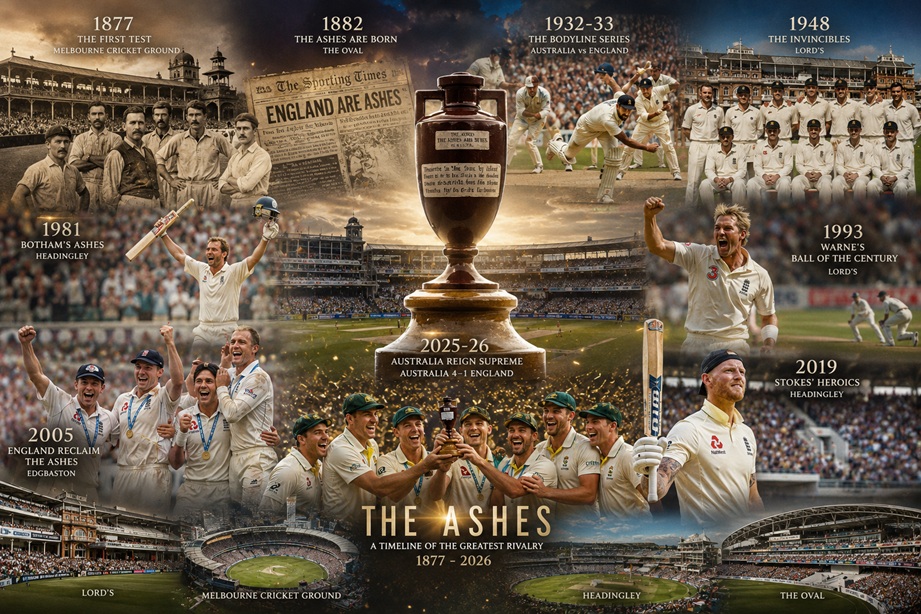
The saga commenced on 15 March 1877 at the Melbourne Cricket Ground (MCG). Few attendees were aware they were partaking in the inaugural official Test match in cricket history. Australia triumphed over England by 45 runs, laying the groundwork for what would evolve into the sport’s most renowned rivalry.
The importance of this matchup expanded even further five years later.
The Origin of the Ashes
In 1882, England faced an unexpected loss at The Oval. Following their defeat, a British newspaper wittily published an obituary declaring the demise of English cricket and that its ashes would be shipped to Australia. That symbolic declaration led to the formation of the Ashes, a trophy that has become the pinnacle of achievement in Test cricket.
Since that time, every Ashes series has come to signify much more than mere wins and losses. It has transformed into a battle for honor, heritage, and athletic dominance.
Early Years: Building a Historic Legacy (1877–1914)
The initial decades laid the groundwork for cricket’s earliest icons.
Australia quickly embraced a more aggressive style of play led by figures such as Charles Bannerman and Fred Spofforth, while England focused on disciplined batting and strategic bowling techniques. Tours between the two countries evolved into major sporting spectacles despite the lengthy sea journeys taking weeks.
Throughout this era:
- Australia gained recognition as a budding cricket powerhouse.
- England continued to hone the strategic aspects of Test cricket.
- The Ashes became the premier series in the sport.
Each tour heightened excitement among the public and drew greater media attention, assisting cricket in gaining traction throughout the British Empire.
The Bradman Era Changed Everything
No account of the Australia versus England timeline can be considered complete without mentioning Sir Donald Bradman.
Bradman’s Incredible Dominance
Throughout the 1930s, Bradman shattered batting records with remarkable consistency. His striking average of 99.94 is regarded as one of the greatest accomplishments in the realm of sports.
England found it difficult to keep him in check, even when employing their best bowling lineups.
Bradman’s supremacy compelled England to explore entirely new strategic methods, eventually resulting in one of cricket’s most talked-about tactics.
Bodyline: Cricket’s Greatest Controversy
The 1932–33 Ashes are notable for the “Bodyline” tactic.
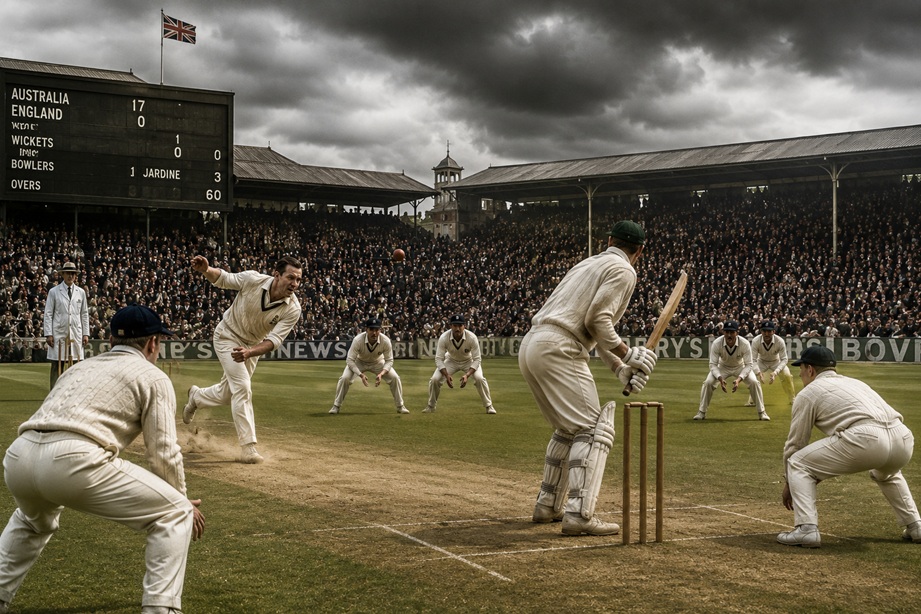
The captain of England, Douglas Jardine, directed fast bowlers to aim at the bodies of Australian batsmen with short-pitched balls while having close leg-side fielders ready to catch any defensive plays.
While this strategy reduced Bradman’s ability to score runs in comparison to earlier series, it sparked significant debate in both nations and even put a strain on diplomatic ties between Australia and Britain. This discourse eventually led to revisions in cricket regulations and ethical standards in the sport.
Currently, Bodyline is recognized as one of the most talked-about strategic choices in the history of cricket.
Post-War Cricket Produces New Icons
After the conclusion of World War II, international cricket returned with increased vigor.
Australia experienced one of its most powerful eras, marked by outstanding leadership and exceptional team cohesion.
The Invincibles of 1948
Under the captaincy of Don Bradman, Australia’s 1948 touring team achieved an unbeaten series in England, earning the title The Invincibles.
This accomplishment remains unparalleled and is considered one of the finest feats in Test cricket history. Bradman’s heartfelt farewell contributed yet another significant moment to the rivalry.
At the same time, England made a strong comeback in the 1950s, showcased by the legendary spinner Jim Laker, whose extraordinary feat of taking 19 wickets in a single Test match is celebrated as one of the finest bowling performances in cricket.
The Revival of England in the 1970s
In the years following World War II, the competition became more even. Although Australia retained a formidable presence, England slowly reformed a team that was able to challenge their rivals consistently. Leaders like Ray Illingworth and Mike Brearley prioritized discipline, while Australia continued to develop elite fast bowlers and reliable batsmen.
A key aspect of this time was the growing professionalism within international cricket. The expansion of television coverage attracted a larger audience, transforming every Ashes series into a worldwide sporting event rather than just a competition watched by traditional cricket enthusiasts.
Fast Bowling Takes Centre Stage
The 1970s marked a period heavily influenced by aggressive pace bowling. Australia exploited powerful fast bowlers to exert pressure on England, while the English team countered with strong batting displays and strategic captaincy. Numerous tightly fought series showed that even minor errors could sway the outcome of the Ashes.
This rivalry also progressed beyond mere statistics. Each match ignited national pride, as fans from both nations regarded Ashes victories as significant milestones in the realm of sports.
Botham’s Ashes: A Series That Changed Cricket Forever
Few moments in the history of Australia versus England are as memorable as the 1981 Ashes, famously known globally as “Botham’s Ashes.”
Entering the series, England faced significant pressure due to previous performances, leading to diminished expectations. However, everything transformed when Ian Botham delivered one of the most exceptional all-round performances witnessed in Test cricket.
Headingley 1981
At Headingley, England seemed on the brink of defeat after being forced to follow on. Ian Botham initiated an extraordinary counterattack, scoring an unbeaten 149 with fearless shot selection. His performance completely changed the trajectory of the match.
Despite Australia still seeming to have the upper hand, Bob Willis produced an astonishing spell of fast bowling, claiming eight wickets and achieving one of the most extraordinary wins in cricket history. This comeback is regarded as one of the sport’s most inspiring tales and motivated future generations of cricketers.
The 1981 series served as a powerful reminder to fans that willpower and confidence can turn the tide in seemingly hopeless scenarios.
Australia’s Era of Dominance
The late 1990s and early 2000s signified one of the most impressive eras in Australian cricket history. Guided by Steve Waugh and subsequently Ricky Ponting, Australia assembled a roster packed with legendary players.
Their batting was marked by consistency, aggression, and depth, while their bowling unit featured a blend of pace, swing, and outstanding spin.
Legendary Players Who Defined an Era
Australia’s supremacy relied on numerous legendary figures:
- Shane Warne’s remarkable leg-spin.
- Glenn McGrath’s unwavering precision.
- Ricky Ponting’s authoritative batting.
- Adam Gilchrist’s innovative wicketkeeping and explosive batting style.
- Matthew Hayden’s strong opening partnerships.
Collectively, they played a crucial role in leading Australia to multiple Ashes titles while establishing new benchmarks for consistency across various formats.
England struggled to keep pace against such a well-rounded team, yet individual achievements continued to create memorable instances throughout the rivalry.
The 2005 Ashes: Cricket’s Modern Masterpiece
The 2005 Ashes is widely celebrated as one of the finest Test series ever contested.
England, under the leadership of Michael Vaughan, took on an Australian team that had been a powerful force in global cricket for many years. Each game offered incredible excitement, reigniting worldwide enthusiasm for Test cricket.
The second Test held at Edgbaston became a legendary encounter. England triumphed by a slim margin of just two runs after a dramatic conclusion that kept millions of fans engaged until the last wicket fell.
Andrew Flintoff rose to prominence as England’s motivating all-rounder, while Kevin Pietersen showcased his talent as one of the most thrilling batsmen in the sport. Australia battled fiercely right until the series’ last session, yet England ultimately retrieved the Ashes after a wait of 18 years.
Many cricket historians contend that the 2005 series rekindled global admiration for Test cricket due to its remarkable competitiveness and emotional depth.
A New Generation Continues the Battle
The rivalry evolved into an exhilarating new chapter throughout the 2010s.
Australia brought forth talents like Steve Smith, David Warner, Pat Cummins, Mitchell Starc, and Josh Hazlewood. In response, England introduced Joe Root, Ben Stokes, Stuart Broad, James Anderson, and more recently, Harry Brook.
Both nations adjusted to contemporary cricket while preserving the fierce spirit of competition that has characterized their matchups over the years.
The Rise of Bazball
England embraced a bolder approach under the captaincy of Ben Stokes and the guidance of coach Brendon McCullum. Commonly referred to as “Bazball,” this method promoted offensive cricket regardless of the match conditions.
Instead of merely striving for survival, England focused on scoring quickly and applying relentless pressure on their rivals.
Australia countered with methodical bowling, steady batting, and strategic adaptability, ensuring that every recent Ashes match remained intensely competitive.
Memorable Individual Performances
Many exceptional individual performances have become enduring elements of Ashes history.
- Don Bradman’s remarkable batting average of 99.94 remains unparalleled in the realm of international cricket.
- Shane Warne’s legendary “Ball of the Century” in 1993 astonished England’s Mike Gatting, instantly becoming one of cricket’s most replayed moments.
- Ben Stokes delivered an unforgettable unbeaten innings at Headingley in 2019, salvaging England from what seemed like inevitable defeat with his fearless batting and impressive composure.
These performances underscore the reasons why this rivalry continues to enthrall cricket fans across different generations.
Records That Highlight the Rivalry
Over nearly 150 years, Australia and England have established numerous records that emphasize the significance of their competition.
Some of the most notable achievements include:
- The inaugural official Test match in the history of cricket took place between Australia and England in 1877.
- The Ashes is recognized as the oldest and most esteemed bilateral Test series.
- A plethora of batting and bowling records have been set during Ashes matches.
- Several contests are regarded as some of the greatest Test matches of all time.
- Both countries have produced many of the sport’s top captains and all-rounders.
These achievements illustrate why this rivalry continues to hold a distinct and important position in cricket’s history.
The 2025–26 Ashes: Australia Reestablishes Its Dominance
The latest installment in the ongoing saga between Australia and England occurred during the 2025–26 Ashes series hosted in Australia. As the series began, England was optimistic that their aggressive approach would lead to their first away victory in the Ashes. However, Australia effectively utilized a blend of meticulous batting and a superior bowling lineup, maintaining control throughout the series right from the first Test.
With a 4–1 victory in the series, Australia reaffirmed the significance of playing in familiar conditions as a considerable advantage. Their pace bowlers were able to consistently harness speed and bounce from the Australian surfaces, while the batting order formed essential partnerships whenever England posed a challenge to the match dynamics.
Although England displayed moments of brilliance, particularly during intense batting segments that showcased their contemporary approach, they were unable to sustain consistent performance throughout the five grueling Test matches. This outcome reinforced Australia’s status as one of the premier Test cricket nations globally, while also providing England with instructive experiences for their upcoming international series.
Overall Head-to-Head Record
Examining nearly a century and a half of competition, the statistics highlight the balance between these two cricketing powerhouses across different time periods.
Historically, Australia has witnessed more success in the overall Ashes counts, particularly during dominant eras in the late 1940s, early 2000s, and more recently. Meanwhile, England has delivered memorable series victories that have significantly impacted the history of cricket, including notable achievements in 1981, 2005, and several remarkable home series.
Beyond mere figures, each generation has seen the rise of new legends. Players like Don Bradman, Dennis Lillee, Shane Warne, Ricky Ponting, Joe Root, Ben Stokes, and Pat Cummins have all emerged as iconic figures whose achievements have woven themselves into the fabric of cricket legend.
Why This Rivalry Remains Unique
The ongoing narrative between Australia and England captivates cricket enthusiasts for reasons beyond just being a simple series.
Several elements contribute to the uniqueness of this rivalry:
- It traces back to the inaugural official Test match in 1877.
- The Ashes represents the oldest and most esteemed trophy within Test cricket.
- Each series holds immense historical relevance.
- Remarkable individual accomplishments have molded the history of the sport.
- Countless fans worldwide passionately track each encounter.
In contrast to many contemporary sports rivalries, the competition between Australia and England merges deep-rooted tradition with continuous evolution. New strategies, advancements in technology, and fresh generations of players infuse the rivalry with vitality while honoring the rich legacy that the Ashes signify.
Lessons from Nearly 150 Years of Competition
The timeline of Australia versus England also showcases the progression of cricket itself.
Improvements in protective gear, innovations like the Decision Review System affecting umpiring calls, and heightened fitness expectations have transformed the game. Nevertheless, the fundamental traits essential for success—discipline, patience, bravery, and collaboration—have remained constant.
Every Ashes series imparts critical lessons about adapting to varying conditions, managing pressure, and overcoming challenges. Whether taking place before enthusiastic fans at venues like Lord’s, the Melbourne Cricket Ground, Headingley, or the Sydney Cricket Ground, the rivalry consistently creates memorable instances that motivate upcoming generations.
Looking Ahead Beyond 2026
The upcoming period holds the promise of an exhilarating chapter for both teams.
Australia persists in cultivating skilled young batsmen and fast bowlers who are able to uphold the country’s illustrious cricket legacy. Similarly, England is devoted to developing aggressive athletes who can thrive in varying conditions while honing the bold style that has fascinated audiences globally.
The forthcoming Ashes series are anticipated to showcase fresh rivalries, rising talents, and strategic advancements. With both cricket boards making substantial investments in player training and elite performance initiatives, the level of competition is expected to remain remarkably high.
Fans can look forward to future matches that combine the rich heritage of Test cricket with the thrills of the contemporary game, which will keep the rivalry pertinent for future generations.
Conclusion
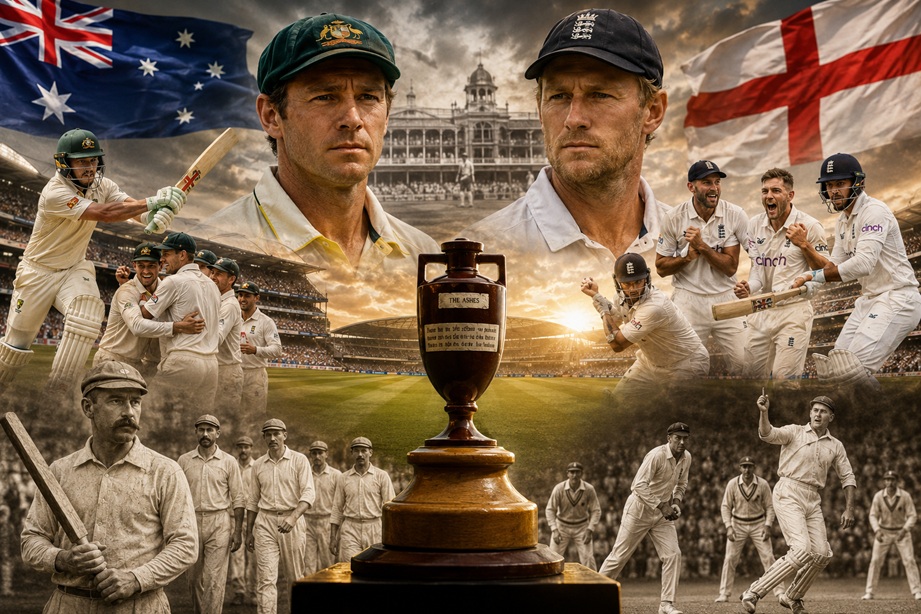
The timeline of Australia vs England effectively narrates the saga of cricket’s most significant rivalry. From the inaugural Test match in 1877 to the recent Ashes encounters in 2026, these two countries have consistently provided games replete with excitement, determination, and memorable sporting brilliance.
Remarkable accomplishments by figures such as Bradman, Botham, Warne, McGrath, Root, Stokes, Cummins, and numerous others have elevated typical Test matches into everlasting sporting memories. Each Ashes series contributes another extraordinary chapter to a rivalry founded on admiration, intense competition, and an unyielding will to triumph.
As cricket progresses, one thing remains constant: whenever Australia and England clash on the pitch, fans worldwide recognize they are witnessing one of the most esteemed contests in sports. The timeline of Australia vs England will keep expanding, establishing new records, unforgettable displays, and legendary moments that will captivate cricket admirers for many years to come.