


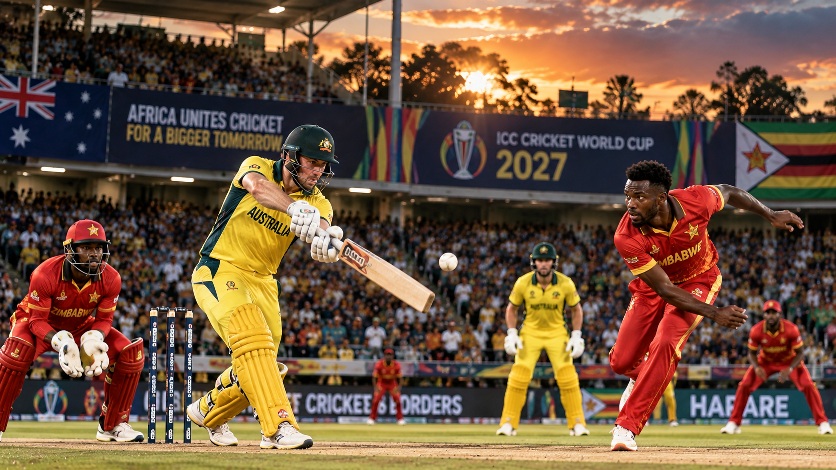
The inaugural match of the three-game ODI series in Harare has already sparked numerous discussions, as Australia faced more challenges than anticipated from a determined Zimbabwean team. This encounter at Harare Sports Club holds special importance since it marks Australia’s first ODI series against Zimbabwe in over ten years. The three matches are set to take place on September 15, 18, and 20, all in Harare.
As of now, Australia has finished their batting and scored 294/8 from 50 overs, establishing a target of 295 for Zimbabwe. Matt Renshaw shone brightly with a remarkable first ODI century, while Zimbabwe’s up-and-coming left-arm bowler Newman Nyamhuri made quite an impression with a fantastic five-wicket performance. The second half of the match is crucial, as Zimbabwe aims to reach a challenging total.
This game signifies more than merely being the opener of a bilateral series. Both squads possess greater goals. Australia is utilizing this tour to refine their ODI lineup before the 2027 World Cup in Southern Africa, while Zimbabwe is gaining essential experience against one of the top teams in international cricket as they gear up for a World Cup that they will co-host.

Australia vs Zimbabwe 1st ODI 2026: Match Overview
The initial ODI is taking place at Harare Sports Club, a venue well-known to Zimbabwean cricket but somewhat unfamiliar for Australia’s current ODI squad. This match kicked off the three-game series, with the next two scheduled for September 18 and 20.
Australia won the toss and opted to bat first. This choice initially seemed to position the visitors favorably, but Zimbabwe’s bowling unit quickly showed that Australia would not have an easy time during their innings.
The Australian batting lineup featured a blend of seasoned international athletes and younger competitors vying for spots in the ODI team. This mix is a central theme of the series. With Australia participating in relatively few ODIs recently, every chance for marginal players to showcase their skills is particularly significant.
The visitors ultimately accumulated 294/8, a score that appeared notably improved following Renshaw’s middle-order recovery. Meanwhile, Zimbabwe managed to display just enough potency with the ball to maintain competitiveness in the match.
Match Snapshot
- Venue: Harare Sports Club, Harare
- Date: September 15, 2026
- Format: One-Day International
- Series: Three ODIs
- Australia: 294/8
- Target for Zimbabwe: 295
- Australia’s leading scorer: Matt Renshaw, 109
- Zimbabwe’s leading bowler: Newman Nyamhuri, 5 wickets
The match also held historical significance for Brendan Taylor. Upon his return to international cricket, the veteran Zimbabwean batsman became the longest-serving player in men’s ODIs by career duration, surpassing the previous record held by Sachin Tendulkar. Taylor’s participation in Harare added an additional layer of historical relevance to the match.
Matt Renshaw Produces the Defining Australian Innings
The paramount individual highlight of the Australian innings was undoubtedly Matt Renshaw.
Renshaw achieved 109 runs off 94 balls, marking his first ODI century and delivering much-needed stability for Australia after Zimbabwe’s bowlers consistently took wickets. His performance was not merely a display of powerful hitting. It was a significant demonstration of an Australian batsman adjusting to the circumstances instead of attempting to rapidly increase the scoring from the outset.
The significance of his century was heightened by the fact that Australia’s innings did not progress smoothly. Zimbabwe continued to dismiss players, hindering Australia’s ability to establish a substantial foundation that could have easily surpassed the 300-run mark.
Thus, Renshaw had a dual responsibility. He needed to navigate the challenges posed by the constant fall of wickets while ensuring that Australia avoided finishing with an inadequate score.
He accomplished both tasks successfully.
Why Renshaw’s 109 is Significant
This inning may hold importance that extends beyond just this one game. The Australian ODI team is in a transitional phase, with newer players gaining chances while seasoned athletes strive to secure their places in the World Cup lineup.
Renshaw’s capability to score a century under stressful conditions provides selectors with additional information to evaluate.
His position in the batting lineup is also significant. He contributed from the middle order rather than depending on the safety typically associated with opening the batting.
Moreover, this century marked the end of a lengthy wait for an Australian ODI hundred against Zimbabwe. Renshaw became the first Australian to notch an ODI century against Zimbabwe since 2004, adding to the significance of his accomplishment.
For Renshaw on a personal level, the more crucial aspect may be what his innings reveals about his versatility. Australia requires players who can adapt to various conditions in Southern Africa, and an inning characterized by patience and measured acceleration exemplifies the type of performance that can enhance a player’s case.
Newman Nyamhuri Provides a Major Advantage for Zimbabwe
If Renshaw was the key batting figure for Australia, Newman Nyamhuri emerged as the leading bowler for Zimbabwe.
The young left-arm fast bowler concluded with 5/62, achieving his first ODI five-wicket haul. His performance stopped Australia from turning a strong start into a dominating total and ensured that Zimbabwe entered their batting innings with a viable chance.
Claiming five wickets against Australia is an impressive accomplishment for any bowler, but its significance is amplified for a young athlete aiming to make a mark on the international scene.
Nyamhuri consistently found ways to disrupt partnerships. His wickets included crucial Australian players, and his determination maintained the pressure throughout the innings.
A Performance of Great Importance
The significance of Nyamhuri’s outing transcends mere statistics.
Zimbabwe is looking ahead to the 2027 World Cup, and one of their main goals will be to cultivate a bowling attack capable of withstanding formidable international batting lineups. Performances like Nyamhuri’s offer the kind of motivation a developing squad requires.
His five wickets also illustrated that Zimbabwe’s attack could take advantage of moments when Australia lost their rhythm.
The hosts did not merely wait for their opponents to make errors. They applied pressure, targeted the stumps, and maintained control over Australia’s scoring rate during critical moments.
This strategy ultimately compelled Australia to depend significantly on Renshaw’s century and additional late runs to achieve 294.

Australia’s Batting Was More Exposed Than Anticipated
At first glance, a score of 294/8 may seem impressive, but the innings showcased multiple red flags for Australia.
The visiting team struggled to sustain a consistently high scoring pace, and Zimbabwe repeatedly disrupted their partnerships. The Australian middle order was required to handle pressure instead of just capitalizing on a strong start.
This is significant because Australia will encounter tougher bowling attacks in the upcoming segments of their 2027 World Cup preparations.
The team’s coaching staff is not solely focused on securing victories. They must also identify which combinations are dependable when facing challenging conditions.
Australia’s recent planning for ODIs has been influenced by the limited chances available in this format. Reports indicate that the team had participated in only 28 ODIs since early 2024, with Test matches and T20 formats taking precedence. This makes the current tour particularly beneficial for players looking to solidify their positions ahead of the World Cup.
The Selection Competition Is Underway
Australia’s ODI team features several individuals vying for positions.
Josh Inglis and Alex Carey are both part of the discussion for wicketkeepers. Emerging talents like Cooper Connolly, Joel Davies, and Oliver Peake have also been given chances. Cameron Green continues to be a vital all-round option, while fast bowlers such as Xavier Bartlett, Spencer Johnson, and Billy Stanlake are fighting for spots.
This indicates that individual performances in Zimbabwe will be significant.
A player who excels in this series could potentially move ahead of a competitor in the selection rankings. Conversely, a poor performance may complicate the path to the World Cup.
Zimbabwe Approached the Match With Extensive Experience
The selection of Zimbabwe’s squad featured an intriguing balance of youth and experience.
With regular captain Richard Ngarava sidelined due to a lower-back injury, Sikandar Raza was appointed as the captain. Tanaka Chivanga was also unavailable due to an Achilles injury, and wicketkeeper Clive Madande was absent following his recent participation in ODIs.
In response, the hosts reintegrated experienced players into the lineup.
Veterans such as Brendan Taylor and Graeme Cremer returned to the squad. Taylor’s addition is particularly significant as his international journey has become quite remarkable.
Zimbabwe’s roster also comprises players like Craig Ervine, Blessing Muzarabani, Brian Bennett, Ben Curran, Ryan Burl, and Brad Evans. This mixture grants Zimbabwe a diverse combination of experience, youth, speed, spin, and all-round skills.
Raza’s Role as Leader
Sikandar Raza has emerged as one of Zimbabwe’s key senior players, and his leadership was particularly crucial in Ngarava’s absence.
Raza offers both strategic insight and batting strength. Additionally, his bowling capabilities grant Zimbabwe versatility in managing the middle overs.
This adaptability is vital when facing Australia.
The guests possess sufficient batting strength to take advantage of cautious bowling, which means Zimbabwe requires leaders who can discern when to be aggressive and when to safeguard the boundary.
Raza’s background in facing top-tier international opponents renders him ideal for this role.
The Historical Significance of Harare
The inaugural ODI signifies a return to a location and nation that Australia has not frequented often for this format.
This series marks Australia’s first ODI visit to Zimbabwe in over a decade. The last time they played ODIs on Zimbabwean turf was during the triangular tournament with South Africa in 2014.
This extended absence adds more significance to this tour.
The playing conditions in Zimbabwe differ from what Australia regularly experiences back home. Factors like the pitch conditions, climate, match scheduling, and potential assistance for slower bowlers contribute to a beneficial preparation setting.
Australia will have to adjust instead of solely depending on their established reputation.
On the other hand, for Zimbabwe, facing a full-strength or nearly full-strength Australian team at home offers essential competitive experience.
The home side also benefits from their deep familiarity with Harare Sports Club.
What the 294/8 Score Implications Are for the Chase
Australia’s score of 294 sets Zimbabwe a target of 295 runs.
This isn’t an unattainable chase in Harare, particularly if the pitch continues to favor batting. Yet, the escalating run rate adds pressure as wickets are lost.
The main focus for Zimbabwe should hinge on managing partnerships.
Instead of pursuing aggressive plays throughout, the hosts should prioritize preserving wickets for the later stages of the match. Australia’s bowling lineup has sufficient variety to trigger a collapse if given the chance.
At one juncture in their chase, Zimbabwe stood at 153/4 after 28.5 overs, requiring 142 runs more to secure victory. This left the match delicately poised, with Australia enjoying a statistical edge while Zimbabwe remained within reach.
Thus, the middle overs assumed great importance.
Understanding Why 295 Is a Challenging Target
Australia might have wished to achieve a higher score after establishing a strong position through Renshaw.
Nonetheless, 294/8 remains a formidable ODI score.
Chasing 295 necessitates that Zimbabwe averages nearly six runs per over over the course of the innings. If Australia manages to take early wickets or applies pressure through dot balls, meeting that target will become significantly tougher.
Zimbabwe’s optimal strategy is to safeguard their wickets and ensure that Raza, Ervine, and other seasoned batters are available when the required rate escalates.
Consequently, the match transforms into a challenge of both composure and shot selection.
Australia’s World Cup Preparation Has Commenced
It would be tempting to consider this series as a typical bilateral series.
However, that is not the case.
Australia’s ODI tour in Zimbabwe and the subsequent series in South Africa are being regarded as vital preparations for the 2027 World Cup, which is set to take place in Southern Africa. The selectors have indicated that evaluating roles and pinpointing suitable players are primary goals.
This clarifies some of the selection choices.
Marnus Labuschagne was excluded from the ODI squad after experiencing a challenging phase in that format. Simultaneously, Australia reintroduced Mitchell Marsh, Travis Head, and Josh Hazlewood to the ODI lineup while also incorporating younger players.
The approach is clear: provide the upcoming athletes with sufficient international matches to see if they can cope with the stress of competing at World Cup standards.
Why the Zimbabwe Tour Is Significant
There are only a few ODI matches available before the tournament in 2027.
Thus, Australia must avoid treating all series as mere trials without gaining valuable insights from them.
Players must have specific roles assigned.
Selectors must figure out which batting arrangements are effective.
The bowling unit needs to evaluate who can perform efficiently during various game segments.
Additionally, team management should pinpoint players who can maintain composure when a game deviates from Australia’s preferred path.
The initial ODI presented all these challenges.

Zimbabwe’s Preparation for the 2027 World Cup Is Just As Crucial
The hosts have their own long-term goals.
Zimbabwe will jointly host the 2027 Men’s Cricket World Cup with South Africa and Namibia. Thus, the series against Australia offers a chance to assess their advancement against a top cricket nation.
Facing Australia at home can highlight flaws that may not be evident when competing against teams with lower rankings.
This also provides young players from Zimbabwe the chance to play alongside international stars.
Nyamhuri’s five-wicket performance serves as a perfect illustration.
A young bowler delivering such a result against Australia can significantly enhance his development by boosting his confidence from achieving success at the elite level.
The same holds true for the batting lineup in Zimbabwe.
A successful run chase or even a competitive effort deep into the innings would showcase their ability to endure pressure when facing a strong bowling attack.
Brendan Taylor Contributes Another Noteworthy Achievement
One of the most intriguing personal narratives linked to the match centers around Brendan Taylor.
Taylor’s re-entry into international cricket has been nothing short of unique, and his match against Australia marked a statistical achievement. He became the male ODI player with the longest career duration, surpassing Sachin Tendulkar’s previous achievement.
Starting his ODI journey in 2004, Taylor has represented Zimbabwe through various eras of international cricket.
His experience is crucial for a Zimbabwe side looking to blend seasoned players with rising talents.
The timing for this milestone is also particularly appropriate.
Australia’s return to Zimbabwe has created a connection between the past and future of the nation’s cricket. Taylor embodies the experienced cohort, while Nyamhuri symbolizes the forthcoming talent.
Both played significant roles during the opening ODI.
Areas for Improvement for Australia Before the Second ODI
Even if Australia secures victory in the initial match, there are numerous aspects the team can enhance.
The first aspect is consistent batting.
A score nearing 300 is commendable, but Australia would prefer to see fewer instances of wickets falling in quick succession. Against stronger rivals, losing multiple wickets during the middle overs could convert a favorable position into a challenging one.
The second focus is on capitalizing on good starts.
Players reaching scores of 20 or 30 must find methods to transform those onto substantial tallies.
The third priority is to adjust more swiftly to Zimbabwe’s bowling strategies.
Nyamhuri’s success highlighted that Zimbabwe’s bowling attack can exploit Australian batsmen who do not adapt properly.
Australia should also keep assessing their younger talent.
The aim of this tour is not merely to secure victories in every game with the most seasoned squad. It seeks to pinpoint the collective that can propel the team towards the World Cup in 2027.
What Zimbabwe Can Learn From the First ODI
Zimbabwe can find numerous positives, notwithstanding the final outcome.
The performance of Nyamhuri, taking five wickets, stands out prominently.
The bowling team illustrated that Australia can be put under pressure, especially by skillfully utilizing the pitch and weather conditions.
Additionally, the batting lineup has a chance to prove it can pursue a significant target while keeping the required run rate in check.
Most crucially, Zimbabwe has demonstrated that they are not daunted by the reputation of Australia.
The matchup has been intense because Zimbabwe has aggressively approached the game rather than merely seeking to survive.
This attitude will be vital for the remainder of the series.
Australia vs Zimbabwe First ODI 2026: Key Contributors
A number of players stood out as pivotal in the inaugural match.
Matt Renshaw
Renshaw’s score of 109 from 94 deliveries was the standout performance for the Australians. His first ODI century turned an innings that might have fallen short of 250 into a formidable 294/8.
Newman Nyamhuri
The Zimbabwe bowler delivered a career-defining display with figures of 5/62. His five-wicket haul proved he could challenge seasoned international batsmen, granting Zimbabwe a valid opportunity to manage Australia’s scoring.
Cooper Connolly
Connolly’s contribution was vital as he scored a half-century, amassing 51 runs off 46 balls. His performance highlighted the reasons Australia aims to nurture younger talent for the upcoming ODI cycle.
Sikandar Raza
Raza’s significance goes beyond just his personal statistics. As the captain and a senior batsman, along with offering bowling options, he plays a crucial role in Zimbabwe’s capacity to vie against Australia.
The Overall Perspective for the Series
The opening ODI must be perceived as the start of a broader narrative, rather than an end point.
The second match is set for September 18, followed by the third ODI on September 20, all to be held at Harare Sports Club.
This condensed schedule means that teams will have little time for substantial changes.
Australia needs to determine whether to keep the same lineup or allow another player a chance.
Zimbabwe must evaluate the effectiveness of their bowling strategies and assess if their batting order can withstand Australia’s bowling attack.
Thus, for both teams, the second match may be more strategic than the first.
The teams now possess new insights.
Australia is aware of which Zimbabwean bowlers posed challenges.
Zimbabwe is informed about which Australian batsmen adapted well to their conditions.
This situation adds an intriguing element to the upcoming encounter.
Reasons This Match May Be Remembered
There are multiple factors that may cause the initial game to be memorable even after the series concludes.
To begin with, Renshaw achieved his first ODI century under thrilling conditions.
Moreover, Nyamhuri secured his inaugural five-wicket haul against a team renowned in international cricket.
Additionally, Brendan Taylor reached another impressive milestone in his extensive career.
Furthermore, the match signified Australia’s return to Zimbabwe for an ODI series after over ten years.
Lastly, both teams are utilizing this series as part of their training for the upcoming 2027 World Cup.
These elements contribute to making this encounter more significant than an ordinary September ODI.
Key Insights
The opening match has already illustrated the enduring importance of bilateral ODI cricket, regardless of the differing rankings and resources of the teams involved.
Australia arrived with a notable reputation and a roster filled with seasoned international players, yet Zimbabwe required them to strive for each run.
Renshaw’s century transformed a potentially average Australian score into a competitive total of 294/8. Nyamhuri’s five-wicket haul ensured that Zimbabwe’s bowlers stayed very much in contention.
The game also showcased the differing objectives of both sides.
Australia is on a quest to find the optimal lineup ahead of the 2027 World Cup, with seasoned athletes and rising talents vying for spots. Meanwhile, Zimbabwe is working towards assembling a competitive team capable of making an impression when they co-host the global tournament next year.
This significance makes each performance crucial.
For Renshaw, the century might serve as a significant milestone in his ODI journey. For Nyamhuri, the five-wicket haul may be the display that positions him as one of Zimbabwe’s most promising young bowlers. For Australia, the match supplies essential insights into their evolving roster. For Zimbabwe, it demonstrates their ability to compete against top-tier teams on home ground.
Thus, the upcoming matches in Harare ought to be followed with interest.
The first encounter has already produced a century, a five-wicket haul, a significant milestone, and a competitive battle. The next two ODIs have the potential to expand upon this groundwork and uncover even more about both teams prior to the 2027 World Cup.
In this regard, Australia vs Zimbabwe 1st ODI 2026 is more than just a match score or a singular outcome. It acts as an early glimpse into the preparations of two teams gearing up for a much larger stage.
And if the inaugural match serves as any indicator, this series could offer much more excitement before the final ODI wraps up.