


The loss of India to England reignited discussions regarding the team’s batting style in foreign settings. Despite an initial appearance of a competitive score, former Indian wicketkeeper-batter Dinesh Karthik suggested that the true narrative lay in the progression of the innings and where significant chances were lost. His analysis following the match emphasized strategic understanding instead of merely pointing fingers at specific players.
The ex-cricketer underscored multiple components that hindered India from imposing more pressure on England. From adjusting to unfamiliar field dimensions to making superior choices in the middle overs, Karthik emphasized that contemporary T20 cricket requires more than just aggressive batting. His insights have brought discussions regarding India’s batting problems back to the forefront, especially in matches played outside of the subcontinent.
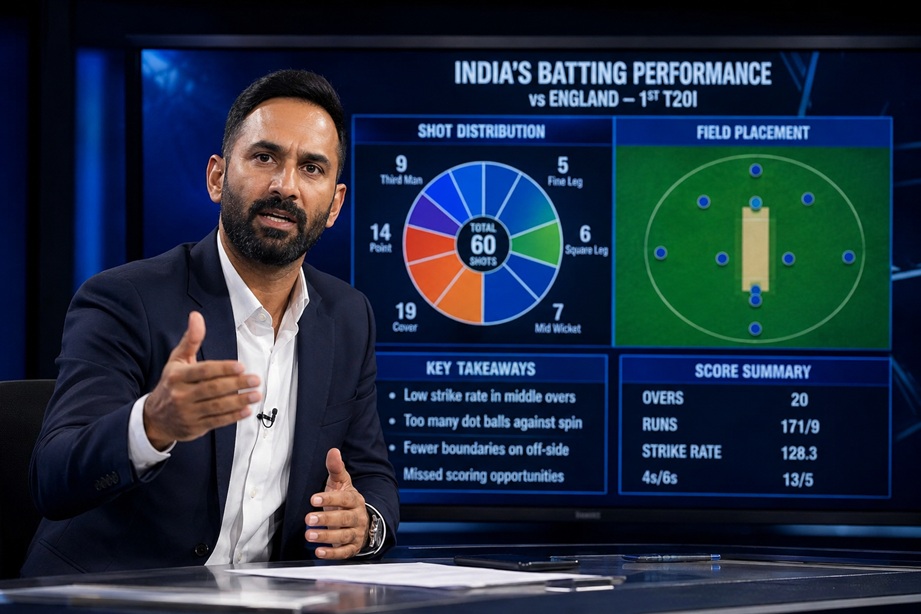
Reasons Dinesh Karthik Believed India Underperformed
India achieved a commendable score after choosing to bat first, but Karthik contended that the innings fell short of the expected acceleration that would typically follow a promising start.
He claimed that India should have advanced past the 210-run threshold when they were in a solid position. Instead, the middle order struggled to keep the run rate up as England’s bowlers intelligently adapted their strategies to the conditions.
Karthik noted that when a batting team reaches around 130 runs with a significant number of wickets in hand, the expectation is to make the most of the closing overs rather than simply settling for a satisfactory score. This failure to take advantage became one of the primary batting issues for India observed during the game.
Key Points
- India had a strong platform but failed to accelerate.
- The team was expected to cross the 210-run mark.
- Middle-order slowdown affected the final total.
- Failure to maximize the death overs became a major concern.
England Better Utilized Conditions Than India
One of Karthik’s main observations focused less on technique and more on game awareness.
Recognizing the Field Dimensions
Old Trafford posed a distinct challenge, as one boundary was much larger than the opposite one. England’s bowlers repeatedly compelled Indian batsmen to aim toward the longer side of the field while cleverly protecting the shorter boundary with strategic field placements.
Instead of allowing easy scoring chances, they consistently bowled into the batsmen’s pads, encouraging risky shots aimed at the larger boundary. This strategy slowed India’s scoring pace and escalated pressure on the middle order.
Karthik described this strategic awareness as a skill that Indian batsmen must acquire for successful performances consistently in foreign conditions.
Highlights
- Old Trafford had uneven boundary dimensions.
- England forced batters to target the longer boundary.
- Strategic field placements protected the shorter side.
- India’s scoring rate gradually slowed.
Wind Became Another Adversary
Another element Karthik brought up was the impact of wind during the innings.
The strong gusts made it increasingly challenging to clear the longer boundary, prompting batters to reconsider their shot options. England quickly grasped this and tailored their bowling strategies accordingly, while India persisted in looking for boundaries that increasingly evaded them.
This failure to adjust showcased yet another instance of the batting challenges India faced throughout the match.
Key Takeaways
- Wind conditions influenced shot selection.
- England adapted their bowling quickly.
- India struggled to modify their approach.
Middle Overs Lacked Momentum
India started off well with an attacking mindset from the top order, but maintaining that drive became challenging once the innings moved into its middle stages.
Abhishek Sharma initiated the innings with great enthusiasm, while Ishan Kishan served as a stabilizing presence. Nonetheless, post powerplay, England significantly reduced the scoring rate with their precise bowling and strategic field placements.
Shivam Dube Faced Challenges in Finding His Rhythm
Karthik remarked that Shivam Dube typically does not show discomfort against fast bowling in T20 matches, making his performance in this game particularly unexpected.
England effectively restricted his ability to hit in his favored zones, leading him to use crucial deliveries without achieving the explosive outcome that India anticipated. This delay placed additional stress on the batsmen who followed.
Important Observations
- England denied Dube access to his preferred hitting areas.
- Valuable deliveries were consumed without acceleration.
- Pressure shifted onto the following batters.
Tilak Varma Needed Time to Adjust
Though Tilak Varma managed to hit a few fours towards the end of the innings, he required considerable deliveries to find his groove.
This strategy may not pose a significant issue in longer formats, but T20 cricket often necessitates an immediate impact, especially during the final overs when each delivery gains heightened importance.
These instances contributed to reinforcing worries regarding India’s batting problems, especially when it is essential to accelerate against disciplined bowling.
Key Points
- Tilak Varma took time before attacking.
- Late acceleration is costly in T20 cricket.
- Every delivery becomes valuable in the closing overs.
Ishan Kishan’s Performance Traveled Beyond the Numbers
One statistic notably piqued Karthik’s interest.
Ishan Kishan, typically recognized for his aggressive batting, concluded his innings with 49 runs off 40 balls. While it seemed to be a valuable innings, Karthik argued that the strike rate indicated how well England executed their strategy.
Kishan generally scores at a faster pace, but England’s bowlers did a commendable job of preventing him from targeting the shorter boundary. Instead, they continuously forced him into challenging scoring positions throughout his time at the crease.
Karthik aimed to illustrate that even aggressive players can be hindered by strong tactical execution, rather than targeting Kishan alone.
This further exemplified his wider argument concerning India’s batting difficulties in unfamiliar playing settings.
Highlights
- 49 runs off 40 balls reflected England’s tactical success.
- Kishan was denied opportunities to exploit the shorter boundary.
- Tactical bowling neutralized an aggressive batter.
Batting Involves More Than Just Power
Contemporary T20 cricket favors powerful hitters; however, Karthik asserts that intellect is increasingly crucial.
Top-tier international teams consistently adjust to various factors such as:
- Playing conditions
- Boundary dimensions
- Wind direction
- Opponents’ tactics
Solely depending on aggressive intent does not suffice against skilled bowling teams that formulate comprehensive match strategies.
India has achieved remarkable success by playing fearless cricket in recent years, yet England demonstrated that strategic bowling can disrupt even the most explosive batting line-ups when conditions are effectively leveraged.
In Karthik’s perspective, addressing India’s batting challenges necessitates enhancing tactical awareness while simultaneously preserving an attacking mindset.
How England Effectively Carried Out Their Bowling Strategies
The bowlers from England warrant considerable praise for the manner in which they managed the match. Rather than depending solely on speed or swing, they created pressure by adhering strictly to clear strategies for each batsman. With each over appearing to serve a specific goal, whether it involved protecting the shorter side of the field, varying delivery speeds, or compelling Indian batsmen to play against the wind.
This focused approach hindered India’s ability to achieve the fluid and explosive finish that has become one of their primary advantages in T20 cricket. Instead of allowing runs with relative ease each over, England made sure that Indian batsmen had to exert considerable effort for nearly every chance to score. Such a consistent approach revealed more issues with India’s batting than many had predicted prior to the series.
Key Highlights
- England relied on clear bowling strategies instead of only pace or swing.
- Bowlers protected the shorter boundary effectively.
- Delivery variations and wind conditions were used tactically.
- India struggled to build momentum throughout the innings.
Intelligent Bowling in the Final Overs
The closing overs frequently determine the results of T20 games, and England undoubtedly excelled during this segment.
Their bowlers combined yorkers, slower balls, and well-placed short deliveries, rendering it challenging for India’s finishers to anticipate their next move. Rather than faltering under pressure, they maintained their composure and executed their strategies with exceptional precision.
Consequently, India accumulated fewer runs than expected in the concluding overs, even with wickets remaining. Those uncapitalized scoring chances ultimately alleviated the strain on England’s batting order as they approached the target.
Key Points
- Effective use of yorkers.
- Clever variations through slower balls.
- Accurate short-pitched deliveries.
- Calm execution under pressure.
- India failed to maximize the death overs.

Dinesh Karthik’s Insights for Indian Batsmen
Karthik’s assessment was not aimed at undermining India’s capabilities. Instead, he concentrated on the modifications needed to achieve consistent success across various global conditions.
He pointed out that the landscape of international cricket is becoming increasingly strategic, with teams dedicating vast amounts of time analyzing opponents and spotting vulnerabilities. Consequently, batsmen must anticipate several deliveries ahead rather than merely reacting once bowlers alter their tactics.
Some Essential Takeaways from Karthik’s Insights Include:
- Understanding boundary sizes before constructing an innings.
- Recognizing advantageous scoring zones early in the game.
- Consistently rotating the strike during less active periods.
- Steering clear of predictable shot choices against defensive field placements.
- Launching an offensive immediately when bowlers err in length.
While these represent relatively minor adjustments in isolation, collectively they can greatly boost India’s batting performance in matches outside their home ground.
Quickly Adjusting to Game Situations
A key emphasis from Karthik was the necessity for swift adaptation.
Successful batsmen at the international level continually evaluate conditions throughout their innings. When one scoring avenue is blocked, they promptly look for alternatives. England showcased this adaptability both in their bowling and batting, whereas India seemed slower to modify their tactics upon realizing that the longer boundary and the wind were influencing their larger hits.
This delay underscored another factor contributing to India’s batting struggles during the loss.
Highlights
- Successful players constantly reassess conditions.
- England adapted more quickly than India.
- The longer boundary and wind affected India’s approach.
- Delayed tactical changes increased batting pressure.
Why Foreign Conditions Continually Challenge India
India has evolved into one of the most formidable white-ball squads globally, yet challenges persist during overseas tours.
Pitches, climatic conditions, boundary dimensions, and gameplay environments frequently vary greatly from those encountered in India. Teams that adjust more swiftly typically secure the advantage, even when the individual talent levels appear evenly matched.
England has dedicated years to developing a T20 framework that prioritizes adaptability. Their players commonly modify their strategies based on the venue, their opponents, and the circumstances of the match instead of relying on a single, unchanging approach.
Karthik indicated that India has all the required skills but needs to enhance their adaptability if they wish to achieve consistent success outside of their home grounds. Tackling the issues within India’s batting lineup is more about refining decision-making in high-pressure situations than it is about altering the personnel on the team.
Key Factors
- Different pitch conditions.
- Changing weather.
- Varying boundary dimensions.
- Need for faster tactical adaptation.
- Better decision-making under pressure.
The Significance of Strike Rotation
Though boundaries draw the most focus in T20 cricket, singles and doubles often dictate whether stress intensifies or subsides.
England restricted effortless rotation for long stretches, compelling Indian batsmen to resort to risky shots as the innings progressed. When dot balls piled up, achieving the necessary acceleration became increasingly challenging.
Karthik pointed out that sustaining movement on the scoreboard holds equal significance to clearing boundaries. Consistent strike rotation prevents bowlers from falling into predictable patterns and opens up more chances for runs as the innings advances.
Important Points
- Singles and doubles reduce pressure.
- England restricted easy strike rotation.
- Dot balls forced riskier shots.
- Regular rotation creates more scoring opportunities.
Can India Recuperate Swiftly?
Even with the setback, there is minimal reason to panic.
India remains one of the strongest batting teams globally, boasting numerous players who can transform a match in a matter of overs. A single loss does not diminish the team’s recent achievements or its ongoing progress in limited-overs cricket.
Nonetheless, losing often presents meaningful learning experiences, and Karthik thinks this game provides several critical insights ahead of future overseas challenges.
The Coaching Team Will Probably Evaluate:
- Batting speed during the central overs.
- Selection of shots against defensive bowling strategies.
- Performance during the concluding five overs.
- Adjustment to evolving match conditions.
- Communication among batting partners in tense moments.
Enhancing these aspects could help resolve recurring issues within India’s batting lineup and render the batting unit even more lethal in forthcoming series.
Greater Challenges Lie Ahead
India’s international schedule is filled with prominent bilateral series and significant ICC competitions. Each encounter with top-ranking teams serves as vital preparation for those larger events.
England’s triumph serves as a reminder that the differences between elite teams are often quite narrow. A variation of just 15 to 20 runs or a few improved tactical choices can entirely alter the result.
Karthik’s insights therefore go beyond a single loss. They initiate a larger dialogue about how contemporary T20 batting is continually progressing and why being adaptable has become as crucial as sheer power.
As India gears up for their future matches, the emphasis will likely stay on resolving India’s batting dilemmas through more strategic planning, heightened awareness, and enhanced execution during critical moments of the innings.
Learning From Defeat Can Strengthen the Team
Exceptional teams are recognized not merely by their celebratory moments after wins, but by their reactions to failures. The recent defeat of India against England revealed aspects that need enhancement, while simultaneously offering significant reflections on what the squad can enhance before larger tournaments.
The batting lineup has consistently proved its capability to chase down challenging targets and achieve match-winning figures against elite bowling attacks. This history indicates that the necessary talent is already present. The current objective is to improve strategic choices under diverse situations, particularly as foreign pitches and distinct ground dimensions require a different strategy.
Past players and analysts have frequently highlighted that the ability to adapt swiftly is a key characteristic of successful international cricketers. England demonstrated this flexibility throughout the match by modifying their bowling lengths, field configurations, and speed variations based on the circumstances. Conversely, India sometimes seemed overly focused on pre-determined shots instead of adjusting to the demands of the game.
Another positive takeaway for India is that many of these deficiencies are fixable. Enhanced communication among batting partners, better understanding of boundary dimensions, and clever strike rotation could result in a significant improvement without needing drastic alterations to the squad. These are aspects that improve through experience, preparation, and ongoing education.
Emerging players in the team will also gain from encounters like these. Competing against high-quality teams in tough situations aids development much more than easy victories. The knowledge acquired from this series can contribute toward better decision-making in future tense situations.
Key Takeaways
- India already possesses the required batting talent.
- Better strategic decision-making is needed in overseas conditions.
- Adaptability remains a key quality of successful international teams.
- Improved communication, strike rotation, and awareness of boundary dimensions can strengthen the batting unit.
- Tough matches provide valuable experience for emerging players.
The Road Ahead for India’s Batting Line-up
It is unlikely that India’s management will have an excessive reaction to a single loss, but there will certainly be dialogues about ways to enhance the effectiveness of the batting lineup in overseas conditions.
The coaching team will likely prioritize training sessions based on scenarios where batters can practice adjusting to various field arrangements, differing wind conditions, and assorted boundary sizes. Such training helps players to make instinctive decisions during games instead of relying purely on set strategies.
Maintaining an aggressive attitude will still be crucial, but contemporary T20 cricket increasingly favors teams that mix offensive intent with strategic intelligence. The most successful batting units understand when to take intelligent risks and when to keep the scoreboard active through smart placements and swift running between the wickets.
As India prepares for future international challenges, the insights gained from this loss may hold more significance than the final outcome. If the players successfully adopt the changes recommended by Dinesh Karthik, the team will be better positioned to face similar obstacles in upcoming encounters.
Areas the Coaching Team May Prioritize
- Practicing against different field arrangements.
- Adjusting to varying wind conditions.
- Understanding different boundary sizes.
- Improving instinctive decision-making.
- Combining aggressive intent with strategic intelligence.
- Enhancing running between the wickets.

Conclusion
Dinesh Karthik’s analysis after the match went beyond assigning blame to individual players. He focused on how contemporary T20 cricket is deeply affected by strategic awareness, the ability to adapt, and comprehension of playing conditions. His remarks underscored that England triumphed not just through skill, but also through the execution of their plans.
India continues to have one of the most formidable batting line-ups in global cricket, and a single loss does not reduce the strength of the team. Nonetheless, this match acted as a timely reminder that international cricket often hinges on narrow differences, where clever choices can hold equal weight to strong shots.
If the players take lessons from these situations and adjust more successfully in future international matches, the conversation surrounding India’s batting problems might quickly transition from negative feedback to positive acknowledgment. With a skilled roster of batsmen and a seasoned coaching team, India has every chance to recover more resiliently and transform this defeat into an essential learning opportunity for the upcoming challenges.
Final Key Points
- Dinesh Karthik emphasized strategy over individual criticism.
- England succeeded through excellent planning and execution.
- India remains one of the strongest batting teams in world cricket.
- Better adaptability and game awareness can improve future performances.
- This defeat can become an important learning opportunity for upcoming international competitions.