

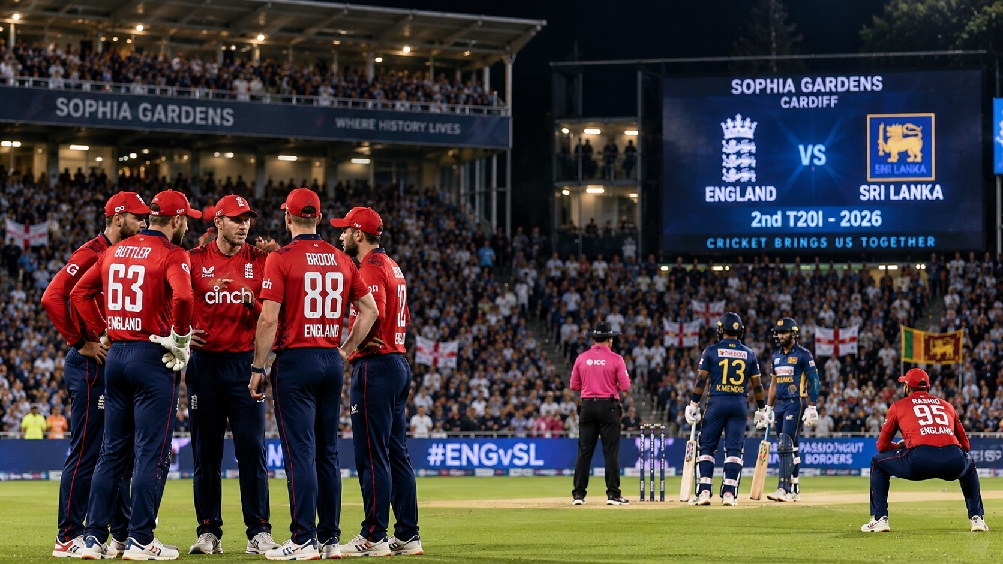
The upcoming second encounter in the three-match T20I series between England and Sri Lanka will take place at Sophia Gardens in Cardiff on Thursday, September 17, 2026. England steps onto the field with a 1-0 lead after delivering one of their most dynamic T20 displays lately in Southampton.
The initial match was not just an easy victory. England amassed 254 runs for 4 wickets in their 20 overs, while Sri Lanka was bowled out for 135 in just 19 overs, resulting in a 119-run triumph. Harry Brook‘s outstanding 114 not out off 49 deliveries was the standout performance, complemented by Jos Buttler‘s contribution of 80 runs from 44 balls. Sonny Baker also made significant contributions with the ball, claiming three wickets while conceding only 12 runs.
That outcome provides England with positive momentum, but the second match will pose a different test. Transitioning from Southampton to Cardiff requires both teams to promptly adapt to a new venue, a different evening, and possibly altered match conditions.
For Sri Lanka, the task is clear: enhance their batting performance, exert pressure on England from the outset, and avoid allowing the home team to set another substantial foundation.
For England, the objective will involve sustaining their aggressive style while possibly offering chances to players vying for positions and roles within a well-stocked white-ball lineup.
Thus, the England vs Sri Lanka 2nd T20I carries significant implications, even before the series culminates in its concluding match in Manchester.
England Lead the Series After a One-Sided Opener
England has embarked on the series with a great deal of self-assurance.
In Southampton, Sri Lanka elected to field after winning the toss. That choice quickly became difficult to defend as England’s top order launched an assault on the bowling from the start. Buttler provided the experienced backbone, while Brook propelled the innings with remarkable acceleration.
England amassed a total of 254/4, significantly bolstered by a 128-run partnership between Brook and Buttler. Brook finished not out on 114 from 49 balls, hitting 10 fours and six sixes, and achieved his century in a mere 42 balls.
Sri Lanka struggled to find their rhythm during the chase. Ultimately, they concluded at 135, losing all ten wickets in 19 overs.
Dunith Wellalage stood out as one of the rare Sri Lankan batsmen to show considerable resistance, but by that point, the target was already too steep. England’s bowlers consistently took wickets at important moments, with Sonny Baker being particularly effective.
As a result, the upcoming England vs Sri Lanka 2nd T20I will take place with England holding a 1-0 advantage in the three-match series.
For Sri Lanka, this makes Thursday’s match especially crucial. A second loss would allow England to secure the series prior to the final game.
Match Details: Cardiff Takes Centre Stage
The second T20I will occur at Sophia Gardens in Cardiff, one of the renowned international cricket venues in Wales.
The schedule released by Sri Lanka Cricket confirms that the second T20I is set for September 17, with the match commencing at 6:30 PM local time. The time for India is 11:00 PM IST.
England vs Sri Lanka 2nd T20I Match Details
- Date: Thursday, September 17, 2026
- Venue: Sophia Gardens, Cardiff
- Local start: 6:30 PM
- India start: 11:00 PM IST
- Series: Sri Lanka tour of England 2026
- Format: T20 International
- Series position: England leads 1-0
The schedule for the series was revealed as part of Sri Lanka’s six-match white-ball visit to England, featuring three T20 matches followed by three One Day Internationals.
Sophia Gardens serves as the home ground for Glamorgan and is situated alongside the River Taff. This venue has previously hosted international cricket events under artificial lighting and has successfully managed numerous high-stakes limited-overs games.
That environment should create an intriguing contrast to the first match held in Southampton.
Why Harry Brook Is the Player Everyone Will Watch
The key narrative heading into the second T20I between England and Sri Lanka centers on Harry Brook.
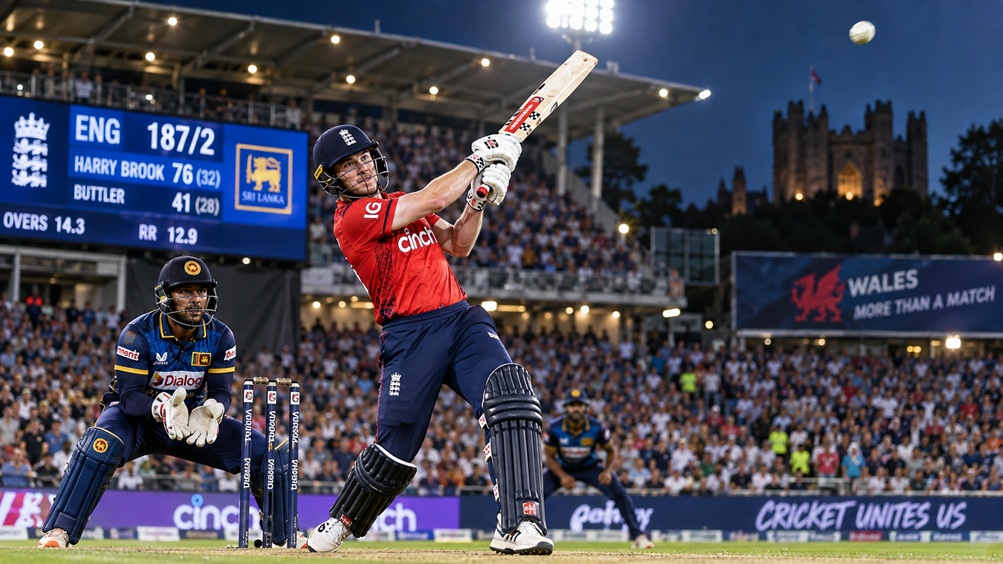
The captain of England delivered an impressive performance in the first match, scoring an unbeaten 114. This was his second T20I century of the calendar year, dramatically influencing England’s final score.
Brook’s performance stood out not only for the runs he accumulated but also due to his aggressive approach, as he consistently targeted the bowling with powerful shots and swift running between the wickets.
As reported by Reuters, Brook’s century was part of a 128-run partnership with Buttler, assisting England in reaching a score of 254/4.
His recent performances in T20 matches provide England with another significant benefit: bolstered confidence in their middle order.
Brook has been batting at No. 3, a position where his skill to evaluate the situation before accelerating is incredibly beneficial. The Guardian mentioned that he entered the opening match with impressive statistics for that position and maintained that performance against Sri Lanka.
Can Sri Lanka Find a Way to Contain Brook?
This poses one of the main strategic challenges.
Sri Lanka must not allow Brook the same freedom he had in Southampton. The bowlers should vary their pace, switch angles, and avoid delivering balls in zones where he can unleash powerful shots.
The difficulty lies in the fact that overly focusing on Brook could provide avenues for other England batsmen to capitalize.
This was evident with Buttler’s score of 80 in the first match. If Sri Lanka devises their strategy solely around Brook, England is still equipped with numerous seasoned and aggressive players who can potentially shift the game’s momentum.
Jos Buttler Adds Another Major Threat
While Brook garnered most of the attention, Buttler’s performance was equally crucial to England’s impressive score during the first innings.
The opener for England accumulated 80 runs off just 44 balls, contributing the necessary stability and speed that enabled Brook to launch his attack later in the innings. Their partnership significantly alleviated the pressure on England’s middle order.
Buttler’s presence also allows for tactical versatility for England.
Having played ample international T20 matches, he knows when to speed up the innings and when the batting side should regroup. With Brook positioned at No. 3, England has the potential for one batsman to aggressively score while another controls the pace of the game.
This combination presents a tough challenge for opposing bowlers to manage.
Thus, Sri Lanka will need to start strong with the ball instead of waiting for England’s middle order to come into play.
Sri Lanka Requires a Much Improved Batting Strategy
The primary issue for Sri Lanka following the initial match was not merely the extent of their loss.
It was the way the chase unfolded.
After England set a target of 254, Sri Lanka required a remarkable beginning. Instead, they lost wickets frequently, leading to an increasingly unattainable required run rate.
Ultimately, the visitors ended with a score of 135, which left them 120 runs behind England’s score before considering the one-run difference from the official verdict. The scoreboard illustrates the situation: England posted 254/4, whereas Sri Lanka was all out for 135.
Sri Lanka now requires a more strategic batting approach.
They do not have to pursue runs aggressively from the very first ball. They require solid partnerships.
If a couple of experienced batsmen can endure through the powerplay, it could alter the match’s dynamics. Should Sri Lanka reach the middle overs with wickets intact, their aggressive players can aim for the smaller boundaries and exploit the less effective bowling matchups.
Charith Asalanka’s Role Will Be Crucial
Charith Asalanka captains Sri Lanka in this T20I series, a responsibility that grows in significance following the initial loss.
The skipper must find the right balance between aggression and caution. Facing an England team that scored 254, the inclination may be to counterattack with equally bold batting.
However, T20 matches usually favor teams that effectively manage their resources.
Sri Lanka requires their experienced batsmen to remain engaged for extended periods, making it challenging for the English bowlers.
Sonny Baker Has Introduced An Additional Element
While England’s batting received significant attention in Southampton, Sonny Baker‘s bowling also warrants recognition.
The young fast bowler achieved figures of 3/12, aiding England in stopping Sri Lanka from gaining any substantial momentum during their chase.
Baker’s performance is notable as England has several well-established bowling options at their disposal.
The squad confirmed by the ICC consists of Jofra Archer, Gus Atkinson, Sonny Baker, Saqib Mahmood, Josh Tongue, Adil Rashid, Liam Dawson, and Jamie Overton.
This depth enables England to choose combinations tailored to the conditions and workload.
Thus, the second T20I between England and Sri Lanka could present another chance to observe how England utilizes their bowling assets.
Baker’s showing in the first match has sparked a discussion about selection. When a younger player excels in an international game, the coaching staff must decide whether to keep the same lineup or rotate players.
England’s Squad Features A Lot of Competition
England’s T20I team is a blend of seasoned players and emerging talent.
Harry Brook serves as captain, while Buttler brings a wealth of experience. The team also features Will Jacks, Tom Banton, Jordan Cox, Liam Dawson, Jamie Overton, Adil Rashid, and various fast-bowling options.
Aneurin Donald stands out as an intriguing choice for the T20I series. He received his first call-up and opened the batting with Buttler in the opening match, stepping in for Phil Salt, who was injured.
This introduces a significant secondary narrative.
England is not solely focused on achieving victory in a bilateral series. They are also working on creating partnerships and evaluating players for the extended white-ball period.
The second match could indicate if the management favors consistency following the dominant initial performance or sees merit in making changes.
Sri Lanka’s Bowling Attack Faces a Huge Test
The bowlers from Sri Lanka were subjected to significant stress in Southampton.
Once Brook and Buttler formed their partnership, the bowling unit faced difficulties in curbing the scoring pace. England’s total of 254/4 highlighted that issue clearly.
The Sri Lankan squad features both seasoned and young athletes, but the match in Cardiff will demand greater discipline.
Effectively bowling to Brook and Buttler necessitates a well-defined strategy. Full deliveries might go for boundaries through the gaps or directly down the pitch, while easily predictable short balls can be punished with pulls or hooks.
The bowlers must utilize the crease wisely and adjust their lengths without compromising their lines.
The First Six Overs Could Set the Tone
The initial six overs for powerplay bowling could be the most crucial stage for Sri Lanka.
Should England post another substantial score in the first six overs, the pressure would swiftly shift back onto the visiting team.
On the other hand, securing two or three quick wickets might compel England’s middle order to focus on stabilizing rather than launching continual attacks.
That is why the first six overs could reveal more regarding the second game than the final score of the first match.
What Should We Expect From Sophia Gardens?
Sophia Gardens can deliver exciting limited-overs cricket, and its location in Cardiff makes it a well-known international venue for England.
The ground has hosted matches under lights and is renowned for producing competitive white-ball encounters. According to Cricbuzz’s venue details, Glamorgan is the home side and it has floodlights available.
However, any pitch assessment should be seen as a part of the match-day evaluation rather than an assurance.
Conditions can be affected by preparation, weather, moisture levels, and the behavior of the surface during the evening.
For fantasy enthusiasts and those following the match, the toss and confirmed playing XIs will be key pieces of information before the game kicks off.
Team News and Selection Watch
England began the series with a T20I squad consisting of 16 players.
The ICC named Harry Brook as captain and included players like Jofra Archer, Gus Atkinson, Sonny Baker, Tom Banton, Jos Buttler, James Coles, Jordan Cox, Liam Dawson, Aneurin Donald, Ben Duckett, Will Jacks, Saqib Mahmood, Jamie Overton, Adil Rashid, and Josh Tongue in the lineup.
Due to injuries, Sam Curran and Phil Salt were not available for the series, while Jacob Bethell was undergoing rehabilitation following knee surgery.
Sri Lanka also faces decisions regarding team selection.
Kusal Mendis was reported as unavailable for the T20I series, while Charith Asalanka is the captain of the squad.
Therefore, the confirmed XI should be verified close to the toss since squad lists do not necessarily reflect the final playing team.
What Sri Lanka Must Change
Sri Lanka cannot simply apply the same tactics from the opening match and expect a different result.
The primary area for enhancement must come from strengthening batting partnerships.
Instead of permitting England’s bowlers to control the innings, Sri Lanka needs to seek out measured scoring methods during the powerplay and then target particular bowlers through the middle overs.
Their bowling strategy also requires more diversity.
Against an England team capable of scoring more than 250 runs, every delivery is crucial. A single costly over can significantly alter the target, especially if it features several boundaries.
Sri Lanka’s fielding performance will also be key. Facing a team that excels in aggressive running and hitting boundaries, any missed chances can become very costly fast.
What England Will Aim to Enhance
It may appear odd to discuss improvements following a 119-run win; however, there are still aspects that England needs to address.
The initial partnership could be improved, opportunities for middle-order batsmen need to be created, and the bowling unit must continue to exhibit discipline.
The first match illustrated just how quickly a T20 game can turn unbalanced when England’s batting gains momentum.
England’s objective is to maintain their intensity while avoiding any lapses in focus.
The upcoming game may also serve as an opportunity to experiment with different combinations. With three T20 matches followed by three ODIs lined up during the tour, England’s schedule is quite demanding. The series itinerary has the third T20 match set for September 19, prior to the ODI series that kicks off on September 22.
This makes it essential to manage workloads, especially for fast bowlers.
Five Key Matchups That Could Influence the Game
The second T20I between England and Sri Lanka features several individual matchups that are worth observing.
1. Harry Brook vs Sri Lanka’s Pace Bowlers
Brook comes into this match after scoring an unbeaten 114. Sri Lanka’s bowlers will aim to stop him from crafting another lengthy innings.
2. Jos Buttler vs the Opening Bowlers
Buttler’s performance of 80 in the first match showed the impact of a strong start for England. Dismissal of him early could significantly disrupt England’s batting flow.
3. Sri Lanka’s Top Order vs England’s Powerplay Bowlers
Sri Lanka cannot afford another sluggish or shaky start. Their opening batsmen must withstand pressure while ensuring the runs keep flowing.
4. Sonny Baker vs Sri Lanka’s Middle Order
After claiming three wickets in the first match, Baker will be in the spotlight. The Sri Lankan batsmen will need to avoid allowing him to get into another economical spell.
5. Adil Rashid vs Sri Lanka’s Right-Handed Batsmen
Rashid’s knowledge during the middle overs provides England with another tool for managing the innings. Sri Lanka will need to handle his overs with care instead of letting him control the pace.
Series Context Renders Cardiff Significant
The second T20I between England and Sri Lanka holds greater significance as the series stands at 1-0.
England requires one additional win to clinch the three-match T20I series.
On the other hand, Sri Lanka must secure a victory in Cardiff to keep their hopes alive for the final match in Manchester.
The third T20I is designated for September 19 at Emirates Old Trafford, with the match set to start at 2:30 PM local time according to the announced series schedule.
This adds a distinct significance to the second match compared to the first.
For England, it represents a chance to conclude the T20I series ahead of time.
For Sri Lanka, this represents an opportunity to recalibrate their strategy before the concluding match.
Live Score and Match Updates
Supporters keeping track of the England versus Sri Lanka second T20I should anticipate a variety of live-match highlights: the results of the toss, official team line-ups, powerplay scores, wickets taken during the middle overs, and the final runs scored.
The match is set to commence at 6:30 PM in Cardiff, equating to 11:00 PM in India.
As the contest is being held in the evening, the toss may influence strategic choices. Nonetheless, the true effect will rely on the conditions and pitch specifics during that time.
Instead of presuming that the second match will mirror the events at Southampton, audiences are encouraged to observe the first several overs to assess the pitch’s characteristics.
Why This Match Might Be Very Distinct From the Previous One
In the initial game, England exhibited an outstanding batting performance.
Yet, outcomes in T20 cricket seldom replicate precisely.
Sri Lanka is now aware of the threat posed by England’s aggressive top-order batsmen. Their bowlers have had the opportunity to analyze the first innings, pinpoint scoring opportunities, and devise alternative strategies.
On the other hand, England has no compelling reason to alter their fundamental approach following such a resounding victory.
This results in a fascinating tactical dynamic.
Sri Lanka will likely arrive in Cardiff with ambitions for improvement, while England will approach the match buoyed by their series lead.
The initial match also highlighted that England has numerous methods to challenge Sri Lanka. If Brook is not in form, Buttler certainly can take charge. Should the opening pair falter early, the middle order includes players who can speed up the scoring later. With Rashid, Baker, and their other bowlers available, England holds various options.
Therefore, Sri Lanka must deliver a well-rounded performance instead of depending on a single standout player.
Final Preview
The second T20I between England and Sri Lanka takes place at a pivotal moment in the 2026 white-ball series.
England has already showcased their offensive capabilities. Their score of 254/4 at Southampton featured Brook’s remarkable unbeaten 114 and Buttler’s 80, along with Baker’s vital three wickets that decisively concluded the match.
Sri Lanka’s reaction will be the central focus in Cardiff.
The visiting team must form stronger batting partnerships, exhibit more disciplined bowling, and find a way to stop England’s top scorers from taking control of the game.
Additionally, the venue introduces a new factor. Sophia Gardens will offer a different pitch and atmosphere, suggesting that the second game should be regarded as a separate contest rather than just a continuation of the Southampton encounter.
For England, a victory would secure the T20I series with one match still to play.
For Sri Lanka, a win would equalize the series and bring the contest to Manchester.
With Brook taking the field after delivering one of the most impressive T20 innings of his international journey, Buttler offering seasoned firepower, and Sri Lanka seeking to bounce back, Cardiff is set for a captivating second chapter in the series.
The crucial question has shifted from whether England can score rapidly; they have already proven they can do that.
The concern is if Sri Lanka has the ability to interfere with that flow soon enough to force England to perform under tension.
The response will start to take shape when the two squads face off at Sophia Gardens on September 17.