

Japan vs India Women Scorecard: The scorecard from the quarter-final match between Japan and India Women at the 2026 Asian Games illustrates a lopsided encounter where India Women displayed exceptional bowling before swiftly overcoming a modest run target.
On September 18, 2026, at Korogi Sports Park in Nisshin, India triumphed over Japan Women by 8 wickets. Japan was dismissed for a mere 57 runs in 19.5 overs, setting a target of 58 runs for India. The defending champions of the Asian Games required just five overs to achieve 59/2, finishing with 90 balls remaining.
Though the final outcome was by eight wickets, the most notable element was the contrasting scoring rates in the two innings. Japan took nearly the entire 20 overs to accumulate 57 runs, while India surpassed that score in just five overs.
Sree Charani was instrumental in limiting Japan’s score, posting impressive bowling stats of 4 wickets for 10 runs. Following that, Shafali Verma contributed a blistering unbeaten 40 from only 15 balls, making the chase look rather simple.
Japan Women vs India Women
Asian Games 2026 • 4th Quarter-final • September 18, 2026
India Women won by 8 wickets
India chased 58 runs in just 5 overs, with 90 balls remaining.
Japan Women — 57 All Out
19.5 Overs • Run Rate 2.87
| Batter | Dismissal | R | B | 4s | 6s | SR |
|---|---|---|---|---|---|---|
| Haruna Iwasaki | c Shafali Verma b Sree Charani | 10 | 22 | 1 | 0 | 45.45 |
| Ayaka Kato-Stafford | c G Kamalini b Shafali Verma | 25 | 47 | 2 | 0 | 53.19 |
| Mai Yanagida | c Richa Ghosh b Sree Charani | 0 | 1 | 0 | 0 | 0.00 |
| Erika Oda | c Shreyanka Patil b Deepti Sharma | 5 | 14 | 0 | 0 | 35.71 |
| Shimako Kato | c Harmanpreet Kaur b Shafali Verma | 3 | 10 | 0 | 0 | 30.00 |
| Akari Nishimura | c Bharti Fulmali b Sree Charani | 2 | 9 | 0 | 0 | 22.22 |
| Hinase Goto | Run out | 1 | 1 | 0 | 0 | 100.00 |
| Ahilya Chandel | Run out | 0 | 2 | 0 | 0 | 0.00 |
| Ayumi Fujikawa NOT OUT | — | 4 | 6 | 0 | 0 | 66.67 |
| Erika Toguchi-Quinn | c Shafali Verma b Sree Charani | 0 | 2 | 0 | 0 | 0.00 |
| Nonoha Yasumoto | b Shreyanka Patil | 0 | 5 | 0 | 0 | 0.00 |
| Extras | LB 2, WD 5 | 7 | — | — | — | — |
| TOTAL | 57/10 (19.5 Overs) | |||||
| Bowler | O | M | R | W | Eco |
|---|---|---|---|---|---|
| Kranti Gaud | 2 | 0 | 4 | 0 | 2.00 |
| Nandani Sharma | 2 | 0 | 6 | 0 | 3.00 |
| Sree Charani | 4 | 2 | 10 | 4 | 2.50 |
| Shreyanka Patil | 3.5 | 0 | 8 | 1 | 2.08 |
| Deepti Sharma | 4 | 0 | 14 | 1 | 3.50 |
| Shafali Verma | 4 | 0 | 13 | 2 | 3.25 |
India Women — 59/2
5.0 Overs • Run Rate 11.80
| Batter | Dismissal | R | B | 4s | 6s | SR |
|---|---|---|---|---|---|---|
| Shafali Verma NOT OUT | — | 40 | 15 | 6 | 2 | 266.67 |
| G Kamalini | c Ahilya Chandel b Nonoha Yasumoto | 0 | 2 | 0 | 0 | 0.00 |
| Bharti Fulmali | c Shimako Kato b Ayaka Kato-Stafford | 6 | 7 | 1 | 0 | 85.71 |
| Richa Ghosh NOT OUT | — | 12 | 6 | 2 | 0 | 200.00 |
| Extras | WD 1 | 1 | — | — | — | — |
| TOTAL | 59/2 (5.0 Overs) | |||||
| Bowler | O | M | R | W | Eco |
|---|---|---|---|---|---|
| Ahilya Chandel | 1 | 0 | 17 | 0 | 17.00 |
| Nonoha Yasumoto | 2 | 1 | 8 | 1 | 4.00 |
| Ayaka Kato-Stafford | 1 | 0 | 14 | 1 | 14.00 |
| Shimako Kato | 1 | 0 | 20 | 0 | 20.00 |
Japan vs India Women Scorecard 2026: Match Overview
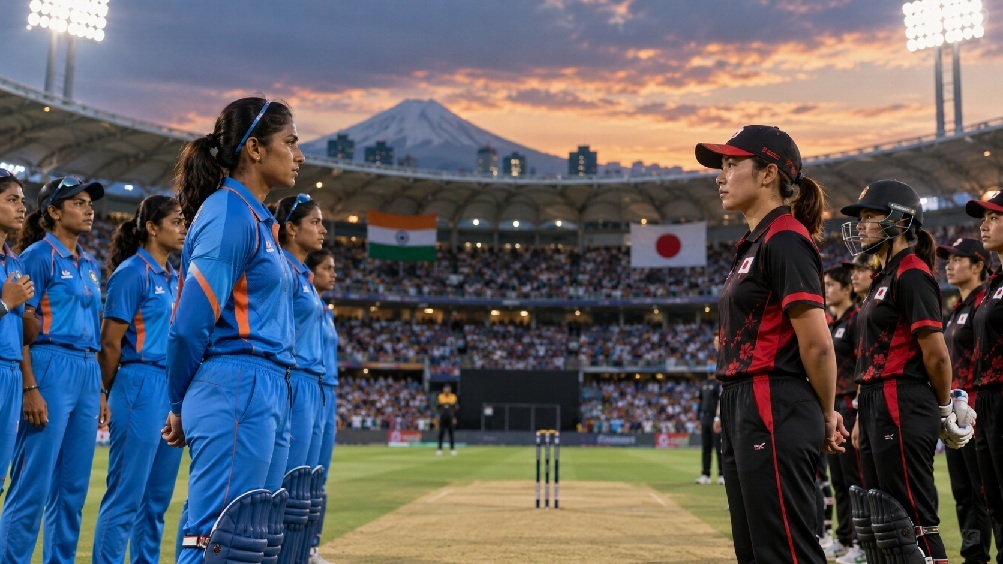
The quarter-final occurred on September 18 at Korogi Sports Park in Nisshin, Japan, marking it as the fourth quarter-final in the women’s cricket tournament at the 2026 Asian Games.
As the reigning champions, India entered the knockout phase with high expectations. They had triumphed in the 2022 Asian Games held in Hangzhou and arrived in Japan with a lineup of both seasoned international players and promising younger individuals.
Conversely, Japan played on their home turf, seizing the chance to gauge their emerging women’s cricket program against one of the top teams in the realm of women’s cricket.
India won the toss and opted to field first.
This decision quickly proved advantageous.
Japan’s batters found it challenging to create scoring chances against India’s tight bowling lineup. Runs came at a sluggish pace, partnerships were regularly disrupted by lost wickets, and Japan failed to generate the late-game surge often anticipated in a T20 match.
When the innings concluded, Japan had only managed 57 runs.
India’s reply was remarkably different.
Initially, the target of 58 seemed small, but the rapid pace at which India achieved it made the disparity even clearer. Although they lost two wickets early on, India managed to reach 59/2 within five overs.
Thus, the scorecard for Japan vs India Women illustrates the stark contrast between two innings: one lengthy and challenging for Japan, followed by a quick and aggressive pursuit by India.
Match details
Key facts from the quarter-final match include:
- Date: September 18, 2026
- Venue: Korogi Sports Park, Nisshin, Japan
- Competition: Asian Games 2026 Women’s Cricket
- Stage: Fourth Quarter-final
- Japan Women: 57 all out in 19.5 overs
- India Women: 59/2 in 5 overs
- Result: India Women won by 8 wickets
- Player of the Match: Sree Charani
India’s triumph secured their spot in the semi-finals, continuing their quest to retain the women’s cricket gold medal.
Japan Women Face Challenges in Accumulating Runs
The brevity of the match can be attributed primarily to Japan’s innings.
Upon being invited to bat first, Japan struggled to find a rhythm against India’s bowling unit. The Indian bowlers consistently applied pressure throughout the innings, preventing Japan from forming the necessary partnerships to set a formidable score.
Ayaka Kato-Stafford emerged as Japan’s top scorer. She accumulated 25 runs from 47 balls, including a couple of boundaries.
Her performance lent Japan some degree of steadiness, yet the slow pace of scoring kept the team under ongoing strain.
Haruna Iwasaki was the sole other Japanese batter to cross into double digits, contributing 10 runs off 22 balls.
The rest of the batting lineup had difficulty making meaningful contributions.
Japan’s failure to generate regular boundaries was particularly significant. In T20 cricket, teams typically need to accelerate their scoring at certain intervals to offset less productive overs. Japan could not uncover such opportunities against India.
Instead, the team lost wickets, which continuously disrupted their innings.
Consequently, they managed to post only 57 runs, with Japan bowled out on the second-to-last ball of the 20th over.
Ayaka Kato-Stafford Offers Resistance
Kato-Stafford’s 25 runs represented the most notable contribution from Japan.
She spent 47 deliveries at the crease, accounting for a considerable portion of Japan’s total score. Although her innings couldn’t alter the match’s course, it provided Japan with some much-needed stability during an otherwise tough batting display.
The crucial issue lay in the absence of a secondary significant partnership.
When a team scores below three runs an over over the majority of a T20 innings, it becomes exceedingly hard to make up for lost time later. Japan was unable to find the necessary momentum to shift from a defensive approach to an aggressive one.
India’s bowlers deserve acknowledgment for their performance.
They consistently limited Japan’s scoring opportunities, ensuring that even the more extended partnerships failed to evolve into substantial accumulations.
Sree Charani Achieves a Four-Wicket Haul
The Japan against India Women Scorecard emphasizes Sree Charani’s role as a crucial factor in the match.
Charani bowled four overs, yielding just 10 runs and capturing four wickets.
Her figures of 4/10 represented the best bowling performance of the quarter-final and were pivotal in restricting Japan to 57 runs.
Her performance was especially critical as Japan was already having difficulties scoring freely. Every wicket presented an opportunity for India to increase the pressure.
Charani eliminated key Japanese batters throughout the innings, including Haruna Iwasaki, captain Mai Yanagida, and Akari Nishimura.
India also benefitted from Shafali Verma‘s contributions, who secured two wickets for 13 runs in her four overs.
Deepti Sharma and Shreyanka Patil also took wickets, allowing India to maintain dominance.
Thus, the bowling display wasn’t reliant on a singular moment. India collectively applied pressure, with Charani’s impressive figures standing out.
The Importance of Charani’s Bowling Spell
A four-wicket haul gains notable significance when paired with economical bowling.
Charani allowed only 10 runs over four overs, creating limited chances for Japan to relieve the pressure.
As a result, Japan could not maintain wickets for a final push.
In a T20 match, the last five overs can significantly elevate a mediocre score into a more formidable one. Japan, however, never got that chance.
India’s bowling attack had already established dominance.
India Begins the Pursuit with Two Quick Outs
India’s pursuit did not start ideally.
G Kamalini was out for a duck after just two balls faced.
This situation presented Japan with a fleeting chance to build pressure. India had already lost an opening batsman without any runs and still faced a target to reach.
Nonetheless, Shafali Verma quickly altered the tone of the match.
Bharti Fulmali came in next but was dismissed for six runs off seven balls. India’s score was now 24/2.
At this juncture, Japan had taken down two Indian batswomen and might have thought they could prolong the game.
Instead, Shafali initiated a remarkable counter-offensive.
She ended up unbeaten with a score of 40 from a mere 15 balls, hitting six fours and two sixes.
Her strike rate of 266.67 highlighted the aggressive nature of her batting during the chase.
Shafali did not allow the run requirement to force a cautious mindset; instead, she attacked the bowlers, consistently finding boundaries.
Richa Ghosh then contributed significant support at the end.
She scored 12 not out from six balls, which included two fours.
The duo ensured that India surpassed the target within just five overs.
Shafali Verma Turns a Minor Target into a Frenzy
The scorecard for the Japan vs India Women‘s match cannot be reviewed without acknowledging Shafali Verma‘s outstanding performance.
India needed a mere 58 runs, but Shafali’s aggressive strategy made the target appear negligible almost instantly.
She was responsible for 40 of India’s 59 total runs.
More notably, she achieved this in only 15 balls.
The six fours and two sixes accounted for 36 runs coming solely from boundaries.
This represents an exceptional ratio in an innings, especially in a knockout context.
Shafali’s performance illustrated the effectiveness of aggressive batting during the powerplay when chasing a small total.
India had no reason to hold wickets back for an extended innings. The target was low enough for the batspersons to take calculated risks right from the start.
Japan’s bowlers thus had little margin for mistakes.
A few loose deliveries rapidly turned into boundaries.
Once Shafali found her rhythm, stopping the chase became increasingly challenging.
Richa Ghosh Wraps Up the Chase
Richa Ghosh played a crucial supporting role.
Her not out 12 came off just six balls, giving her a strike rate of 200.
With Shafali aggressively batting from one end, Richa was not required to play a lengthy innings. Her role was simply to maintain the scoring pace and seize opportunities when they arose.
The two finished the chase in a mere five overs.
India’s final tally was 59/2.
Five Overs That Altered the Match
India’s pursuit stands out as one of the most remarkable statistical features of the game.
The squad needed 58 runs.
Rather than opting for a cautious tactic, India racked up runs at an impressive rate of 11.80 runs per over, finishing the pursuit in precisely five overs.
This indicates that India’s scoring was over four times that of Japan’s rate during the encounter.
The disparity becomes even more evident when examining the duration of the innings.
Japan played for 19.5 overs.
India had a batting time of five overs.
Japan struggled to accumulate 57 runs over nearly the full innings, while India exceeded that score in just a quarter of the usual T20 time frame.
This was not merely a straightforward win.
The match illustrated how the two sides operated at entirely different speeds of scoring.
The scorecard for the Women’s match between Japan and India highlights India winning with 90 balls to spare, a statistic that underscores the rapidity of their chase.
The key statistical divergence
Japan:
57 all out in 19.5 overs
India:
59/2 in 5 overs
Japan’s rate of scoring was around 2.87 runs per over.
India’s rate was an impressive 11.80 runs per over.
These numbers provide a clearer understanding of the eight-wicket victory beyond just the difference in runs.
India’s Bowling Maintained Pressure on Japan
India’s triumph began with their bowling performance.
The bowling unit consistently thwarted Japan’s attempts to score quickly, leaving the batting side struggling to find chances.
Sree Charani‘s figures of 4/10 were particularly noteworthy, but the rest of the bowling unit contributed significantly as well.
Shafali Verma‘s 2/13 provided India with another potent option, while Deepti Sharma and Shreyanka Patil also took wickets.
The pressure was especially noticeable during the middle overs for Japan.
While Japan needed to devise ways to rotate the strike and eventually speed up their scoring, the Indian bowlers consistently restricted scoring chances.
The lack of substantial partnerships meant Japan was perpetually attempting to rebuild.
This predicament poses a challenge in T20 cricket.
Every new batter requires time to acclimate, but Japan lacked sufficient scoring traction to withstand those adjustment phases.
By the latter stages, the team saw no viable path to establishing a significant total.
Japan’s Batting Obstacles Against India
Japan’s performance must also be understood within the broader narrative of women’s cricket advancement in the nation.
The Japanese women’s squad has been evolving through both domestic and international avenues, with the Asian Games providing a significant platform for the sport.
The Japan Cricket Association’s women’s initiative includes players emerging from clubs, universities, and various cricket communities.
However, playing against India presents a substantial hurdle.
India boasts a vast reservoir of players with significant international experience in T20 cricket.
For Japan, this match provided exposure to a level of bowling and fielding pressure that could be beneficial for their future development.
Although the outcome heavily favored India, Japan’s involvement marks a significant milestone in the ongoing growth of women’s cricket in the nation.
What Japan Can Learn From the Game
Japan’s primary batting weakness was their failure to transform individual performances into substantial partnerships.
Kato-Stafford’s score of 25 was valuable, but the innings needed another player to forge a meaningful partnership alongside her.
The squad also required additional scoring strategies during the middle overs.
When facing a formidable bowling lineup, being able to rotate the strike is vital. Accumulating singles and twos can help alleviate mounting pressure and create chances for a stronger finish later in the game.
These aspects will be crucial for Japan as they keep competing on both international and regional stages.
India’s Experience in Knockouts Shines Through
The scorecard from the women’s match between Japan and India highlights how significant experience can be during a knockout encounter.
The Indian team featured numerous athletes who have had extensive participation at the international level.
Harmanpreet Kaur served as captain, with Smriti Mandhana taking on the role of vice-captain. The lineup also included players like Shafali Verma, Deepti Sharma, Richa Ghosh, Renuka Singh, and Sree Charani, among others.
India arrived at the Asian Games as the reigning champions.
This experience was evident in the manner the team managed the quarter-final.
The bowlers effectively prevented Japan from gaining any momentum.
The batters then tackled the modest target with determination, completing the chase before the game could evolve into a tighter contest.
Even after losing two wickets, India remained composed.
Instead, Shafali and Richa kept their aggressive approach.
This ability to stay focused on their plan after losing wickets was crucial.
India Advances to the Semi-Finals
The success in the quarter-final secured India a spot in the women’s cricket semi-finals at the 2026 Asian Games.
India is set to compete against Bangladesh Women on September 20.
The other semi-final will feature Sri Lanka Women and Pakistan Women.
The final and the match for the bronze medal are planned for September 22.
For India, the focus now shifts toward securing another gold medal at the Asian Games.
The team had previously claimed the women’s cricket gold medal at the 2022 Asian Games, making the upcoming 2026 tournament a chance to defend that title.
The win over Japan marked the first significant knockout step in this campaign.
Due to the quarter-final finishing quickly, many players from India’s senior batting lineup didn’t need to spend much time at the crease.
This could be advantageous as the tournament progresses into its subsequent phases.
What This Outcome Means for Japan
For Japan, the defeat concludes this knockout endeavor, yet the match offers important experience against a top cricketing nation.
Facing India allows Japan to evaluate their current capabilities against a team with well-established international players and considerable T20 experience.
The conditions at home also provided Japanese players the chance to compete before an important domestic crowd during a significant multi-sport event.
Women’s cricket is still growing in Japan, and taking part in competitions like the Asian Games can enhance the sport’s visibility.
Though the score was heavily in favor of India, the insights gained from such a match can extend well beyond the final numbers.
Japan must continue to enhance their batting partnerships, scoring rotation, boundary selections, and their capacity to endure sustained pressure from high-caliber bowling attacks.
Seven Statistics That Characterize the Quarter-Final
A number of statistics are notable when reflecting on the match.
- 57 was the total scored by Japan.
- 19.5 represented the overs Japan required before they were bowled out.
- 59/2 was the total achieved by India to secure victory.
- Five overs were necessary for India to finish their pursuit.
- Shafali Verma‘s not-out score was 40 runs.
- She faced a total of 15 deliveries.
- Sree Charani achieved bowling figures of 4 wickets for 10 runs.
Each statistic contributes to the overall narrative.
Collectively, they illustrate a match that was dominated by India from the time Japan commenced their batting.
Accordingly, the scorecard for the Women’s match between Japan and India offers a numerical summary of a game where India’s bowlers initially set a very low target, followed by a batting performance that accomplished the chase with remarkable speed.
Shafali and Charani Shine Brightly
While Shafali Verma‘s score of 40 off 15 balls garnered significant attention, Sree Charani‘s bowling display was similarly crucial.
Had it not been for Charani and the other bowlers from India limiting Japan to just 57, Shafali would not have faced such a minimal target to achieve.
Thus, the match can be analyzed through the lens of two standout performances.
Charani dominated the initial innings.
Shafali took control in the latter innings.
This collaboration provided India with a clear path to the semi-finals.
Charani’s four wickets guaranteed that Japan could not create a solid foundation.
Shafali’s aggressive batting ensured that Japan could not apply pressure during the chase due to time constraints.
Richa Ghosh‘s swift contribution of 12 runs rounded out the effort.
It was an efficient collective team performance.
The Significance of Batting in Powerplay
India’s chase also highlights the evolving dynamics of T20 cricket.
When the target is low, the beginning overs can serve as a chance to secure victory rather than merely establishing a base.
Shafali’s performance exemplified this perfectly.
She opened with an attacking mindset right from the start, capitalizing on fielding restrictions to hit boundaries.
Since India needed only 58 runs, there was no justification for playing conservatively in the latter overs.
This bold tactic paid off.
India achieved 59 runs within five overs.
Consequently, Japan had almost no chance to utilize their bowling resources effectively throughout a complete innings.
This serves as one of the most evident lessons from the quarter-final: a minimal target can create a dramatically different tactical situation for the team chasing.
A Game of Two Distinct Innings
The scorecard for the Women’s match between Japan and India ultimately portrays a competition characterized by two sharply different innings.
Japan’s batting approach was cautious and often under duress.
In contrast, India’s batting was bold and resolute.
Japan’s top score was just 25 runs.
Shafali alone scored 40 runs for India.
It took Japan nearly 20 overs to accumulate 57 runs.
India required only five overs to surpass that, reaching 59.
Japan had difficulties finding boundaries.
Conversely, India was able to find them consistently.
These differences clarify why the quarter-final concluded so swiftly.
The outcome was not influenced by a single over or a moment of batting failure. It emerged from India’s consistent control throughout the first innings, which continued into a vigorous chase.
Full Match Result in Brief
For those looking for the scorecard of the Japan vs India Women’s match, the key outcome is quite clear.
The Japan Women’s team was all out for 57 runs in 19.5 overs.
Ayaka Kato-Stafford scored the highest with 25 runs off 47 balls, while Haruna Iwasaki contributed 10 runs.
The top bowler for India was Sree Charani, who took 4 wickets for 10 runs, and Shafali Verma secured two wickets.
India subsequently achieved 59 runs for 2 wickets in just five overs.
Shafali Verma ended her innings not out on 40 from 15 deliveries, which included six boundaries and two sixes.
Richa Ghosh safely finished with 12 runs off six balls.
India clinched victory by eight wickets while still having 90 balls to spare.
This win propelled India into the semi-finals where they will face Bangladesh.
Final Takeaway
The scorecard from the quarter-final between Japan and India Women at the 2026 Asian Games illustrates a convincing win for India, with the statistics highlighting the outcome’s significance.
Japan struggled to form effective partnerships or build scoring pace, ultimately being bowled out for 57 runs. Ayaka Kato-Stafford emerged as the mainstay with 25 runs, but the Indian bowling lineup maintained dominance throughout their batting innings.
Sree Charani excelled, taking four wickets at the expense of only 10 runs. Additionally, Shafali Verma contributed to two dismissals, preventing Japan from gaining any momentum in the latter stages of their innings.
Shafali then transformed India’s batting response.
Her invincible knock of 40 runs off 15 balls came with an impressive strike rate of 266.67. Richa Ghosh added a quick 12 off six balls, enabling India to meet the target in a mere five overs.
The victory by eight wickets allows India to move forward to the semi-finals, where they will meet Bangladesh.
For Japan, this match represents another significant experience on the international stage while their women’s cricket program continues to advance.
The quarter-final will be remembered for India’s extraordinary efficiency: conceding 57 runs, scoring 59 runs, completing the chase in five overs, with 90 balls still in hand.
This performance showcased a blend of precise bowling and dynamic T20 batting, paving the way for India’s successful progression into the next phase of the 2026 Asian Games women’s cricket event.