

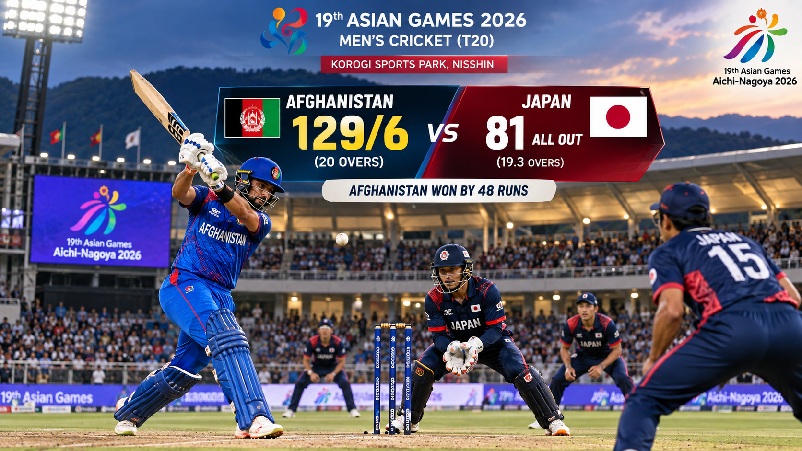
Afghanistan vs Japan 2026: On September 24, the 2026 Asian Games men’s cricket tournament commenced with an exciting match between Afghanistan and the host nation, Japan, at Korogi Sports Park in Nisshin. What began as a potentially tight chase evolved into a straightforward 48-run win for Afghanistan, as Japan was dismissed for 81 runs in 19.3 overs, following Afghanistan‘s score of 129/6 in their allotted 20 overs.
The outcome of the match was shaped by two contrasting segments of play. Afghanistan was not entirely dominant with the bat, yet they accumulated sufficient runs during the middle and closing overs to exert pressure on the Japanese side. The Afghan bowlers consistently maintained that pressure during Japan‘s batting effort, especially after Japan had reached a promising score of 50 within the first eight overs.
For Japan, the encounter presented a mixture of positive moments and hard lessons. Benjamin Ito-Davis had a brief but impactful innings, while Reo Sakurano-Thomas showed the greatest resistance at the crease. Nonetheless, the home team found it challenging to convert early starts into meaningful partnerships, culminating in the loss of their last seven wickets for only 22 runs.
Below is an in-depth review of the match, featuring the scorecard, highlights of batting performances, bowling statistics, critical turning points, and the implications of the result for both teams’ campaigns in the Asian Games.
Match Result and Scorecard
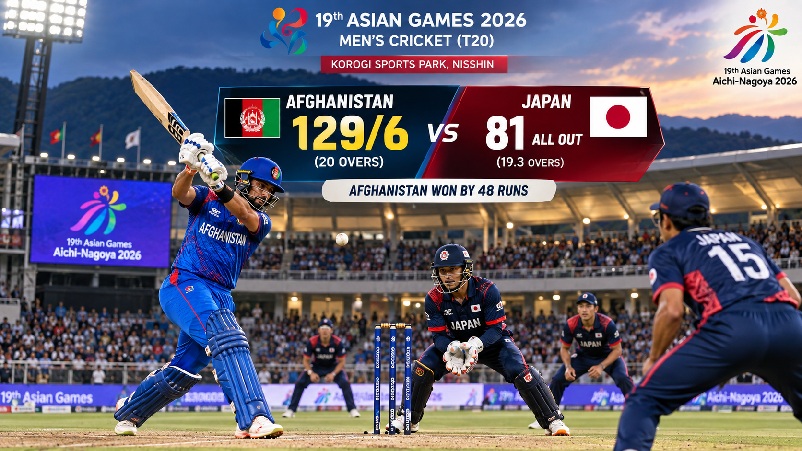
The first Group A match yielded a definitive outcome. Afghanistan managed to score 129/6 in 20 overs, while Japan responded with 81 all out in 19.3 overs.
Final result: Afghanistan prevailed by a margin of 48 runs.
| Team | Score | Overs |
|---|---|---|
| Afghanistan | 129/6 | 20.0 |
| Japan | 81 all out | 19.3 |
- Japan won the toss and opted to field first at Korogi Sports Park. This decision provided the hosts with a chance to chase the target under relatively clear conditions, but Afghanistan‘s total proved challenging to exceed.
- This match marked the initial men’s cricket encounter of the 2026 Asian Games tournament, which features ten teams, including five ICC Full Members — India, Pakistan, Sri Lanka, Bangladesh, and Afghanistan — in addition to five Associate teams: Nepal, Hong Kong, Malaysia, Oman, and host Japan.
- Thus, the opening win offered Afghanistan a significant result early in Group A.
Afghanistan’s Innings: 129/6
The Afghan innings centered around several valuable contributions rather than a single standout performance. Mohammad Akram emerged as the top scorer with 34 runs off 29 balls, while captain Darwish Rasooli chipped in with 29 runs from 27 balls. Mohammad Ishaq also made an essential late contribution, remaining not out with a score of 25 runs off just 17 deliveries.
The innings commenced at a steady pace before Afghanistan progressively accelerated their scoring rate.
Mohammad Akram Provides the Foundation
Mohammad Akram was the leading scorer for Afghanistan. His innings of 34 included two boundaries and two sixes, providing valuable momentum for Afghanistan‘s scoring.
Rather than attacking aggressively from the outset, his performance helped lay the groundwork for Afghanistan as they moved into the middle overs. His strike rate of 117.24 was especially beneficial in light of the eventual winning margin.
Akram was eventually out, being dismissed by Benjamin Ito-Davis, with wicketkeeper Alexander Shirai-Patmore effecting the stumping.
Rasooli Keeps the Middle Overs Moving
Darwish Rasooli scored 29 runs off 27 deliveries, which included four fours. The innings played by the captain of Afghanistan was crucial in ensuring that the batting side did not lose too much momentum following the loss of their first wicket.
Rasooli’s approach differed from Ishaq’s later in the innings. While Ishaq maintained a quicker pace of scoring, Rasooli contributed to a consistent scoring rate for Afghanistan during the middle overs.
His wicket fell when Wataru Miyauchi caught him off the bowling of Shoma Sugaya-Slater while Afghanistan was attempting to set themselves up for a competitive total.
Mohammad Ishaq’s Late Push
The most remarkable strike rate during Afghanistan‘s innings was achieved by Mohammad Ishaq.
The wicketkeeper-batsman ended not out on 25 off just 17 balls, hitting two fours and one six. His strike rate of 147.06 provided Afghanistan with the crucial late surge needed in a 20-over innings.
This late input became increasingly vital as Japan‘s batting began to slow down.
Afghanistan concluded their innings at 129/6, averaging 6.45 runs per over. Although it was not a monumental total for T20, the subsequent bowling display clarified why that score was sufficient for the day.
Japan’s Bowling Display
Japan effectively limited Afghanistan‘s scoring in the early stages of their innings. The home team consistently took wickets and had multiple bowlers making contributions.
Ibrahim Takahashi and Shoma Sugaya-Slater claimed two wickets apiece, while Benjamin Ito-Davis and Reo Sakurano-Thomas also got on the scoresheet for wickets.
This bowling performance proved valuable as it kept Afghanistan down to 129 instead of allowing for a significantly larger score.
For a team chasing a target of 130, Japan aimed to start strongly and sustain that momentum throughout the middle overs. Their initial overs of the chase indicated that they could achieve this.
However, Afghanistan’s bowling response altered the flow of the match.
Japan’s Innings: 81 All Out
Japan‘s batting began on a poor note, losing Lachlan Yamamoto-Lake for a duck off just three balls.
Reo Sakurano-Thomas brought some steadiness with a score of 23 off 24 balls. His innings featured three fours and represented the highest individual tally in Japan’s chase.
Captain Kendel Kadowaki-Fleming managed 14 runs from 17 balls, while Benjamin Ito-Davis made the fastest scoring impact of the innings with 17 runs off just eight deliveries.
Ito-Davis hit two fours and a six, providing Japan with a momentary lift in momentum. His strike rate overcame 200, yet the innings was too brief to steer the overall trajectory of the chase.
Japan Reaches 50 but Loses Steam
One of the more noteworthy phases of the chase unfolded prior to the collapse.
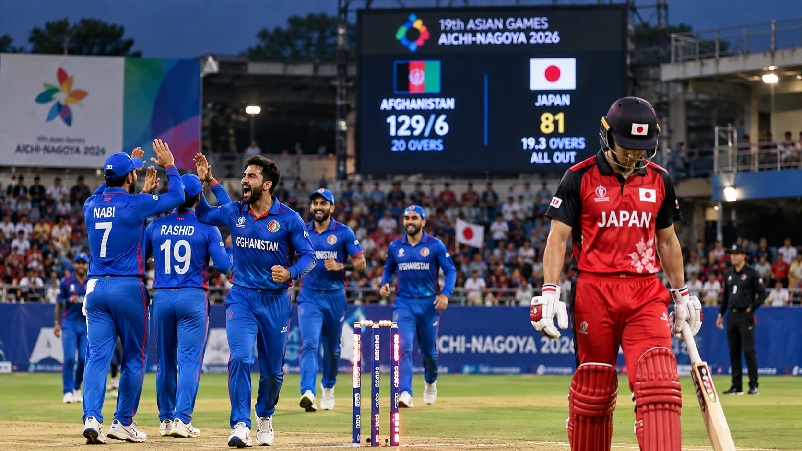
Japan reached a score of 50 in 7.3 overs, establishing a decent foundation. However, after 10 overs, they found themselves at 59/3. Following that juncture, the innings deteriorated sharply, with Japan losing their last seven wickets for merely 22 runs.
This sequence of events clarifies the final outcome more effectively than the total score.
At 59/3, Japan still possessed the chance to form partnerships and keep the required run rate manageable. Instead, Afghanistan consistently discovered breakthroughs, hindering the hosts from establishing prolonged partnerships.
Arab Gul Swings the Match
The exceptional bowling display was delivered by Arab Gul.
He concluded his four overs with an impressive tally of four wickets while conceding just eight runs, which included two maiden overs. His economy rate of 2.00 contributed significantly to the outcome of the match.
His achievement of four wickets at such a low economy rate meant Japan struggled to exert sufficient pressure back on Afghanistan.
Supporting Gul was Nangeyalia Kharote, who secured three wickets for 19 runs over 3.3 overs. Abdullah Ahmadzai joined in by taking two wickets as well.
Collectively, these bowlers effectively dismantled the middle and lower batting order of Japan.
Afghanistan’s Bowling Statistics
The primary bowling statistics for Afghanistan were:
| Bowler | Overs | Runs | Wickets |
|---|---|---|---|
| Arab Gul | 4 | 8 | 4 |
| Nangeyalia Kharote | 3.3 | 19 | 3 |
| Abdullah Ahmadzai | 3 | 13 | 2 |
| Najibullah Zadran | 3 | 7 | 1 |
| Faridoon Dawoodzai | 3 | 16 | 0 |
| Karim Janat | 3 | 16 | 0 |
These statistics highlight how successfully Afghanistan leveraged wickets to manage the chase.
Arab Gul‘s achievement of four wickets was crucial since Japan had already demonstrated their ability to score runs at a solid rate early in the innings.
Full Japan Batting Scorecard
The batting statistics for Japan illustrate an innings that featured a few notable contributions but missed having a solid partnership.
| Batter | Runs | Balls |
|---|---|---|
| Lachlan Yamamoto-Lake | 0 | 3 |
| Reo Sakurano-Thomas | 23 | 24 |
| Kendel Kadowaki-Fleming | 14 | 17 |
| Benjamin Ito-Davis | 17 | 8 |
| Alexander Shirai-Patmore | 2 | 12 |
| Ibrahim Takahashi | 2 | 10 |
| Charlie Hara-Hinze | 0 | 5 |
| Wataru Miyauchi | 9 | 14 |
| Declan Suzuki | 0 | 4 |
| Makoto Taniyama | 4 | 7 |
| Shoma Sugaya-Slater | 5 | 13 |
Japan was all out for 81 within 19.3 overs.
The notable difference is seen between Ito-Davis and a number of Japan‘s batsmen. His 17 runs from eight balls demonstrated that it was feasible to score rapidly, but the surrounding innings lacked adequate backing.
Conversely, Reo Sakurano-Thomas scored 23 runs from 24 balls but was unable to establish a significant partnership with another player.
7 Key Talking Points From the Match
1. Afghanistan Held Out Against a Modest Target
A score of 129/6 seemed to be within Japan’s reach.
Afghanistan accumulated their total through various contributions, lacking a single century or exceptionally large innings. Consequently, the bowlers had a crucial role to play.
And they delivered.
Japan targeted 130 for victory but fell short at 81, resulting in Afghanistan winning by 48 runs.
2. Japan’s Downfall Determined the Outcome
The key numerical aspect was Japan tumbling from 59/3.
The hosts had already crossed 50 and remained competitive, but losing seven wickets while adding only 22 runs effectively ended their chase.
This scenario wasn’t just a slow pursuit; it resulted from a batting downfall due to consistent wicket losses.
3. Arab Gul Delivered a Game-Changing Performance
Taking four wickets for only eight runs is a remarkable achievement in T20 bowling.
Gul blended wicket-taking with exceptional control, preventing Japan from regrouping after a promising start.
4. Benjamin Ito-Davis Highlighted Japan’s Aggressive Potential
Ito-Davis notched up 17 runs off eight balls, including two fours and a six.
Even though his time at the crease was short-lived, it exhibited the attacking capability in Japan’s batting order. The challenge for them will be to transform these spurts into longer-lasting partnerships.
5. Lower-Order Contributions from Afghanistan Were Significant
Mohammad Ishaq‘s unbeaten 25 runs off 17 balls proved crucial, as Afghanistan required extra runs towards the latter part of their innings.
Without that late surge, Japan might have faced a considerably smaller target.
6. Japan’s Bowling Performance Was Competitive
The outcome should not overshadow the reality that Japan’s bowlers restricted Afghanistan to 129/6.
Ibrahim Takahashi and Shoma Sugaya-Slater each took two wickets, while Benjamin Ito-Davis and Reo Sakurano-Thomas also contributed effectively with the ball.
The main issue arose during their batting.
7. Afghanistan Kicked Off Their Campaign With Two Points
This win marks a successful beginning for Afghanistan in the men’s cricket competition at the Asian Games.
Japan, on the other hand, has a chance in Group A against Nepal on September 26, while Afghanistan is set to play against Nepal on September 25.
Afghanistan vs Japan 2026: The Implications of the Result
The initial match serves as a preliminary indicator of the significance of the group stage.
Afghanistan took part in the Asian Games as one of five Full Member countries in the men’s cricket event. Japan, as the host nation, is listed among the Associate teams participating in the opening round.
The tournament’s structure ensures that each group match holds significant importance. The teams competing in the first round are divided into groups, and the top two from each group advance to the quarter-finals. Those successful teams will then face the four Full Member nations that qualify for the knockout phase.
For Afghanistan, a victory against Japan positions them favorably in their group.
Nonetheless, their journey is not yet complete. Afghanistan still has another match to contend with against Nepal, which means they need to maintain their performance rather than depending solely on their initial success.
In contrast, Japan faces a more challenging situation. Their upcoming match against Nepal becomes crucial since another loss could severely hinder their chances of progressing.
The Larger Narrative Surrounding Japan’s Asian Games Effort
Japan‘s participation in the men’s cricket event is part of a broader growth trajectory for the sport within the nation.
The Japan Cricket Association has been focusing on enhancing cricket’s visibility, engagement, and international presence. The 2026 Asian Games are especially important as Japan serves as the host and fields a men’s team that competes against established cricketing powers.
The men’s tournament showcases five Associate teams alongside five Full Members, creating an atypical setup where emerging cricketing countries can engage on a prominent multi-sport platform.
The players representing Japan possess experience across various levels within the cricket framework of the country. Notable members of the team include Kendel Kadowaki-Fleming, Charlie Hara-Hinze, Benjamin Ito-Davis, and Makoto Taniyama.
This progress makes encounters like this particularly advantageous for Japanese cricket. Facing a side with Afghanistan‘s global experience introduces a unique level of pressure and strategic complexity.
Lessons Japan Can Derive From the Match
Despite suffering a 48-run defeat, Japan found several advantageous takeaways.
The first positive was their readiness to be aggressive. Achieving 50 runs in just 7.3 overs indicated that the batting lineup possesses the ability to start strongly.
The second takeaway was their bowling performance. Limiting Afghanistan to a score of 129/6 kept the target reachable.
The third highlight was Ito-Davis’s individual contribution. His 17 runs off eight balls demonstrated the importance of aggressive play in the middle order.
A key improvement area lies in building partnerships effectively.
Japan consistently lost wickets after the initial phase of their chase. Once Afghanistan‘s bowlers gained the upper hand, the hosts found it challenging to rotate the strike while also preserving their wickets.
The forthcoming match against Nepal will present a swift chance to tackle these concerns.
Insights Afghanistan Can Gain From the Match
Afghanistan‘s primary advantage came from their disciplined bowling.
Though the batting unit managed to score 129, it was the bowlers who converted that total into a decisive victory.
Arab Gul‘s impressive four-wicket performance stood out, while Kharote and Ahmadzai also provided crucial backing. The ability to take wickets regularly meant that Japan never had the opportunity to form a decisive partnership.
There were also encouraging aspects in batting.
Mohammad Akram‘s contribution of 34 runs added stability to the innings, while Rasooli‘s 29 helped during the middle overs, and Ishaq‘s not out 25 provided a boost in the closing overs.
Afghanistan, however, will recognize that their batting performance can enhance. A score of 129 was defendable due to exceptional bowling, but tougher opponents as the tournament progresses may require a more substantial output.
Afghanistan vs Japan 2026 Scorecard Overview
For those seeking the match scorecard specifically, the essential figures are clear.
- Afghanistan: 129 runs for 6 wickets in 20 overs.
- Japan: All out for 81 runs in 19.3 overs.
- Outcome: Afghanistan triumphed by a margin of 48 runs.
- Leading Afghanistan batsman: Mohammad Akram — 34 runs off 29 balls.
- Leading Japan batsman: Reo Sakurano-Thomas — 23 runs off 24 balls.
- Top bowler for Afghanistan: Arab Gul — 4 wickets for 8 runs from 4 overs.
- Notable supporting bowler: Nangeyalia Kharote — 3 wickets for 19 runs from 3.3 overs.
- Location: Korogi Sports Park, Nisshin.
- Date: September 24, 2026.
What Lies Ahead for Both Sides?
The timeline for the Asian Games is progressing swiftly.
Afghanistan is set to compete in its next Group A match against Nepal on September 25, while Japan will take on Nepal on September 26.
The quarter-finals are slated to start on September 28, followed by additional knockout rounds leading to the medal contests in early October.
This initial victory is advantageous for Afghanistan, but the team must deliver in its subsequent group game.
On the other hand, Japan has little opportunity to reflect on the loss. Their upcoming match allows for a chance to recover, especially regarding their batting alliances and bowling during the middle overs.
For enthusiasts of cricket, this tournament also presents a unique situation: established Asian cricket nations are facing off against developing teams in a major multi-sport competition.
Conclusion
The first match between Afghanistan and Japan resulted in a conclusion that was largely influenced by the effectiveness of bowling.
Afghanistan‘s score of 129 runs for 6 wickets was competitive but not dominating. Mohammad Akram, Darwish Rasooli, and Mohammad Ishaq were the key contributors with the bat, and Ishaq‘s late surge helped elevate the total past 120.
Japan commenced their chase with enough determination to imply that they could meet the target. They achieved 50 runs in 7.3 overs, but Afghanistan countered by consistently taking wickets. As soon as Japan fell to 59/3, their innings unraveled, with the last seven wickets collapsing for just 22 runs.
Arab Gul’s remarkable four-wicket performance was the standout display, while Nangeyalia Kharote’s three wickets made sure Japan could not bounce back.
Thus, the final margin of 48 runs illustrated more than just a comparison of the two totals. It highlighted the distinction between a team that maintained its composure during crucial stretches and one that struggled to keep up its pursuit after a promising start.
For Afghanistan, the outcome marks a victorious start to their Asian Games journey. For Japan, the defeat reveals several specific aspects needing improvement before their next group encounter.
With the men’s competition moving forward quickly in the following days, this initial result serves merely as a prelude to the broader narrative of cricket at the Asian Games.