

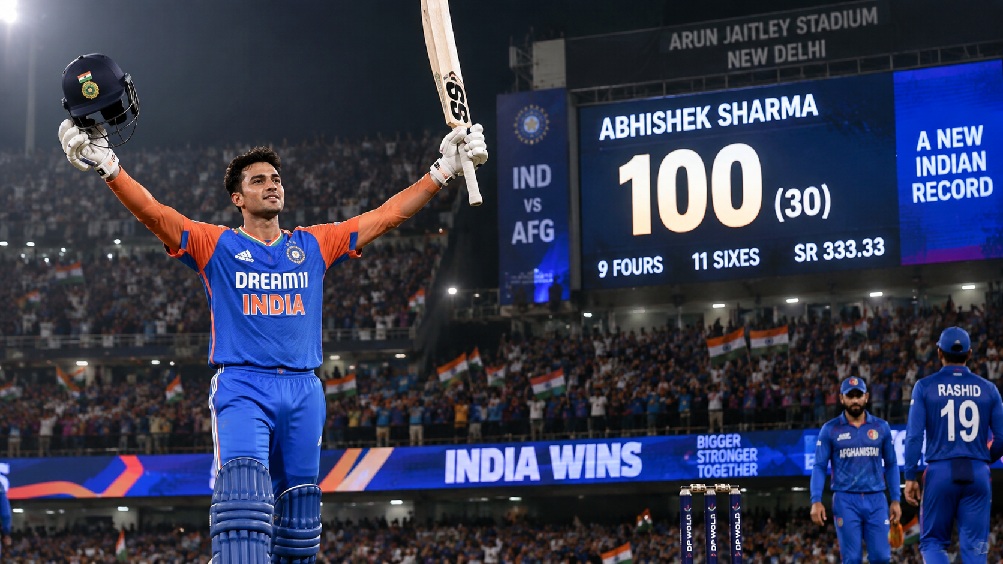
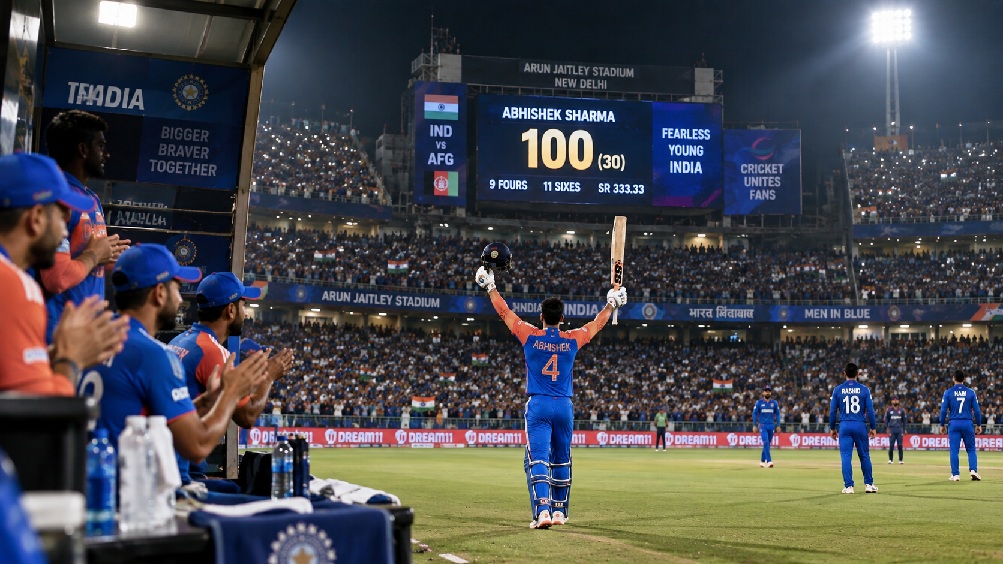
Abhishek Sharma 30-ball century: The third T20I match between India and Afghanistan in New Delhi had already garnered significant attention, but Abhishek Sharma elevated it to a record-breaking display. On September 17, 2026, the left-handed opening batsman achieved his century in just 30 balls at the Arun Jaitley Stadium, marking the fastest T20I hundred by an Indian player. He concluded his innings with a score of 108 from 34 deliveries, featuring nine fours and 11 sixes, as India totaled 221/7 and ultimately triumphed by 127 runs. This victory secured a clean sweep of the series with a 3-0 result.
The impressiveness of his performance lay in the rapid progression of his innings. Abhishek did not take long to adjust to the conditions. He began aggressively, consistently finding the boundary and applying pressure on the Afghan bowlers. By the time he hit triple figures, he had amassed 96 of his first 100 runs from boundaries, as reported by BBC Sport.
Abhishek Sharma‘s 30-ball century became the pivotal moment of a match that also showcased an overall strong team effort.
What happened in Delhi?
India entered the third encounter with a firm grip on the series, having secured victories in the first two matches. This allowed the final game to be utilized as a chance to test new strategies, but it quickly transformed into a demonstration of bold batting.
Abhishek opened for India and immediately appeared at ease against Afghanistan’s bowling attack. India reached 132 runs without losing any wickets in just 8.3 overs, largely due to the opener’s remarkable start. He brought up his fifty in only 16 balls before pushing his scoring rate even further.
The crucial moment
The crucial moment arrived during the ninth over. Abhishek achieved his century in just 30 balls, eclipsing the previous Indian T20I record held by Rohit Sharma, who had reached a century in 35 balls against Sri Lanka in 2017. This achievement also placed Abhishek in the global spotlight for the fastest centuries in T20I cricket.
His innings concluded shortly after this landmark accomplishment. Rashid Khan claimed his wicket for 108 runs off 34 balls, but by that time, India had laid a solid groundwork for an impressive score. India finished with 221/7 in 20 overs, while Afghanistan was dismissed for 94 in 14.1 overs. Consequently, India secured a victory by 127 runs and completed a 3-0 series triumph.

Abhishek Sharma 30-ball century: the numbers behind the knock
The scorecard illustrates just how extraordinary the innings was.
- Runs: 108
- Balls faced: 34
- Fours: 9
- Sixes: 11
- Strike rate: 317.64
- Balls for fifty: 16
- Balls for hundred: 30
The tally of boundaries is especially telling. His nine fours contributed 36 runs, while 11 sixes added an impressive 66. This means that 102 out of his 108 runs came exclusively from boundaries. It’s a straightforward statistic, but it highlights the rapid pace at which the innings unfolded.
The ICC has announced that his fifty runs off 16 balls stands as the joint-fourth quickest fifty achieved by an Indian player in T20 internationals. Abhishek already holds the record for India’s second-fastest T20I fifty, which was scored in 14 balls against New Zealand earlier in 2026. Hence, his recent achievement aligns with a larger trend in his performance in short-format batting rather than being a singular feat.
Importance of the 30-ball milestone
Achieving a century in T20 cricket presents a significant challenge, as a batter has just 120 legal deliveries accessible during a complete innings. Scoring 100 runs before facing 30 balls signifies not only an exceptional scoring rate but also the ability to navigate the risks that come with aggressive play.
The importance of this record becomes more apparent when viewed in context. The BCCI indicated that this was the quickest T20I century by an Indian, surpassing Rohit Sharma’s 35-ball century. Additionally, it marked the fastest century registered against a Test-playing nation in T20Is. In total, the BCCI ranks it as the third-quickest century in men’s T20I cricket, trailing behind Sahil Chauhan’s 27-ball century for Estonia and Muhammad Fahad’s 29-ball century for Turkey.
This distinction holds significance as T20I records encompass teams at various stages of international advancement. While comparing overall performances is beneficial, distinguishing matches between full-member nations offers a clearer understanding of the significance of Abhishek’s accomplishment.
For Indian cricket, this record is particularly striking as the previous record had remained intact since 2017. Rohit’s 35-ball century against Sri Lanka was one of the most notable records within the format for Indian batters. Abhishek managed to surpass that record by five balls.
The powerplay served as the launchpad
The lead-up to Abhishek Sharma’s 30-ball century was almost as impressive as the achievement itself.
The opening powerplay period was the most crucial part of the innings. Abhishek and Sanju Samson provided India with a vigorous start, and their rapid scoring rate quickly compelled Afghanistan to look for strategies to disrupt their momentum.
The ICC highlighted that India had crossed 100 runs during the powerplay, underscoring the importance of the start beyond just Abhishek’s individual tally. His significant contribution during this period included a notable 76 runs off just 22 balls, as reported in the match coverage.
This aggressive approach transformed the nature of the innings. Rather than primarily using the powerplay to build a foundation, India leveraged it to exert immediate pressure on the scoreboard.
Abhishek Sharma’s 30-ball century and the record books
This performance added multiple milestones to Abhishek’s expanding T20I achievements.
Quickest T20I century by an Indian
The most evident record established was for the Indian standard. Since 2017, Rohit Sharma’s 35-ball century had been the measurement for excellence. Abhishek achieved a score of 100 in just 30 balls, resetting the national record.
Fastest century among full-member nations
Reports from BCCI and ICC also emphasized the significance of the match between full-member nations. Against Afghanistan, Abhishek made a record-setting fastest T20I century in a contest featuring two Test-playing countries.
Third-fastest overall T20I century
Looking at the broader record landscape, two centuries rank faster. Sahil Chauhan hit a 27-ball century for Estonia versus Cyprus in 2024, while Muhammad Fahad scored a 29-ball century for Turkey against Bulgaria in 2025. Both of these records were for associate nations.
The achievement of a 30-ball century is not the quickest in T20I history overall, but it stands as the fastest for an Indian player and the quickest in a match involving full-member teams.
A remarkable display of six-hitting
Abhishek hit a total of 11 sixes. According to the BCCI, this now ranks as the second highest amount of sixes by an Indian men’s cricketer in a T20I innings. His record of 13 sixes against England in Mumbai back in February 2025 remains ahead of this figure.
This detail is crucial for grasping the nature of his batting style. The achievement was not the result of singles or ground boundaries but rather stems from a series of powerful hits.
Stages of the innings
Abhishek’s innings can be broken down into three distinct phases.
The first phase
The first part was characterized by an aggressive start. He targeted the new ball effectively, allowing India to score at an impressive pace. His fifty off 16 balls made his aggressive intent evident right from the start.
The second phase
The second phase focused on the surge from fifty to a hundred. Instead of pausing after a rapid half-century, he maintained a bold approach. He reached his century just 14 balls after achieving his fifty.
The final phase
The final segment comprised only four additional deliveries. After hitting the hundred mark, Abhishek added another eight runs before Rashid Khan concluded the innings.
This progression is noteworthy because swift centuries can hinge on a single over or a few favorable deliveries. In this case, the scoring momentum was consistent throughout a large portion of the innings.
The influence of teammates
While Abhishek clearly attracted attention, his innings was not produced in a vacuum. Sanju Samson also played a significant role by scoring a fifty, aiding India in forming a solid opening partnership.
The BCCI noted that Abhishek entered the third T20I in strong form. He amassed 121 runs in the first two encounters of the series, including an impressive 82 runs from 32 balls in the very first match. By the end of the three games, he totaled 229 runs at an average of 76.33 and a strike rate of 269.41, hitting 22 sixes.
These statistics illustrate why the 30-ball century did not seem entirely disconnected from his previous performances. He was already scoring at an extraordinary rate prior to setting the record.
Implications of Abhishek Sharma’s 30-ball century on records
It is impossible to avoid comparing Abhishek’s achievement with Rohit Sharma’s as the Indian record transitioned. However, the importance of this moment extends beyond merely switching names.
The landscape of Indian T20 batting has advanced rapidly over the last ten years. Opening batsmen are now expected to exploit fielding limitations effectively, with a modern strategy that focuses on hitting boundaries early, rather than conserving runs for the concluding overs.
Abhishek’s innings embodied this strategy in an especially pronounced manner. India did not hold back until the last five overs to gain momentum. The offensive began right from the first over, and despite Afghanistan taking wickets later, India managed to score a total of 221.
Significance for his T20I career
Abhishek Sharma’s 30-ball century serves as another significant milestone in his quick growth as an international opener.
One match does not define a player’s whole career, yet outstanding achievements can alter perceptions. Abhishek’s recent century contributes another significant milestone to a T20I journey that is evolving through bold opening batting.
The 26-year-old southpaw has now achieved three T20 international centuries. His capability to score rapidly provides India with an offensive option at the start of their innings, and his recent performances have enhanced his impact in this format.
Moving forward, the task will be to sustain this standard against various bowling styles and in differing environments. T20 cricket is unpredictable: a playing surface can be more sluggish, boundaries can be more expansive, or bowlers may employ a range of deliveries. Thus, the next phase of Abhishek’s growth will require him to adjust his aggressive style while still retaining its effectiveness.
This is the reason why the innings played in Delhi serves as an insightful example. It wasn’t merely about attacking every ball. The innings showcased a blend of power, precision, strategic boundary selection, and an assertive awareness of the field’s layout.
India vs Afghanistan: the broader match outcome
Although Abhishek’s century captured significant attention, India’s overall performance was thorough. The home team concluded their innings at 221 for 7, while Afghanistan was bowled out for 94 in just 14.1 overs.
India secured victory by 127 runs, achieving a clean 3-0 series win in T20Is. Abhishek was awarded Player of the Match for scoring 108, and his contributions throughout the series earned him the Player of the Series distinction.
This outcome also contextualizes the century. It was not a record made in a closely contested loss or an individual accomplishment detached from the overall team success. His innings provided the foundation for India’s dominance, and the bowlers were subsequently able to finish the task.
Bishnoi
Bishnoi stood out as a vital player for India with the ball, claiming three wickets as Afghanistan struggled to maintain the required run rate.
Reasons for the buzz around the innings
There is a unique thrill that comes with a century achieved swiftly because the milestone adds to the overall excitement. Each boundary heightens the chance of breaking records.
In Delhi, that tension escalated quickly. Abhishek reached fifty in just 16 balls, advanced through the 80s and 90s at a remarkable pace, and ultimately completed his century in the ninth over. He concluded the innings with 108 runs from 34 balls, but the record had already been established.
His celebration was also noteworthy. After achieving the milestone, he sat down on the field in a meditative pose, creating another lasting image from that evening.
Abhishek Sharma’s 30-ball century: what lies ahead?
The upcoming challenge isn’t just about replicating a 30-ball hundred. The nature of cricket often doesn’t permit players to recreate the same performance under identical circumstances. Varying venues, bowling strategies, and match scenarios necessitate different approaches.
What Abhishek should focus on moving forward is the methodology behind the success: an aggressive mindset, solid batting during the powerplay, and the self-assurance to keep accumulating runs after achieving a milestone.
His 2026 series against Afghanistan indicated that this record was part of a broader successful streak. His first match produced 82 runs off 32 balls and was followed by more contributions in the second game, laying a solid foundation before the record-setting finale.
This makes his century in Delhi more significant than a mere statistical event. It represented the zenith of an already fruitful series.
For fans of cricket in India, the immediate inquiry will undoubtedly be the evolution of this approach as the fixtures become increasingly rigorous. The response will emerge from performances against various teams and in different environments rather than being dictated by a single statistic.
Final thoughts
Reflecting on Abhishek Sharma’s 30-ball century, the most remarkable aspect is the rapid transition of the innings from an explosive beginning to a landmark achievement.
The narrative behind Abhishek Sharma’s record-setting evening ultimately revolves around pace, determination, and execution. He scored his century off just 30 balls and ended with a total of 108 runs from 34 deliveries, hitting nine fours and 11 sixes, contributing to India’s 127-run victory over Afghanistan.
This accomplishment surpassed Rohit Sharma’s former Indian T20I record for the quickest century, making it the fastest T20I hundred in a match involving full-member nations. Additionally, it ranks third overall in the men’s T20I records, trailing only two centuries by players from associate nations.
Most crucially, the innings fit into a broader series during which Abhishek accumulated 229 runs over three matches. This regularity added significant context to the record.
Abhishek Sharma’s 30-ball century will be remembered as one of the highlight moments of India’s T20I campaign in 2026, yet its lasting importance will depend on the actions of the opener following this milestone. At present, the statistics are remarkable: a century in 30 balls, 108 runs in 34 balls, 11 sixes, and a completed series with India winning every game.