

India vs West Indies 2026: The recent India against West Indies bout in 2026 has offered nearly everything that cricket enthusiasts desire: impressive scores, record chases, individual achievements, and a surprising comeback from West Indies.
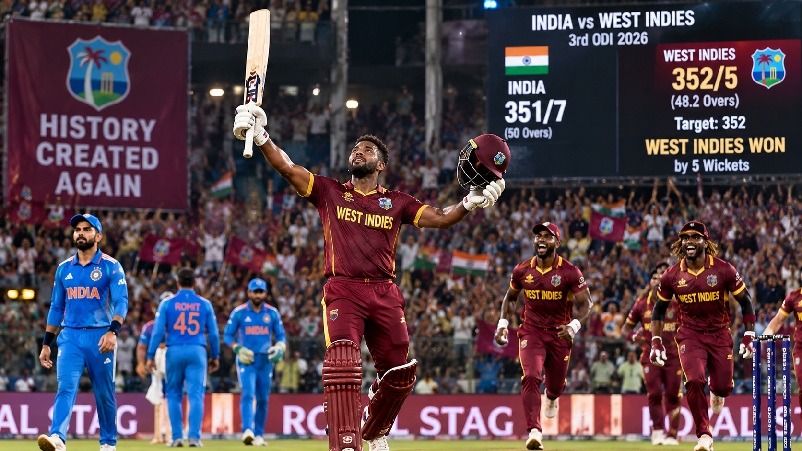
The ODI series consisting of three matches has come to an end, with India securing a 2–1 victory in the series. India triumphed in the first two games, but West Indies made an astounding comeback in the third ODI at New Chandigarh, successfully chasing a target of 352 with five wickets remaining and 10 balls to spare. Shai Hope‘s unbeaten score of 162 highlighted this match. Windies Cricket
Attention now shifts to the upcoming five-match T20I series. The first T20I is slated for October 6, 2026, at the Bharat Ratna Shri Atal Bihari Vajpayee Ekana Cricket Stadium in Lucknow. The other matches will be hosted in Ranchi, Indore, Hyderabad, and Bengaluru. Windies Cricket
WI 352/5
West Indies chased down India’s 352-run target in 48.2 overs at the PCA International Cricket Stadium, New Chandigarh, with Shai Hope starring with an unbeaten 162.
This series holds particular intrigue. The ODI matches showcased India’s batting strength, while the West Indies illustrated that their top order can effectively challenge even a formidable Indian bowling lineup when the conditions and momentum favor them.
India vs West Indies 2026: Events Up to This Point
The ODI matches kicked off on September 27 and swiftly turned into a battleground for batsmen.
India claimed victory in the first ODI held in Thiruvananthapuram by a margin of eight wickets. Virat Kohli delivered an impressive performance with an unbeaten 139 off 88 balls, while Shubman Gill added 110 runs. India easily chased down the West Indies total of 295. Kuldeep Yadav was also instrumental, taking four wickets. Reuters
The second ODI in Guwahati was even more sensational.
West Indies posted an astounding score of 405/7, making them the first team to surpass 400 runs against India in this series. John Campbell, Shai Hope, and Amir Jangoo each scored centuries, showcasing the unusual feat of three hundreds within a single ODI innings. Reuters
However, even a score of 405 proved insufficient.
India surpassed the target with 39 balls to spare, finishing with a score of 406/2. Shubman Gill dominated the match with an unbeaten 223 off 133 balls. Rohit Sharma also contributed with a century, and the opening partnership between these two Indian players radically altered the course of the game. Reuters
The third ODI provided a contrasting conclusion.
India posted a total of 351/7, driven by KL Rahul’s unbeaten 129 and Rohit Sharma’s 92 runs. In reply, West Indies achieved 352/5 in 48.2 overs. Shai Hope remained not out with 162 runs, leading the visitors to their most successful ODI chase to date. India Today
Though India secured the series victory, West Indies gained substantial confidence heading into the T20Is.
India vs West Indies 2026 Match Schedule
The ODI segment is complete, but there are still five T20Is ahead.
- 1st T20I October 6 Lucknow 7:00 PM IST
- 2nd T20I October 9 Ranchi 7:00 PM IST
- 3rd T20I October 11 Indore 7:00 PM IST
- 4th T20I October 14 Hyderabad 7:00 PM IST
- 5th T20I October 17 Bengaluru 7:00 PM IST
The official schedule from West Indies confirms the five-match T20I timeline, while the ICC’s listings also indicate that the first T20I will be held in Lucknow on October 6. Windies Cricket
The timetable offers both squads a fairly swift transition following the ODI matches. This situation could make the choices regarding team composition particularly crucial. Individuals who have logged considerable time playing may be rested, while experts in the shorter format might take on more significant responsibilities.
For spectators, the sequence proves to be quite favorable. The brief intervals between games imply that the series is likely to keep its momentum intact throughout the month of October.
Why the T20I Series Might Be Unique
Assuming that the results of the ODI series will inherently determine the outcome of the T20I matches would be a significant oversight.
T20 cricket follows a distinct pace. A batter can influence the course of a game within just 20 deliveries, and a bowler can change the dynamics of an innings with a spell lasting only two overs. A single dropped catch or one costly over can entirely shift the match’s result.
India possesses numerous players who can create an immediate effect in this format. Earlier this year, the announcements for the BCCI’s 2026 T20I squad featured players like Shreyas Iyer, Abhishek Sharma, Sanju Samson, Ishan Kishan, Tilak Varma, Shivam Dube, Axar Patel, Washington Sundar, Arshdeep Singh, among others.
On the other hand, the West Indies demonstrated during the ODI series that their batting lineup is capable of achieving formidable totals. This blend of strengths renders the T20I phase challenging to forecast.
India’s Batting Edge
India’s most significant asset continues to be the diversity in their batting lineup. They possess the ability to construct an innings in a traditional sense through their top order, yet they also feature players who can quickly increase the scoring rate. This adaptability is particularly beneficial in T20 matches, where the optimal strategy might vary based on the pitch conditions, target score, and wickets that have fallen.
One player who can instantaneously alter the rhythm of an innings is Abhishek Sharma. Wicketkeepers Sanju Samson and Ishan Kishan not only provide options behind the stumps but also offer aggressive batting capabilities. Additionally, players like Tilak Varma and Shivam Dube contribute further strength in the middle order.
India also boasts a range of all-rounders, which offers the captain greater flexibility when selecting the final team.
West Indies’ Explosive Capability
The West Indies should not be evaluated solely based on their 2-1 defeat in the ODI series. Their batting showcased considerable power.
The second ODI served as a strong illustration of this. Accumulating 405 runs for the loss of 7 wickets against India was not a mere result of one player’s exceptional performance. Three batters from the West Indies reached the three-figure mark, illustrating that multiple players could effectively challenge India’s bowling line.
Then, there was Shai Hope‘s remarkable score of 162 in the third ODI. His innings stood out particularly, as he remained calm during a demanding chase. With a target of 352 runs to achieve, he did not let the required run rate induce panic, instead focusing on forging partnerships and identifying scoring chances.
That composure could prove advantageous in the T20 series, despite the format necessitating a significantly quicker scoring rate.
Shubman Gill’s Performance Has Become a Key Topic
Shubman Gill has undeniably emerged as one of the prominent narratives of the ODI series.
He achieved a total of 110 in the initial ODI and followed it up with an incredible not out score of 223 in Guwahati. This double century occurred during India’s triumphant pursuit of 406, highlighting his capacity to be extremely powerful when he bats for a prolonged period. Reuters
The second ODI held particular importance as Gill did more than just gather runs. He intensified his scoring as the innings progressed and ultimately transformed a substantial personal score into a performance that secured victory for the team.
His collaboration with Rohit Sharma was another significant element.
Rohit played a key role with 101 runs while chasing in Guwahati, leading to a formidable opening partnership that practically eliminated West Indies from the match. Reuters
Nonetheless, the T20 format might necessitate a different strategy for Gill.
He may not have the time he needs to build his innings slowly. Batting during the powerplay, percentage of boundaries, and the ability to rotate strikes become considerably more critical.
It will be intriguing to see this tactical shift in action.
Virat Kohli Continues to Add to His Legacy
Meanwhile, Virat Kohli delivered a remarkable performance throughout the ODI series.
In the opening match, he achieved an unbeaten score of 139 off 88 balls as India pursued a target of 296 in Thiruvananthapuram. This innings allowed him to surpass the impressive milestone of 15,000 runs in ODIs, becoming only the second cricketer, after Sachin Tendulkar, to accomplish this feat. Reuters
However, the third ODI highlighted cricket’s unpredictable aspect.
Kohli was sent back for a golden duck by Jayden Seales after the West Indies fast bowler managed to breach his defenses. The Times of India
For Indian supporters, this variation adds to the excitement of the series. One game can showcase a record-setting display, while another can conclude within the very first over.
Kohli’s experience remains crucial, particularly when a team deals with challenging bowling conditions or requires someone to stabilize the innings during the middle phase.
Shai Hope Has Become West Indies’ Biggest Story
If there is one player from West Indies who has altered the atmosphere surrounding the series, it is Shai Hope.
His unbeaten score of 162 in the third ODI was not merely a standout figure; it formed the basis of a remarkable chase.
West Indies successfully chased down India’s 351/7, finishing the match at 352/5 in just 48.2 overs. This win marked their first ODI triumph over India since 2023 and their highest successful chase in ODI history. India Today
Hope’s achievement was made even more remarkable by his extensive workload. He kept wickets throughout India’s innings before starting the West Indies chase and batted continuously until the target was achieved. India Today
This innings might serve as a significant boost of confidence for the West Indies squad.
Rather than starting the T20I series following a 3–0 defeat in ODIs, they concluded the 50-over segment with a record chase and an unforgettable individual performance.
Momentum is crucial in sports, and the West Indies have gained some of it now.
KL Rahul Strengthens His Case
KL Rahul had limited chances to bat during the ODI series, but when his opportunity came in the third match, he made it worthwhile.
India faced a tough situation at 4/2 after losing early wickets, and Rahul ultimately finished with an unbeaten 129 from 87 deliveries. His innings played a vital role in helping India reach 351/7. ESPN Cricinfo
His contribution was important for another reason: the competition for positions as wicketkeeper and batter is fierce.
India possesses several options, including players who can offer diverse combinations of aggressive batting, wicketkeeping, and adaptability.
Rahul’s capability to fulfill both the role of a stabilizer and an aggressive player provides selectors with an additional choice to ponder.
The third ODI highlighted the significance of seasoned middle-order batsmen, even when a squad boasts numerous dynamic young players.
India’s Bowling Still Raises Concerns
While the batting lineup in India has yielded impressive statistics, the bowling unit has presented the team management with additional challenges.
The third ODI was especially enlightening.
India posted a score of 351/7, a total that would typically present a strong chance for victory. Nevertheless, the West Indies managed to achieve that target with 10 balls to spare. ESPN Cricinfo
Shai Hope and Amir Jangoo effectively led the chase for an extended period, while India’s bowling attack found it difficult to exert consistent pressure.
This issue gains importance as the 2027 ODI World Cup approaches.
The team requires dependable bowling combinations, particularly in situations where the pitch provides movement or when the opposing team is poised to attack aggressively.
The ODI series also offered chances for athletes vying for backup roles.
Such experimentation can be beneficial, although it inevitably carries some risks.
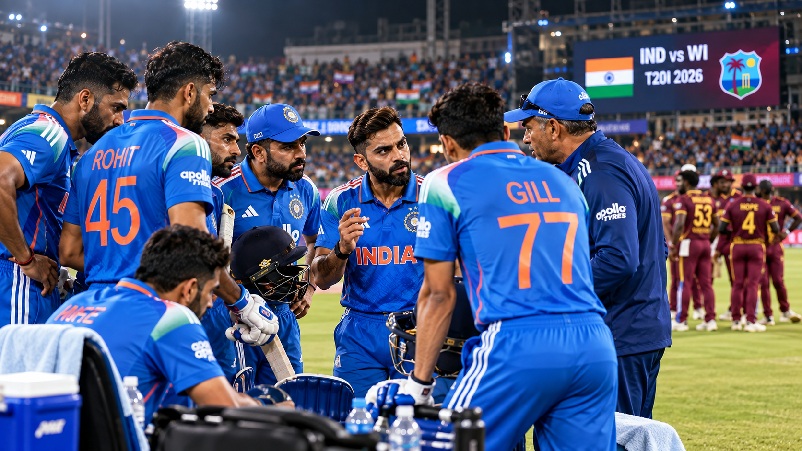
Jayden Seales Provides West Indies with a Fresh Advantage
Jayden Seales was another player who garnered attention throughout the series.
In the third ODI, he took out both Shubman Gill and Virat Kohli early on, putting India under intense strain. Kohli’s dismissal was especially notable as it occurred without scoring. The Times of India
For a young or developing bowling lineup, taking early wickets against India’s top order can serve as a significant morale booster.
The demands of T20 cricket will present a different set of challenges.
Seales and his fellow West Indies bowlers will have fewer balls to create pressure, which means that variations, yorkers, slower deliveries, and clever field placements will be increasingly crucial.
A strong performance during the powerplay could provide the West Indies with the ideal start they need.
India vs West Indies 2026: Key Players to Watch
The T20I series features several athletes who might play a pivotal role in determining the outcome.
Shubman Gill
Gill’s form in ODIs makes him a standout name to monitor. His score of 223 in Guwahati showcased his remarkable control and aggressive play. Reuters
The key question is if he can carry that momentum into the fast-paced environment of T20 cricket.
Abhishek Sharma
Abhishek presents a different kind of threat.
His attacking style at the top can immediately place pressure on the opposing bowling team. If he can navigate the initial overs successfully, India could quickly seize control in either a chase or the first innings scenario.
Shreyas Iyer
Shreyas Iyer adds another significant option in the middle order and possesses leadership experience in T20 cricket. The BCCI’s announcement of the 2026 T20I squad named him as captain for India’s earlier T20I games. BCCI
His role may become critically important if India suffers early losses.
Shai Hope
Hope’s performance in the third ODI has made him a player to watch closely.
Even though T20 cricket requires a different pace, his knack for maintaining composure while pursuing a challenging target makes him one of the most fascinating players for the West Indies.
Jayden Seales
Seales demonstrated that he can pose problems for India’s top order.
If he can reliably generate movement with the new ball, the West Indies could complicate India’s batting strategy during the powerplay significantly.
India vs West Indies 2026: What the ODI Series Uncovered
The ODI series offered numerous insights for each side.
One of the most encouraging aspects for India was their batting strength and capacity to pursue large targets.
The second ODI showcased this best. West Indies posted a total of 405, yet India successfully achieved this goal with 39 balls to spare. Reuters
For the West Indies, their greatest takeaway was their persistence.
After dropping the first two contests, they could have easily let the series slip away. However, they showcased their finest effort in the concluding ODI.
The differences between the second and third games are especially noteworthy.
In Guwahati, the West Indies’ score of 405 was insufficient.
In New Chandigarh, India’s total of 351 fell short.
This indicates something significant: both teams’ batting orders can generate large scores, yet neither bowling unit has effectively managed high-scoring scenarios on a regular basis.
This could render the T20Is quite thrilling.
What Factors May Influence the Outcome of the T20I Series?
Several elements could affect who emerges victorious.
- Wickets taken during the powerplay will be crucial. In T20 games, losing two or three wickets in the first six overs can drastically alter the anticipated score.
- Bowling in the death overs is another vital aspect. A squad can bounce back from a weak middle phase if they have two dependable death bowlers, but one or two costly overs can swiftly shift a competitive score into an easily chaseable total.
- Flexibility in the middle order could also be key. Teams require batsmen who can quickly accelerate but can also consolidate if early wickets are lost.
- Fielding is equally important. As margins narrow in T20 cricket, a dropped catch or a missed run-out can dramatically impact the game.
- The pitch conditions will also play a role. If the surfaces are favorable for batting, both sides have the ability to post scores exceeding 200. Conversely, if conditions slow down, spinners and clever variations may prove to be more effective.
India vs West Indies 2026: T20I Preview by Venue
The opening T20I is scheduled for Lucknow on October 6.
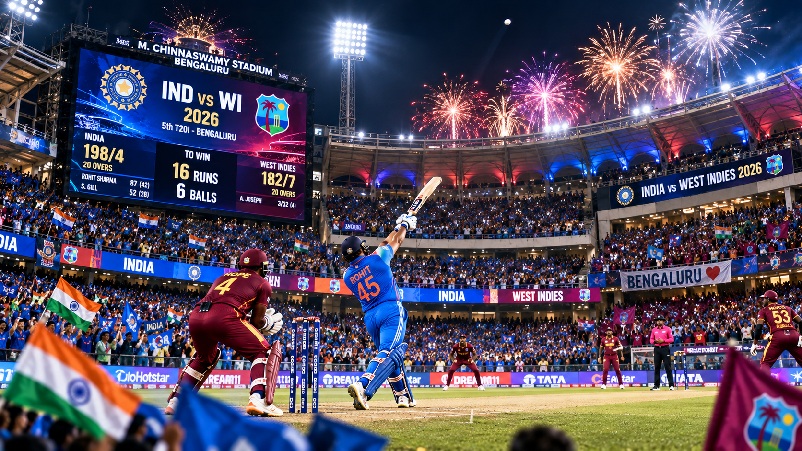
The series will then head to Ranchi on October 9, followed by a match in Indore on October 11. The fourth encounter will take place in Hyderabad on October 14, ending with the final match at the M. Chinnaswamy Stadium in Bengaluru on October 17. Windies Cricket
Each location may offer a unique set of challenges.
Lucknow may create conditions that highlight bowlers who can change their pace effectively.
Ranchi has historically offered riveting matchups between bat and ball, making the toss and the score of the first innings potentially influential.
Indore is recognized for high-scoring matches and could favor aggressive batting styles.
Hyderabad also tends to provide a favorable batting atmosphere, especially when the ball comes nicely onto the bat.
Following that is Bengaluru.
The Chinnaswamy Stadium stands as one of the most famous T20 venues in India. Its relatively small boundaries can promote aggressive cricket and make hitting sixes particularly advantageous.
A series-deciding match there would create an outstanding backdrop for the final contest.
Why This Series Significance Extends Beyond the Outcomes
At first glance, this may seem like yet another bilateral series.
However, there is more involved.
India is in the process of developing combinations for the upcoming stage of international cricket, and players vying for spots need to prove they can excel in varied situations.
The ODI series also offered valuable insights into the depth of India’s squad.
Emerging talents were given chances, while established players like Rohit Sharma, Virat Kohli, and KL Rahul continued to affirm their importance.
Conversely, the West Indies have a different aim.
They need to establish consistency.
Their batting lineup undoubtedly has the potential to accumulate significant scores. This was evidenced in the second ODI. Their capability to pursue a large target in the third ODI demonstrated their ability to perform under pressure. Reuters
The subsequent goal is to transform those individual efforts into more stable outcomes in the series.
India vs West Indies 2026: Prediction
Making predictions about a T20I series after such an erratic ODI series is challenging.
On paper, India is positioned as the favorite due to their extensive resources, playing at home, and diverse strategies.
Nevertheless, the West Indies have clearly indicated that they cannot be overlooked.
Their batting can dismantle a bowling lineup if the top order successfully navigates the powerplay phase. Shai Hope‘s 162, along with the trio of centuries in the second ODI, serves as substantial proof that the visitors can produce pivotal batting performances. India Today
India’s strength lies in the number of players capable of contributing across various roles.
If the Indian top order performs well and the bowlers implement their strategies effectively in the final overs, India should hold the advantage.
If the West Indies secure early wickets and their powerful hitters establish a base, the series could become much more competitive than the ODI results indicate.
The initial T20I in Lucknow should offer the first clear insight into how both teams have transitioned from the 50-over game.
India vs West Indies 2026: Final Takeaway
The ODI segment has already presented an impressive narrative.
India clinched the three-match series 2–1, yet the West Indies concluded with a notable victory. Their successful chase of 352/5 marks their highest ODI chase, with Shai Hope remaining unbeaten on 162. India Today
In contrast, India showcased one of the most remarkable batting performances in the series when Shubman Gill scored 223 not out during the successful pursuit of 406 in Guwahati. Reuters
These differing performances underscore the need for attention to the T20I segment.
The five-match series kicks off in Lucknow on October 6 and will continue through Ranchi, Indore, Hyderabad, and Bengaluru. Windies Cricket
For India, this series presents a chance to explore combinations, sustain momentum, and address some bowling issues that arose in the last ODI.
For the West Indies, it provides an opportunity to harness the confidence from their record-setting chase into a shorter format where explosive batting can alter a game in mere overs.
Cricket enthusiasts already have a promising mix: seasoned stars, up-and-coming talents, aggressive batting, quality pace attacks, and two teams eager to prove themselves.
The primary question now is straightforward: can the West Indies convert their thrilling ODI conclusion into a formidable T20 challenge, or will India’s depth and home field advantage be too formidable?
The resolution will unfold over five T20Is, with the series concluding on October 17 in Bengaluru.